




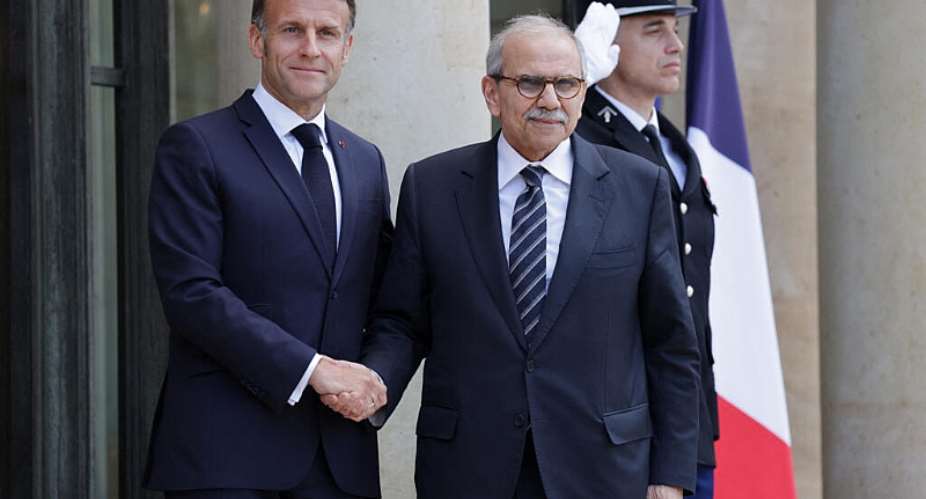
French President Emmanuel Macron has held talks Lebanese Prime Minister Nawaf Salam in Paris, with both leaders using the meeting to push for stability in southern Lebanon and to rally support for a country still reeling from weeks of war.
Speaking after their meetring on Tuesday evening, Salam said Lebanon would need €500 million over the next six months to address the humanitarian fallout from the conflict, as a fragile 10-day ceasefire with Israel continues to hold. The Lebanese authorities have put the toll from six weeks of fighting at some 2,450 dead and at least 7,650 wounded since early March.
The meeting at the Élysée Palace focused on shoring up the ceasefire and reaffirming France's backing for Lebanon's territorial integrity, while also looking ahead to renewed negotiations between Beirut and Tel Aviv.
Macron struck a firm but balanced tone, urging Israel to “renounce its territorial ambitions” in Lebanon while insisting that Hezbollah must stop firing into Israeli territory and be disarmed “by the Lebanese themselves”. He also called for a broader agreement that would guarantee “the security of both countries” and lay the groundwork for a possible normalisation of relations.
For his part, Salam said Lebanon was seeking the “complete withdrawal” of Israeli forces from its territory, alongside the return of prisoners and displaced civilians, as part of the talks set to resume in Washington later this week.
Iran's ambassador to France backs Lebanon truce, tells RFI 'we prefer dialogue'
France's line on Israel's 'buffer zone'
Even as Macron hardened his public language, French officials have continued to strike a more measured tone on the ground situation. The Élysée has described the Israeli military's “buffer zone” in southern Lebanon as “temporary”, stopping short of calling for its immediate removal.
Israeli forces have pushed deep into the region, drawing what officials describe as a defensive “yellow line” aimed at shielding northern Israeli communities from cross-border fire.
French officials have suggested that, for now, stabilisation takes precedence over territorial adjustments. The buffer zone, they argue, is intended as a short-term security measure rather than a permanent redrawing of borders.
“The issue today is not to shift these lines,” an Élysée official said, stressing instead the need to prevent a resumption of hostilities. The expectation in Paris is that the question of territory will be resolved through negotiations – with Lebanon's “territorial integrity” ultimately restored as part of a lasting peace agreement.
France has also pushed back against suggestions it should remain on the sidelines. Despite reported Israeli reluctance to involve Paris directly, Macron's advisers insist France is uniquely placed to support Lebanon in implementing the disarmament of Hezbollah and reinforcing state authority in the south.
UNIFIL attack underscores tensions
Tuesday's meeting came in the shadow of a deadly ambush on UN peacekeepers last week, where a French soldier serving with the United Nations Interim Force in Lebanon (UNIFIL) was killed over the weekend, with three others wounded.
Macron blamed Hezbollah for the attack but stressed that France itself had not been specifically singled out. “They didn't target them because they were French,” he said earlier this week. “They targeted them because they were on a mission to stand alongside the civilian population.”
French soldier killed in Lebanon in attack on UN peacekeepers
The incident has sharpened concerns about the risks facing peacekeepers even as the ceasefire holds. France has said it is ready to maintain its commitment on the ground in Lebanon even after the UNIFIL mission is due to end at the close of the year.
The UN Security Council has condemned the attack in the strongest terms and reaffirmed its full support for the mission. Hezbollah, which opposes the Lebanon–Israel talks, has denied involvement.
Beruit open to peace
Alongside France's diplomatic push, Lebanon's leadership has signalled a willingness to pursue a negotiated end to the conflict, despite strong domestic opposition.
President Joseph Aoun has said the talks with Israel aim to halt hostilities, end the occupation of southern regions, and enable the Lebanese army to deploy fully along the internationally recognised border.
“I have chosen negotiations,” Aoun said, expressing hope that diplomacy could “save Lebanon” from further devastation.
His stance has exposed deep internal divisions, with Hezbollah sharply criticiing the talks, warning that direct negotiations risk undermining national consensus, although it has indicated support for maintaining the ceasefire.
(With newswires)


 Talensi: Minerals Commission orders Nanlamtaaba Enterprise to halt mining in Gba...
 'I faced those who openly insisted that there’s no galamsey going on' – Prof Gya...
 Trump threatens to not reopen Kennedy Center after board blocks renaming
 Minority boycotts Foreign Affairs Committee meeting on South Africa evacuation o...
 Police arrest two over 192 parcels of suspected cocaine in Wa
 Challenging Heights reveals how Ghanaian girls are recruited into sex trade thro...
 GHS records more than 53,000 adolescent pregnancies in 7 months
 No school being demolished to construct 24-hr economy market at Mankranso - Ash...
 Education Ministry to review 'problematic' CSSPS after Catholic Bishops’ concern...
 Family of Salormey Baffoe appeals for her release from alleged National Security...


