




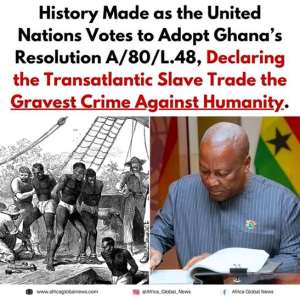
UN Resolution
On Wednesday 25 March ,2026 (was adopted during the commemoration of the International Day of Remembrance of the Victims of Slavery and the Transatlantic Slave Trade, marked by the Assembly on March 25 ). The United Nations (UN) adopted a historic resolution, Ghana Resolution A/80/ L.48 declaring the transatlantic slave trade as the "Gravest Crime Against Humanity", finally saying what the whole world knew all along but too many have been too cowardly to say so. A reminder that history must be remembered, not erased.
Experts say it is the furthest the UN has ever gone in its recognition of the atrocities of transatlantic slavery and the need for reparations. The resolution strongly condemns slavery and the trafficking of Africans and recognizes the impacts of the “abhorrent regimes of slavery and colonialism”and contemporary colonialism of Africa. It calls on member states to have a wide-ranging dialogue about “reparatory justice”, as well as the restitution of cultural properties that were stolen by colonialist states.
Historic & Symbolic
In a historic and symbolic gesture, the West African nation of Ghana put on table the resolution that UN should recognize transatlantic slave trade as the "gravest crime against humanity ". Indeed historical, the world knows so but no one had dared talk about it, let alone demand its adoption by UN. Ghana did it. Remember, it was Ghana the first African nation to gain independence from colonial rule in the year 1957 when the whole of Africa was under colonial yoke and bondage. Fast forward, sixty- nine (69 years) later...2026, Ghana has led the global community to formally acknowledge the transatlantic slave trade as the "gravest crime against humanity".Befitting for Ghana.The resolution was introduced by Ghana President, John Dramani Mahama, who emphasized the importance of remembering the horrors of transatlantic slave trafficking.
“When slaves were captured, they were always stripped of their clothing while being kept in the dungeons of the fortresses that had been built on the African coast by the European traders,”
he said in remarks to UN officials this week.
“They were forced with their limbs, chained, and shackled, into the hold of cargo ships,”
noting that many ships sunk, killing all those aboard, while many others jumped off who,
“preferred death to captivity".
“Whenever a ship arrived at its destination, the enslaved people, still naked, were taken to the market where they were inspected and appraised like livestock".
Mahama went on.
“The people who were enslaved labored on these plantations from sunrise to sunset. And the conditions under which they worked were brutal".
A History We Must Never Forget
The transatlantic slave trade saw more than 12 million people transported from Africa over a period of around 400 years, with at least 2.4 million dying en route and millions more dying on arrival as a result of abuse, raids and exploitation.The Transatlantic Slave Trade stands as one of humanity’s darkest chapters — a system that brought unimaginable suffering.
The Middle Passage
From the 15th to the 19th century, over 12 million Africans were forcibly taken from their homes. Families were torn apart. Identities were erased. Lives were forever changed. The journey across the Atlantic — known as the Middle Passage — was brutal. Countless lives were lost to disease, starvation, and cruelty before even reaching distant lands.Those who survived were forced into labor across the Americas and the Caribbean, building economies while being denied their basic humanity. Even after slavery was abolished in places like the United States (1865) and the United Kingdom (1807/1833), the impact did not end. The legacy of slave trade still lives on — in inequality, in culture, and in ongoing struggles for justice.
Aims Of The Resolution
Samuel Okudzeto Ablakwa, Ghana’s minister of foreign affairs, told journalists after the Assembly vote that the resolution,
“is not about apportioning blame across generations or nations,”
Nor is
“...is it about reopening old wounds; it is about ensuring that those wounds are neither forgotten nor denied ".
and,
"...it is about creating space for truth for education and for a more honest conversation that allows us to move forward with greater understanding".
The resolution, he added,
“is to deepen our collective moral awareness".
Introducing the draft text just before the vote in the General Assembly, Ablakwa of Ghana pointed out that the text did not target individual countries.Instead, it was a framework for reconciliation.
“it is focused on truth, remembrance, education and dialogue",
Ablakwa said.
“it is grounded not in retribution, but in moral recognition, and it is intended to strengthen global efforts to combat racism, racial discrimination and xenophobia in all its forms. Its objectives are clear, to provide formal and unequivocal recognition within the United Nations system".
Ghana President,John Dramani Mahma pointed out that,
"this resolution allows us as a global community to collectively bear witness to the plight of more than 12,5 million men, women and children whose homes, communities,names, families,hopes, dreams, futures and lives were stolen from them over the course of 400 years".
Adding that the resolution,
"is a pathway to healing and reparative justice".
Before stating that,
"This resolution is a safeguard against forgetting".
Before the vote by the Assembly, UN, Secretary-General António Guterres called for
“far bolder actions”,
from countries to end the pillaging of African resources and to ensure the continent’s
“equal participation and influence in the global financial architecture and the UN Security Council”.
“We cannot continue to tolerate racial violence or bigotry,”
Guterres said.
“We cannot keep letting inequality and injustice be ignored. We must turn memory into progress and remembrance into responsibility".
Annalena Baerbock, president of the General Assembly, said that while slavery was abolished in the 19th century, it has continued in modern-day form through forced labor, human trafficking and debt bondage.
“We must therefore be tireless in pursuit of justice,”
Baerbock said,
“ensuring that we remain active participants in the pursuit of dignity, accountability and equality across generations".
US & EU Objections
Dan Negrea, US ambassador to the UN, said at the Assembly.
"The United States also does not recognize a legal right to reparations for historical wrongs that were not illegal under international law at the time they occurred,”
Further stating that,
"The United States strongly objects to the cynical usage of historical wrongs as a leverage point in an attempt to reallocate modern resources to people and nations who are distantly related to the historical victims",
Negrea added.
Washington also objected to the financial implications of the resolution on the UN itself, as it grapples with shrinking liquidity flow, mostly brought on by the US nonpayment of its mandated UN dues of approximately $4.2 billion.
The European Union(EU) cited similar concerns as Washington in its abstentions. The representative of Cyprus, speaking for the (EU) bloc, said the proponent of the resolution failed to “adequately reflect ” concerns raised during negotiations.
One such issue raised by the EU was the use of the word “gravest” in the resolution, saying such a term is legally inaccurate.
“When no legal hierarchy between crimes against humanity exists, it risks undermining the harm suffered by all victims of these crimes and lacks legal clarity crucial for ensuring accountability",
Gabriella Michaelidou, the deputy permanent representative of Cyprus, said on behalf of the EU.
“We are also concerned by certain legal references and assertions that are either inaccurate or inconsistent with international law",
she added.
“This includes suggestions of a retroactive application of international rules which were nonexistent at the time and claims for reparations, which is incompatible with established principles of international law".
The VOTE
Out of One hundred and seventy- right (178 countries) that voted, One hundred and twenty three (123 voted in favour of the resolution. Fifty-two (52 countries mostly all European countries, Australia, Oman, and Japan abstained . Three (3 countries), United States Of America (US), Israel and Argentina voted against the resolution.
Predictably, Shamefully & Disgracefully
Predictably, shamefully, and disgracefully , US, Israel and Argentina voted against the resolution. European countries like the United Kingdom UK, France and many European countries abstained from the vote. In simple terms they could not bring themselves to stand on the right side of history. Let that sink in.
US , a nation that built its wealth, power, and global dominance on the backs of stolen Black bodies, on rape, torture, forced labor, family separation, and generational dehumanization, refused to fully acknowledge the magnitude of its crimes.US did not just participate in slavery, it perfected it. Chattel slavery in America was not incidental. It was industrial. It was theologicalized (Ephesians 6 verse 5). It was codified into law and culture. It was a system so brutal, so comprehensive, that its aftershocks are still there for all to see, through mass incarceration, economic inequality, healthcare disparities, and state-sanctioned violence.
UK , an empire that colonized the globe, trafficked millions of Africans, destabilized nations, extracted resources, and then had the audacity to “abolish” slavery, only to compensate slave owners while leaving the enslaved with nothing but trauma and poverty.And now, when the global community dares to tell the truth, they hesitate. They abstain. They object.
Israel, which voted against the resolution is caught up in a genocide storm and is the perpetrator of inhuman injustice against Palestinians. According to a report by a UN Independent International Commission of Inquiry's finds, 16 September, 2025. The Commission categorically stated that,
"Israel is responsible for the commission of genocide in Gaza,”
said Navi Pillay, Chair of the Commission.
“it is clear that there is an intent to destroy the Palestinians in Gaza through acts that meet the criteria set forth in the Genocide Convention."
Argentina is a country hiding one of the darkest horrors perpetrated against people of the African descent. Argentina committed the most severe and brutal acts against the blacks, from killing them, forming battalions that were send in the frontlines to die,to allowing them die in disease breakouts.In short, Argentina massacred all black population which remained in the former Spanish colony.The truth is now coming to light for all to see. Exterminating a whole race from the surface of the earth.
No Blame Game
This is not about blame.
It’s about awareness, education, and truth. Because only by understanding the past can we build a more just and equal future. Surely, justice, equality, fairness, freedom, democracy, human rights can only be achieved when truth, awareness and education about a human crime, brutality, unfairness, a travesty of justice in the past has been acknowledged and recognized by the global community.
Divide Between Global North & Global South
Adoption of UN Resolution A/80/ L.48 has demonstrated the deeper divide between Africa and Global South versus Global North in terms of past crimes, slavery, colonialism and how to address them and move into the future. Global South is pushing for recognition, reparations and justice but the Global North is concerned, cautious about legal, financial and political consequences.
WHY?
Because truth demands accountability. And accountability demands repair. Repair demands reparations.The US and Europe claims that it is opposed the language of the resolution because it fears a “hierarchy of crimes". That’s not a serious argument, it is a deflection. One cannot rank atrocities while standing on top of one of them. One cannot sanitize history while benefiting from its brutality. This is about refusal. Refusal to apologize. Refusal to repair. Refusal to reckon. Refusal to initiate reparations.
Conclusion
UN Resolution A/80/L.48 was/is not radical, it was / is restrained. It was/is not punitive, it was/ is truthful. And even truth was/is too much for global North. So this development, the adoption of thi particular resolution is setting the record straight and its reflecting: When the world moved toward justice, the US, Israel , Argentina and the UK and it's European counterparts stood still, clutching their myths, protecting their comfort, and exposing, yet again, that their commitment to “freedom” to "human rights" to "justice" is not genuine and has always been conditional.
History is watching.
F. Madondo (African Teacher) [email protected]

 Justice Yonny Kulendi reveals how some lawyers abuse appeals process, wants revi...
 Ibrahim Mahama offers to cover cost of leg amputation for Ghana's tallest man
 Detained Abu Trica reportedly hospitalised, lawyer threatens habeas corpus over ...
 Roads Minister directs contractors to submit work schedules or risk payment dedu...
 GTEC names unaccredited tertiary institutions, lists 50 affected campuses and ce...
 Kenya journalist escapes abduction after criticism of president, says CPJ
 NPP sets September 19 for national delegates conference to elect national office...
 Here are areas to be affected by ECG's planned maintenance today
 Judicial office is for service, not personal wealth — Justice Kulendi
 Ghana Water to shut down Dodowa booster station for 24-hour maintenance

