




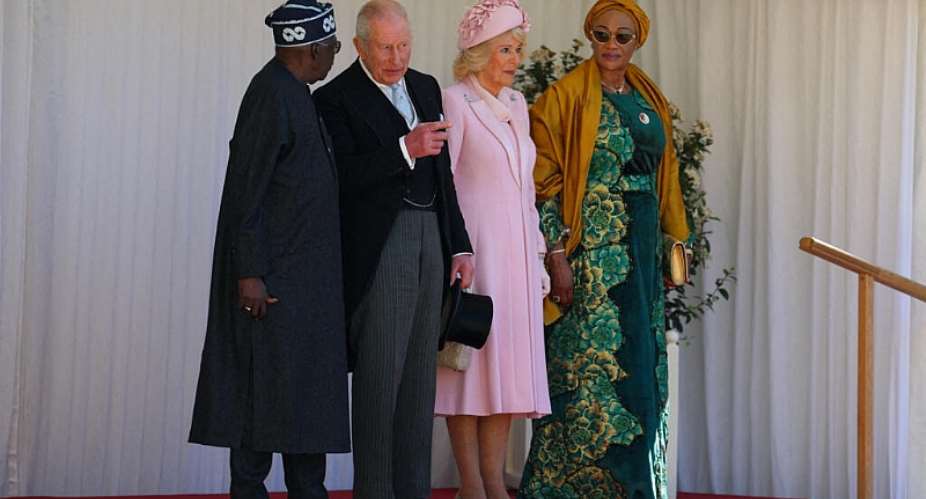
There is something tragic in the ritualistic way African mis-rulers continue to shuffle, hat in hand, toward the gates of a dying empire, seeking affirmation from an institution whose moral and historical bankruptcy is as evident as its fading relevance.
It would be comic if it were not so grotesque to watch the abject self-abasement of African plantation supervisors in 2026.
One struggles to imagine what precisely Nigerians, or Africans more broadly, are expected to celebrate when a president from Africa is received by the brother of a man whose personal scandals have become global shorthand for elite degeneracy. King Charles’ brother, Andrew, stands accused of pedophilia and alleged cannibalism.
Predictably, the optics have been spun as triumph. Attention needs to be shifted from the scandal engulfing the Nazi-loving British Monarchy. Like clockwork, a faithful plantation manager was summoned to the big house, and, like an obedient child, Tinubu answered the summons.
Stripped of the charade of its ceremonial varnish, African leaders still behave as though their legitimacy requires the benediction of an archaic monarchy.
Why does a continent of 1.4 billion souls, rich in immense resources, culture, and enormous potential, still measure its worth by proximity to a crown forged in conquest and sustained by historic plunder?
This is not diplomacy; it is psychological, even a psychic, submission.
The so-called Commonwealth - what a deliciously deceptive term - invites us into a club where nothing is truly common, and the wealth is conspicuously absent for those who need it most.
The question that Tinubu and his fawning entourage failed to ask themselves is what exactly is “common” between the former colonizer and the colonized, beyond a shared history of massacres (*), oppression, and exploitation which continue till today.
Africans should ask, where, precisely, is the “wealth” that was supposedly the dividend of this imperial association?
Let us in Africa put a stop to the sickening pretense that the Commonwealth is anything more than a relic, an anachronism dressed in diplomatic niceties, designed to preserve the illusion of relevance for a declining power while maintaining the psychological dependency of its former colonies.
Any African who has been to the UK knows how virulently racist British society is, and how differently you are treated as a Black person, even as a citizen.
Commonwealth be damned.
And we, the hoi poloi, are supposed to clap like the mindless picaninies Boris Johnson called us. Here he is: “It is said that the Queen has come to love the Commonwealth, partly because it supplies her with regular cheering crowds of flag-waving piccaninnies.”
In his inimitable way, Frantz Fanon warned us about this pathology with prophetic clarity. In The Wretched of the Earth, he observed that “the colonized man is an envious man.” But Fanon did not mean envy in the trivial sense; he spoke of a deeper, more insidious longing - a desire to be recognized, validated, and ultimately accepted by the very structures that dehumanized him.
This is precisely what we are witnessing today.
The tragedy here is that African leaders do not merely engage with these archaic European institutions; they seek their approval. They crave the symbolic embrace of the former master, mistaking it for international legitimacy.
This is a tragic misreading of power. A betrayal of sovereign power.
As we have written on this blog several times, power does not beg for recognition. It compels it.
Silliness does not begin to describe you if you have to crawl to Buckingham or Windsor Palace to be validated by the shameless inheritor of a cruel British empire.
The Commonwealth’s visa regimes alone expose the farce of the organization. Citizens of so-called “white” Commonwealth countries move with relative ease into the “mother country,” while Africans, whose ancestors’ labor financed the imperial project, are subjected to humiliating scrutiny, bureaucratic obstruction, and outright discrimination.
If this is a “commonwealth,” then it is one structured along the same racial hierarchies that defined colonial rule.
Nothing has fundamentally changed. Only the language has softened.
Carter G. Woodson, in The Mis-Education of the Negro, diagnosed this condition with surgical precision: “When you control a man’s thinking, you do not have to worry about his actions.” That control is not merely educational; it is civilizational. It is embedded in the very frameworks through which African elites interpret the world. I
They have been conditioned to believe that validation flows from the West, that prestige is conferred by proximity to European institutions, and that their own indigenous frameworks are insufficient.
This diagnosis is too complex to penetrate the skulls of compromised leaders like Tinubu. So they perform deference to the same institution that brutalized their ancestors. Unashamed, they vibrate with gratitude for being granted audience with historical plunderers like Charles, the king of England.
And the tragedy is that they do so willingly.
Fanon again, as always, cuts to the bone: “The colonized intellectual has learned from his masters that the individual must assert himself.” But instead of asserting sovereignty, our elites assert their usefulness to the very systems that undermine their people. They become intermediaries, brokers of dependency, custodians of a status quo that benefits everyone except the African masses.
This is why the spectacle of African presidents seeking audiences with European monarchs is not merely embarrassing; it is revealing.
It reveals a class of leaders who have internalized their subordination and relish in their inferiority.
It reveals a continent still trapped in what Fanon described as “the zone of nonbeing”—a space where identity is defined externally, where worth is measured against foreign standards, and where autonomy and sovereignty are perpetually deferred.
And yet, the world has changed.
Except to the purblind, the geopolitical landscape is shifting with tectonic force. The unipolar moment has fractured. New centers of power are emerging, and the old order is struggling to maintain coherence. In this context, Africa’s continued fixation on obsolete institutions is not just anachronistic; it is strategically disastrous.
While others recalibrate, we rehearse colonial scripts, and Africa will suffer the misfortune of being led by compromised neo-colonial puppets like Tinubu.
It is sad to see that in 2026, while others negotiate from strength, we petition from weakness. While others build alliances based on mutual interest, we cling to relationships rooted in historical subjugation.
Tinubu’s UK trip is not merely a failure of leadership; it is a failure of imagination.
Woodson warned us that “if you make a man feel that he is inferior, you do not have to compel him to accept an inferior status.” He will do it himself. And that is precisely what we see when African leaders line up for photo opportunities with monarchs whose relevance is largely ceremonial, authority largely symbolic, and historical legacy largely predatory.
The question, then, is not why the House of Windsor continues to receive African leaders. Power, even in decline, will always seek to perpetuate itself.
The real question is: why do African leaders keep going?
Why do they participate in a theater that diminishes them and helps to perpetuate an anachronism?
Why do our plantation supervisors legitimize institutions that have never truly respected them?
The answer lies in the unfinished business of decolonization.
Political independence was achieved, but psychological liberation remains elusive. The flags changed, the anthems were rewritten, but the mental architecture of colonialism persists. It persists in our education systems, our diplomatic priorities, and our elite culture.
It persists in the belief that Europe is still the center of gravity.
It is not.
The tragedy is that this realization is not universally internalized. While some nations have begun to chart independent paths, many African states remain tethered to outdated paradigms, clinging to the illusion that proximity to former colonial powers confers advantage.
It does not.
It confers dependency.
Fanon’s final warning resonates with chilling urgency: “Each generation must, out of relative obscurity, discover its mission, fulfill it, or betray it.”
The current generation of African leaders appears to have made its choice.
It has chosen betrayal, not in the crude sense of treachery, but in the quieter, more insidious sense of failing to rise to the demands of history.
To continue seeking validation from a decaying imperial structure is to betray the promise of independence. It is to betray the sacrifices of those who fought for liberation. It is to betray the future of a continent that deserves better.
Africa does not need the approval of a European monarchy. We don't need the symbolism of a Commonwealth. We don't need the illusion of belonging to a club that was never designed for its benefit.
What we need in Africa is clarity.
We need clarity and to recognize and understand that dignity cannot be outsourced, to understand that sovereignty is not performative.
We need clarity to reject the psychological chains that still bind it to a past it claims to have transcended.
Until that clarity emerges, the plantation pilgrimage will continue.
And the applause, tragically, will not cease.
©️ Fẹ̀mi Akọ̀mọ̀làfẹ̀ (1st Dan)
(Farmer, Writer, Published Author, Essayist, Satirist, Social Commentator, Geopolitical Analyst.)
My Mission: Ignorantia et stultitia delendae sunt / Ignorance and stupidity must be destroyed.
I am an unapologetic Pan-Africanist who is unconditionally opposed to any form or manifestation of racism, fascism, and discrimination.
I thank you for reading my articles and watching my podcasts. I will continue to make them free, and I will not accept advertisements. But you can show your appreciation by pledging a future subscription. You won't be charged unless you enable payments.
Pan African Digest is a reader-supported platform. Your support is invaluable. If you enjoy my articles and podcasts, I would greatly appreciate it if you would subscribe to my Blog: https://femiakogun.substack.com to support my work and help me continue providing you with detailed, well-researched, and thought-provoking content like this.
Help post URLs to my articles in the comment sections of your favorite YouTube channels, podcasts, and blogs.
* Here are five of the most egregious massacres committed by British and other colonial forces in Africa.
- Benin Expedition — Benin City (present-day Benin City), 1897
- Battle of Omdurman — Omdurman (present-day Omdurman), 2 September 1898
- Chimurenga First War Reprisals — Matabeleland & Mashonaland (present-day Zimbabwe), 1896–1897
- Amritsar of Kenya (Hola Camp Massacre) — Hola Camp (present-day Kenya), 3 March 1959
- Sharpeville Massacre — Sharpeville (present-day South Africa), 21 March 1960

 No room in our standing orders for reconsideration of anti-LGBTQ+ Bill – Sam Geo...
 Court threatens to struck out Mamprobi Baby theft case over disclosure delays
 How ex-convict allegedly sealed teenager's mouth with super glue, raped and murd...
 About 70% of buildings in Ada East lack permits, to be demolished – DCE
 Accra will no longer be sanctuary for indiscipline — Linda Ocloo declares after ...
 Bono Region: Police investigate murder of retired veterinary officer
 GMA says no emergency patient was denied care at KATH despite congestion concern...
 VIDEO: Fuel tanker driver burnt to death in fiery crash at Adubinso, seven shops...
 IMF boosting financial support for four African nations over war impact
 Anti-LGBTQ+ bill: Public clash between Speaker Bagbin and Majority Leader needle...


