




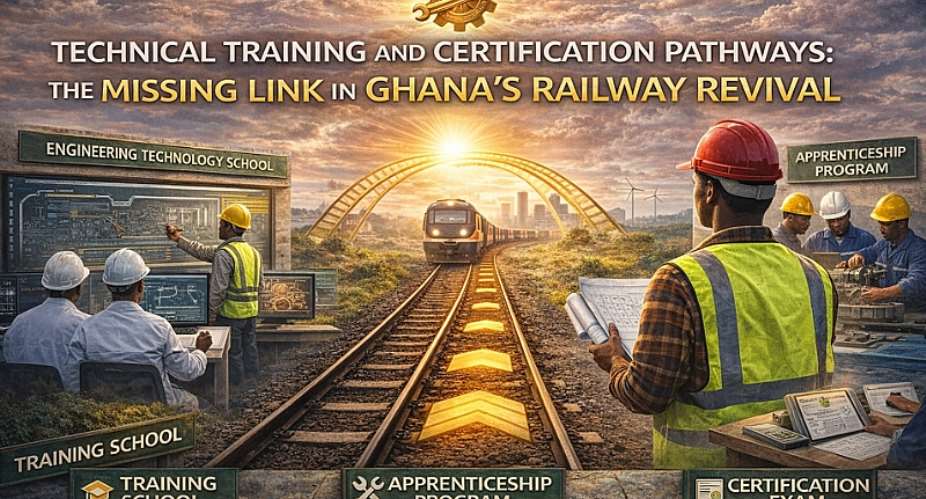
Ghana’s railway conversation has long been dominated by infrastructure, tracks, locomotives, and billion-dollar master plans. Yet history across the world shows a consistent truth: railways do not fail because of steel shortages, they fail because of skills shortages. If Ghana is serious about reviving its rail sector, then the next phase of reform must focus on something less visible but far more decisive: structured technical training and certification pathways.
This is not an abstract recommendation. It is the exact path taken by several developing countries that have successfully transformed their railway systems over the past decades.
The Core Problem: Training Without Certification Pathways
Ghana produces engineers. Universities graduate civil engineers, mechanical engineers, and technicians every year. But railway systems require something more specific: certified competencies tied to operational roles.
Railway systems worldwide operate on structured certification ladders such as:
- Certified signaling technician
- Licensed locomotive engineer
- Rolling stock maintenance specialist
- Track inspection and safety certification
- Railway operations controller
Without these standardized pathways, engineers remain generalists in a specialized industry.
In Ghana today, this structured certification ecosystem is largely absent. The result is predictable:
- Skills remain theoretical
- Experience is fragmented
- Foreign expertise fills operational gaps
Lessons from Kenya: Training as a Strategy for Railway Sovereignty
One of the most relevant examples for Ghana is Kenya. The Railway Training Institute https://www.rti.ac.ke/ was established specifically to build a continuous pipeline of railway professionals. It offers diplomas, certificates, and specialized programs in railway operations, engineering, and logistics, serving as a national center of excellence for railway skills development. https://saraka.info/ministries/roads-and-transport/transport/rti/?utm_source=chatgpt.com
More importantly, Kenya did not stop at institutional training, it embedded certification and practical exposure into its railway expansion strategy.
During the development of the Standard Gauge Railway (SGR):
- Over 3,500 Kenyan staff received advanced railway training in partnership with Chinese institutions. https://english.news.cn/20250923/0032fb588a614944beb2a5d9d572764f/c.html?utm_source=chatgpt.com
- Programs covered signaling systems, locomotive operations, and maintenance diagnostics. https://english.news.cn/20250923/0032fb588a614944beb2a5d9d572764f/c.html?utm_source=chatgpt.com
- Structured training programs (including 11-week intensive courses) combined classroom learning with fieldwork and simulations. https://www.railway.supply/sgr-workers-training-boosts-kenyas-railway-operations/?utm_source=chatgpt.com
The objective was clear:
localize railway operations and reduce long-term dependence on foreign expertise. Today, Kenya’s railway system is increasingly operated by locally trained and certified professionals, not just engineers, but railway specialists.
Lessons from India: Institutionalizing Railway Expertise Over a Century
India offers a deeper historical lesson. Institutions such as the Indian Railway Institute of Mechanical and Electrical Engineering https://irimee.in/ have, for decades, served as dedicated training hubs for railway engineers, producing generations of specialists in rolling stock, signaling, and systems engineering.
More importantly:
- India built specialized training centers for every technical domain (track machines, signaling, tunnels, rolling stock).
- Facilities include simulation labs, diagnostic systems, and real maintenance workshops.
- Training is directly tied to career progression and certification within Indian Railways.
Even modern upgrades continue this model; new training centers integrate mechatronics, digital systems, and high-speed rail technologies, ensuring that skills evolve with infrastructure.
The lesson is powerful: railway excellence is not achieved through projects, it is institutionalized through training systems that outlive governments.
What Ghana Must Do Differently
If Ghana continues to build railways without building training pathways, the country will remain dependent on external expertise for decades. To reverse this, Ghana must adopt a structured, policy-driven approach.
1. Establish a National Railway Training and Certification Authority
Ghana needs a dedicated institution, similar to Kenya’s Railway Training Institute, that will:
- Develop national railway occupational standards
- Certify professionals in signaling, rolling stock, and operations
- Align training with real railway projects
This cannot be a general engineering school. It must be a railway-specific institution.
2. Link Certification to Employment in Railway Projects
Every railway project in Ghana should include a mandatory certification framework:
- No signaling system should be commissioned without certified local technicians
- No rolling stock workshop should operate without trained maintenance engineers
- No railway corridor should run without licensed operations personnel
Certification must become a legal requirement, not an optional qualification.
3. Embed “Train-the-Trainer” Programs in Foreign Contracts
Kenya’s success shows that partnerships matter, but only when structured correctly.
Ghana must require that:
- Foreign contractors train Ghanaian instructors
- Local institutions adopt and adapt international railway curricula
- Knowledge transfer is measurable and audited
Without this, training remains symbolic rather than transformative.
4. Develop Simulation and Practical Training Centers
Railway skills cannot be learned in classrooms alone.
Ghana must invest in:
- Signaling simulation labs
- Locomotive diagnostic centers
- Track maintenance training facilities
- Hydrology and drainage testing labs
India’s model shows that hands-on training infrastructure is as important as railway infrastructure itself.
5. Create Regional Certification Hubs Linked to Ports and Corridors
Training should not be centralized only in Accra.
Ghana should establish:
- A rail-port logistics training hub near Tema
- A mining and freight rail training center near Takoradi
- Inland transport and hydrology training linked to Volta Lake systems
This aligns skills development directly with economic geography.
Conclusion: No Railway Without a Workforce
Ghana does not lack ambition. It has railway master plans, policy frameworks, and political commitment. What it lacks is a structured system for producing railway professionals at scale.
The experiences of Kenya and India make one thing clear:
railway revival is not an infrastructure project, it is a human capital project.
- Tracks can be imported.
- Trains can be purchased.
- But competence must be built.
If Ghana is to achieve true railway transformation, it must move from training engineers occasionally to certifying railway professionals systematically.
Because in the end, the success of Ghana’s rail system will not be determined by how many kilometers are built, but by how many skilled hands are capable of running it.
Author: Joseph Fuseini ([email protected])

 One dead, fire officer hospitalised after bee attack at Quarry Site in Sokode Gb...
 Israel and Iran step back from further strikes after renewed clashes
 Patients stranded as doctors, nurses refuse to see new patients over KATH CEO su...
 Avenor Rural Bank CEO’s house destroyed by fire
 Three arrested in Winneba for illegal mining near GWL water lines
 Two pupils of Alice Elite Academy laid to rest after fatal school bus crash
 Here are areas to be affected by ECG's planned maintenance on Tuesday
 Family of civil engineer killed in alleged military shooting demands justice
 SHS teacher allegedly beats female student over unpaid hostel fees
 Blow to EU defence cooperation as France, Germany abandon joint fighter jet prog...


