




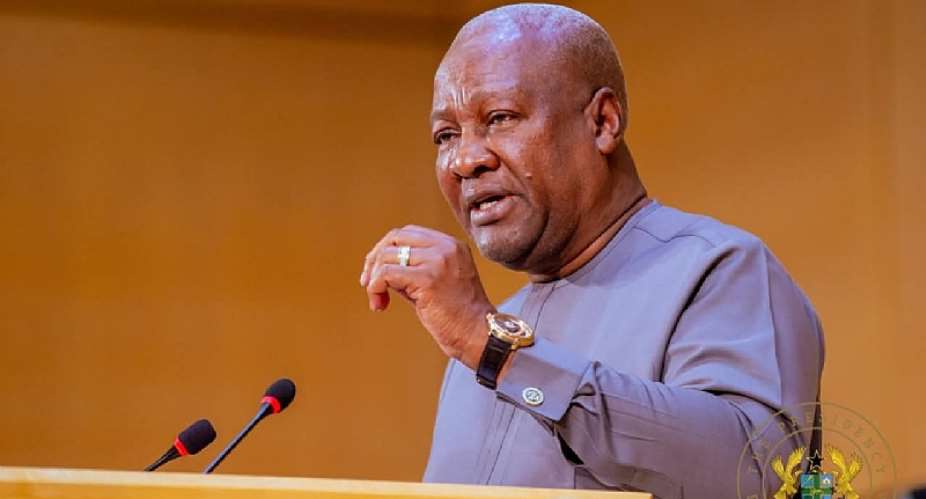
Later this month, Parliament is expected to transmit the Human Sexual Rights and Family Values Bill, 2025, which was passed May 29, to President Mahama for assent. Once the bill reaches his desk, the President will face a constitutional choice: assent to the bill or return it to Parliament for reconsideration.
Thus far, public debate has largely focused on the substance of the legislation and its implications for morality, culture, and human rights. Yet the President's strongest constitutional grounds for returning the bill to Parliament, if he decides to, may lie not in its substance but in unresolved procedural questions arising under Articles 106 and 108 of the 1992 Constitution.
Article 106 governs the legislative process and provides the mechanism through which the President may return a bill to Parliament with a memorandum stating his objections or concerns. Parliament may then reconsider the bill and, under certain circumstances, repass it with the requisite two-thirds majority.
One possible basis for invoking Article 106 relates to concerns about whether all parliamentary procedures were properly followed during the bill's consideration. Speaker Alban Bagbin already raised concerns about procedural irregularities during the legislative process. More recently, President Mahama has echoed some of those concerns. However, these allegations remain contested. Majority Chief Whip Rockson-Nelson Dafeamekpor has consistently maintained that all constitutional and parliamentary requirements relating to quorum, voting, and legislative procedure were fully complied with.
This is where Article 108 assumes greater significance.
Unlike the debate over parliamentary procedure, Article 108 raises a constitutional question that remains unresolved. Derived from the Westminster tradition of the "financial initiative of the Crown," Article 108 mandates that Parliament shall not proceed upon any bill that imposes a charge on public funds, increases public expenditure, or creates financial obligations for the state, unless it is introduced by, or on behalf of, the President. The central issue is whether the Human Sexual Rights and Family Values Bill, 2025 creates financial obligations sufficient to trigger Article 108.
Proponents of the bill argue that Article 108 should be construed narrowly, applying only to legislation that creates direct financial obligations, such as establishing new agencies or drawing funds directly from the Consolidated Fund. They contend that the bill’s fiscal effects are incidental, since it relies on existing institutions. Critics counter that the bill’s scope — prison sentences of up to ten years for offenders who will be fed with public funds, mandatory public education, rehabilitation frameworks, and institutional monitoring — suggests obligations that are neither incidental nor minor. These provisions structurally alter national expenditure, thereby triggering Article 108.
Compounding the varied interpretations, the Supreme Court has not yet provided a definitive answer to the underlying constitutional question of Article 108. In December 2024, the Court dismissed pre-enactment challenges to the bill in the lawsuits brought by Richard Dela Sky and Dr Amanda Odoi on the same bill, a Private Member’s Bill, which had been passed in February 2024, emphasizing that judicial review of the legislation would be premature before the legislative process had run its course. Importantly, however, the Court did not determine whether the bill complies with Article 108. Nor did it endorse Parliament's interpretation of that provision. The constitutional issue therefore remains unresolved.
The significance of Article 108 is reinforced by recent Executive practice under the Nana Addo administration, having treated the provision as an important limitation on private members' bills where legislation carries financial implications for the state. In 2023, President Nana Akufo-Addo withheld assent from both the Witchcraft Accusation Bill and the Armed Forces Amendment Bill, both Private Members’ Bills, citing Article 108. His objection was procedural, not substantive: the bills carried fiscal implications and therefore required executive sponsorship.
Additionally, in his memo to Parliament during the consideration of this same bill in 2023 at the committee level, Attorney General and Minister of Justice, Godfred Dame flagged the bill, which was presented as a Private Member’s bill as likely to violate Article 108 of the 1992 Constitution.
Whether one agrees with President Akufo-Addo’s decision or Dame’s legal opinion or not, they reflect an emerging constitutional understanding that legislation with significant fiscal consequences may not properly proceed without executive involvement.
This constitutional argument is, therefore, not novel. By invoking Article 108, President Mahama would not be creating a new doctrine but reinforcing a bipartisan precedent.
To be clear, this recent practice by President Akufo-Addo does not conclusively determine the meaning of Article 108, nor does it automatically establish that the Human Sexual Rights and Family Values Bill, 2025 falls within its scope. It does, however, strengthen the argument that President Mahama would not be relying on a novel or opportunistic constitutional objection.
Moreover, Article 108 interacts in an important way with Article 106. If President Mahama returns the bill under Article 106 and cites Article 108 as his reason, Parliament may attempt to repass the legislation by the constitutionally required two-thirds majority. Yet a further question would remain: can a bill that allegedly suffered from an Article 108 defect from the outset be cured through the Article 106 reconsideration process?
For that reason, Article 108 may provide President Mahama's strongest constitutional justification for returning the Human Sexual Rights and Family Values Bill, 2025 to Parliament. Unlike allegations concerning parliamentary procedure, Article 108 raises a substantial constitutional question that remains unsettled.
*The author is the Executive Director of the Africa Centre for International Law and Accountability (ACILA)
 Mahama Pushes Ghana–Belarus Agro‑Tech Partnership To Modernise Agriculture
 Ato Forson is selfish, he wants to control everything – Miracles Aboagye
 Kevin Okyere admits Dubai detention, US$50 million Petraco drawdown
 Health Ministry says KATH CEO is suspended for two weeks as administrator, not d...
 'Stop accepting awards from questionable, self-appointed rating bodies' — Mahama...
 Gov’t hints at scrapping unlimited years of mining concession renewals
 Committee uncovers regulatory breaches, structural deficiencies in Madina buildi...
 We're introducing measures to reduce post-harvest losses — Mahama
 Flooding: Building owners who cut corners need to be sanctioned — Fuseini Donkor
 We need an overhaul of Ghana's drainage system — Edem Agbana on flood crisis


