




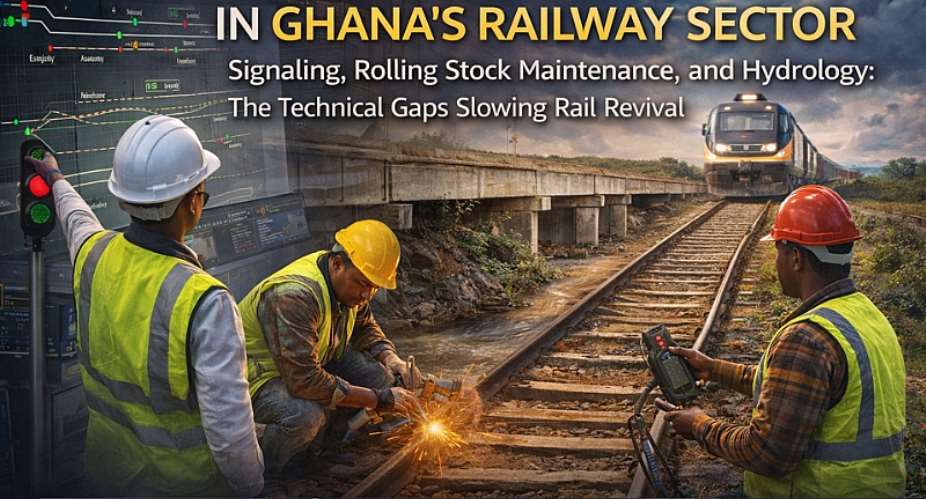
Ghana’s railway revival is often discussed in terms of tracks, locomotives, and ambitious master plans. Governments launch projects, corridors are announced, and modern stations are inaugurated. Yet beneath these visible elements lies a less visible but far more critical issue: the technical skills required to operate and sustain a modern railway system.
Railways are among the most complex infrastructure systems a country can manage. They depend on a specialized workforce trained in signaling systems, rolling stock engineering, hydrology, geotechnical analysis, and maintenance operations. In Ghana, however, these skills remain among the most significant bottlenecks preventing the railway sector from reaching its potential.
The conversation about railway development must therefore move beyond steel tracks and locomotives to a deeper question: does Ghana currently possess the technical human capital required to sustain a modern rail network?
1. Signaling: The Invisible Backbone of Railway Operations
In most successful rail systems, signaling technology forms the operational brain of the network. It controls train movement, prevents collisions, manages traffic, and determines how frequently trains can run on a line.
Modern signaling systems rely on digital communication networks, centralized traffic control, and real-time monitoring platforms. Without these systems, trains must operate at lower speeds and longer intervals, reducing both capacity and safety. https://www.modernghana.com/news/1470968/steel-is-not-enough-why-maintenance-safety.amp?utm_source=chatgpt.com
Historically, Ghana’s railways relied on manual or legacy signaling systems, with limited telecommunications infrastructure supporting train operations. Even where new railway lines promise advanced signaling technology, integrating these systems across old and new segments remains a challenge.
The deeper issue is the shortage of engineers trained specifically in railway signaling engineering. According to sector reports, signaling, telecommunication systems, and traffic management are among the major technical skills gaps identified in Ghana’s railway institutions. https://ndpc.gov.gh/media/Ministry_of_Railways_Development_APR_2019.pdf?utm_source=chatgpt.com
Without specialists capable of installing, diagnosing, and maintaining modern signaling infrastructure, new railway projects risk becoming dependent on foreign technical teams long after construction is completed. In other words, the problem is not only building the railway, it is operating it safely every day for the next fifty years.
2. Rolling Stock Maintenance: The Neglected Engineering Discipline
Railways are not sustained by locomotives alone. The true lifeline of any rail network is rolling stock maintenance, the ability to keep locomotives and wagons operational through systematic inspection, repair, and refurbishment.
Ghana’s railway sector has historically struggled in this area. Studies of the national railway system reveal that many locomotives have aged far beyond their expected operational lifespan. By the mid-1990s, nearly half of Ghana’s locomotives were already over thirty years old, with maintenance constrained by shortages of spare parts and funding. https://pubpdf.net/za/docs/prospects-issues-railway-infrastructure-development-ghana.10393706?utm_source=chatgpt.com
Even today, rolling stock deterioration remains a major challenge. Maintenance facilities lack adequate equipment, spare parts, and training programs, resulting in locomotives and wagons remaining idle for long periods. https://transport-links.com/wp-content/uploads/2024/02/HVT061-Final-Scoping-Report-v4-final.pdf?utm_source=chatgpt.com
Maintenance systems themselves are also outdated. Some workshops operate with aging machines, and preventive maintenance regimes are inconsistently applied due to budget limitations and shortages of materials such as lubricants and consumables. https://openjicareport.jica.go.jp/pdf/12185674_01.pdf?utm_source=chatgpt.com
The implications are severe. When rolling stock maintenance systems weaken, railway capacity collapses regardless of how modern the tracks may be. A railway network without functioning locomotives is simply an expensive steel monument.
3. Hydrology and Climate Engineering: The Silent Threat to Railway Infrastructure
While signaling and rolling stock are widely discussed, another critical technical gap receives far less attention: hydrology and railway drainage engineering.
Railway infrastructure is highly sensitive to water management. Tracks must be designed to withstand flooding, erosion, soil instability, and changing groundwater conditions. In tropical climates such as Ghana’s, heavy rainfall and seasonal flooding pose serious risks to railway embankments, bridges, and culverts.
Hydrological expertise is therefore essential for:
- Designing railway drainage systems
- Managing floodplains and river crossings
- Preventing embankment failures
- Protecting track foundations from erosion
Unfortunately, railway hydrology is rarely emphasized in Ghana’s engineering training programs. Most civil engineering curricula focus on roads, buildings, or general hydraulic engineering rather than railway-specific drainage and embankment design.
The consequences are already visible across parts of the transport network. Poor drainage design often leads to track instability, washouts, and costly rehabilitation projects.
In the age of climate change, where extreme rainfall events are becoming more frequent, this gap in hydrological engineering expertise may become one of the most serious long-term threats to railway reliability.
4. Institutional Capacity Constraints
The technical skills gap also reflects broader institutional challenges within the railway sector. Organizations responsible for rail infrastructure planning and management, including the Ghana Railway Development Authority and the operational railway agencies, face shortages of specialized technical personnel capable of planning, regulating, and supervising complex railway projects.
Research on Ghana’s rail sector highlights that although staffing levels may appear adequate on paper, critical technical skills, especially managerial and engineering expertise, remain limited. This imbalance creates a situation in which policy frameworks and master plans exist, but the technical capacity required to implement them effectively remains insufficient. https://pubpdf.net/za/docs/prospects-issues-railway-infrastructure-development-ghana.10393706?utm_source=chatgpt.com
5. Lessons from Emerging Railway Systems
Countries that have recently built modern rail networks offer important lessons. For example, Kenya’s Standard Gauge Railway program incorporated large-scale technical training initiatives, sending hundreds of local engineers and technicians for specialized railway training abroad while simultaneously establishing domestic training programs. https://english.news.cn/20250923/0032fb588a614944beb2a5d9d572764f/c.html?utm_source=chatgpt.com
These programs focused specifically on:
- Signaling diagnostics
- Locomotive maintenance
- Track inspection
- railway safety management
The result was a growing pool of local technicians capable of managing increasingly sophisticated railway systems. Ghana’s railway revival will require a similar approach.
6. Policy Pathways for Closing Ghana’s Railway Skills Gap
Addressing these challenges requires deliberate and sustained policy action. Several key reforms could significantly strengthen Ghana’s railway technical capacity.
1. Establish a National Railway Engineering Institute
A specialized training institution dedicated to railway engineering, signaling systems, and transport logistics could serve as the backbone of long-term capacity building.
2. Integrate Railway Engineering into Technical Universities
Technical universities should introduce dedicated programs in railway systems engineering, covering signaling, rolling stock maintenance, and rail infrastructure design. https://www.modernghana.com/news/1461637/building-ghanas-rail-future-the-critical-role.amp?utm_source=chatgpt.com
3. Mandatory Technology Transfer in Railway Contracts
Every railway construction contract should include binding provisions requiring foreign contractors to train Ghanaian engineers and technicians.
4. Revitalize Railway Workshops
Investment in modern maintenance workshops, equipped with diagnostic tools, machine shops, and digital inspection systems, is essential to support rolling stock maintenance.
5. Develop Climate-Resilient Rail Engineering Programs
Given the growing impact of climate change, Ghana must develop specialized expertise in railway hydrology, drainage design, and climate-resilient infrastructure.
Conclusion: The Future of Ghana’s Railways Depends on Human Capital
Ghana’s railway ambitions are bold. Plans for thousands of kilometers of new rail lines promise to transform the country’s logistics system and support economic growth. However, railways are not built or sustained by infrastructure alone. They are built by engineers who understand signaling systems, technicians who maintain locomotives, hydrologists who protect track foundations, and planners who integrate transport networks.
Until Ghana invests as heavily in human capital as it does in railway master plans, the country risks repeating a familiar pattern: launching new railway projects while lacking the technical workforce needed to keep them running. In the long run, the success of Ghana’s railway revival will depend not only on how many kilometers of track are built, but on how many skilled railway engineers the country is prepared to train.
Author: Joseph Fuseini ([email protected])

 One dead, fire officer hospitalised after bee attack at Quarry Site in Sokode Gb...
 Israel and Iran step back from further strikes after renewed clashes
 Patients stranded as doctors, nurses refuse to see new patients over KATH CEO su...
 Avenor Rural Bank CEO’s house destroyed by fire
 Three arrested in Winneba for illegal mining near GWL water lines
 Two pupils of Alice Elite Academy laid to rest after fatal school bus crash
 Here are areas to be affected by ECG's planned maintenance on Tuesday
 Family of civil engineer killed in alleged military shooting demands justice
 SHS teacher allegedly beats female student over unpaid hostel fees
 Blow to EU defence cooperation as France, Germany abandon joint fighter jet prog...


