




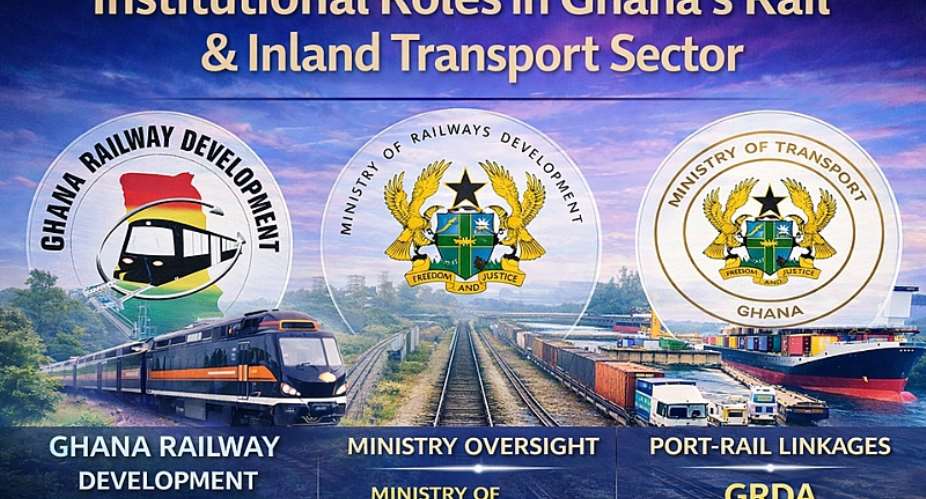
In discussions about reviving Ghana’s railway and inland transport systems, much attention is often given to financing, engineering, and political will. Yet one critical dimension receives far less scrutiny. The institutional architecture governing the sector. The effectiveness of any large transport system depends not only on tracks and trains but also on the clarity, coordination, and accountability of the institutions responsible for planning, regulating, and operating it. In Ghana today, the roles of regulatory authorities, ministries, and sector agencies raise important questions about whether the institutional framework is enabling progress or quietly slowing it down.
One of the key institutions in Ghana’s railway governance structure is the Ghana Railway Development Authority. Established to guide the implementation of the national railway strategy, the Authority is tasked with planning, regulating, and coordinating railway development across the country. In principle, this institutional reform was meant to modernize governance of the sector by separating policy formulation from operational management. The Authority would focus on long-term planning and regulation, while operational entities would manage train services and infrastructure maintenance.
However, institutional mandates are only effective when supported by strong coordination mechanisms and adequate capacity. In practice, Ghana’s railway governance landscape has often appeared fragmented. Railway policy oversight has been managed through government ministries, most recently through the Ministry of Railways Development. While the creation of a dedicated ministry initially signaled a renewed commitment to rail development, its effectiveness depended on how well it coordinated with regulatory authorities, port agencies, and other transport institutions.
Transport systems rarely operate in isolation. Railways, particularly freight railways, must be integrated with ports, inland logistics centers, and industrial zones. For Ghana, this integration is especially critical given the strategic importance of the Port of Tema and the Port of Takoradi. Both ports handle large volumes of cargo that ideally should move inland via rail corridors rather than relying almost entirely on road transport.
This is where institutional coordination becomes decisive. Effective port–rail linkages require collaboration between railway authorities, port authorities, transport ministries, and logistics operators. Yet historically, these linkages have not always been strong. Port expansion projects have often progressed faster than railway connectivity projects, resulting in situations where port capacity grows, but inland rail infrastructure remains limited.
The consequences are visible in the everyday logistics patterns around Ghana’s major ports. Cargo leaving Tema or Takoradi frequently travels by truck along already congested highways, despite the existence or potential of railway corridors designed for heavy freight. This imbalance increases transport costs, accelerates road deterioration, and undermines the efficiency of the broader logistics system.
Institutional fragmentation can also create uncertainty for investors and development partners. When multiple agencies share overlapping responsibilities without clearly defined coordination frameworks, project implementation slows. Railway infrastructure projects require long-term planning, complex financing structures, and consistent policy direction, conditions that depend heavily on institutional stability.
To be fair, Ghana has made important efforts to reform its railway institutions. The establishment of the railway development authority was intended to professionalize planning and regulatory oversight. Government efforts to revive rail corridors and reconnect ports to inland regions show that the sector has not been abandoned. Yet institutional reforms must move beyond structural creation toward effective operational coordination.
The challenge is not simply to have more institutions, but to ensure that existing institutions work together seamlessly. A modern railway system requires an integrated governance model where planning authorities, regulators, port agencies, and transport ministries share clear responsibilities and operate under a unified national logistics strategy.
Looking ahead, strengthening institutional coordination may be one of the most important steps toward reviving Ghana’s rail and inland transport systems. Clear mandates, transparent decision-making, and consistent policy implementation could transform the sector far more effectively than repeated policy announcements alone.
Ultimately, railways are not built only with steel and concrete. They are built with institutions that function efficiently. If Ghana wants its railway revival plans to move from paper to reality, then institutional clarity must become just as important as engineering ambition.
Author: Joseph Fuseini ([email protected])

 Two women die on migrant boat near France seeking to reach UK
 Iran offers strait deal, Trump says he's not satisfied
 Here are areas to be affected by ECG's planned maintenance today
 Suma Paramount Chief commends President Mahama’s development agenda
 How faulty fan regulator sparked fire, destroyed two rooms at Suhum Konfine
 Don’t store bread beyond four days – Baker advises
 Mahama commissions divisional police headquarters at Laasi, Krobo-Odumase
 Lambussie district assembly fails to elect presiding member after two rounds of ...
 Public sector workers struggling to meet pressing needs – TUC secretary
 Seven arrested in Ashaiman police operation over robbery, arms supply


