




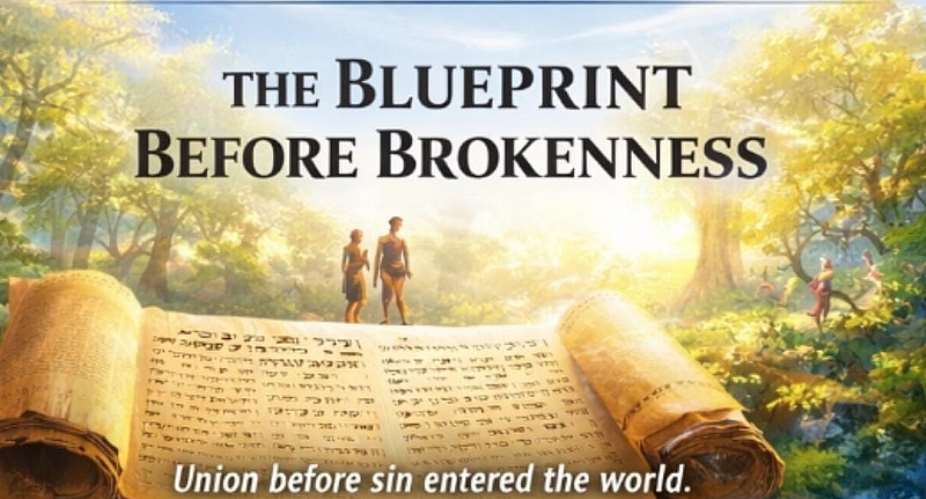
A Verse We Thought We Understood
Few passages in the Bible are quoted more frequently at weddings than Genesis 2:24.
“Therefore a man shall leave his father and his mother and hold fast to his wife, and they shall become one flesh.”
For centuries, the verse has been treated primarily as the foundational text of marriage. It appears in sermons, wedding vows, pastoral counseling sessions, and theological reflections on family life.
Yet beneath its familiar language lies a deeper revelation — one that stretches far beyond matrimonial symbolism.
Long before the first human sin was recorded in Genesis 3, before the Law of Moses defined transgression, and before the crucifixion of Christ became the centerpiece of Christian theology, Genesis 2:24 quietly introduced a profound spiritual architecture: the idea that salvation itself would be defined by union.
In other words, what looks like a statement about marriage may also be one of Scripture’s earliest prophetic glimpses of redemption.
The Verse That Appears Before Everything Else
The placement of Genesis 2:24 is striking.
It appears in the narrative before the Fall.
Before shame enters the human experience.
Before separation between humanity and God.
Before the theological drama of sin begins to unfold.
This timing matters.
It suggests that union was always central to God’s design for humanity. The biblical story does not begin with alienation and repair; it begins with covenant relationship.
That subtle ordering changes how one reads the entire narrative of Scripture. Redemption, in this sense, is not merely a divine response to human failure. It is the restoration of a design that existed from the beginning.
Theologians have long noted that the New Testament itself reinforces this idea. In the Book of Revelation, Christ is described as “the Lamb slain from the foundation of the world.”
The implication is profound: the story of redemption was embedded in the structure of creation long before history unfolded.
Genesis 2:24 may therefore function not only as a description of human marriage, but as a symbolic preview of a greater covenantal union.
The Apostle Paul’s Surprising Interpretation
This interpretation gains further credibility in the writings of the Apostle Paul.
In his letter to the church in Ephesus, Paul quotes Genesis 2:24 almost verbatim. But instead of treating it merely as marital guidance, he makes a remarkable theological claim:
“This mystery is great, but I speak concerning Christ and the church.”
With that statement, Paul reframes the ancient verse.
Marriage, in his view, was not only a social institution; it was a metaphor for a deeper spiritual reality. The union of husband and wife reflected, however imperfectly, the relationship between Christ and the community of believers.
For early Christians, salvation was therefore not described simply in legal or moral terms. It was described relationally — as participation in the life of Christ.
This concept appears repeatedly throughout the New Testament. The Apostle Paul writes elsewhere that “he who is joined to the Lord is one spirit with Him.”
Union becomes the defining language of redemption.
Salvation as Participation, Not Performance
For many modern believers, faith is often framed as a sequence of spiritual efforts: moral improvement, religious observance, personal discipline.
Yet the New Testament suggests something different.
The central promise of Christianity is not merely forgiveness, nor simply ethical reform. It is participation in a new identity — a restored relationship with the divine.
In that sense, salvation is less about humans striving upward and more about God drawing humanity into union with Himself.
Seen through this lens, Genesis 2:24 reads less like a domestic instruction and more like a theological prologue. It hints at a future in which the distance between God and humanity would be bridged not by ritual or law alone, but by covenant union through Christ.
Why This Matters Today
In a religious age often marked by performance, competition, and spiritual anxiety, this perspective offers a corrective.
If redemption is fundamentally about union, then identity precedes achievement. Relationship comes before religious effort.
The biblical narrative, from Genesis to the Gospels, may therefore be read as a long arc returning humanity to the design hinted at in creation itself: a restored communion between God and humanity.
The idea is both ancient and surprisingly contemporary.
At a time when many faith traditions wrestle with questions of authenticity and meaning, Genesis 2:24 invites readers to reconsider one of the Bible’s most familiar lines — and to see in it a quiet but powerful declaration about the ultimate purpose of redemption.
Reflections
“Before humanity ever fell in Adam, it was already destined to rise in Christ. The blueprint of salvation was drafted before the crisis of sin.”
Bismarck Kwesi Davis
Resetting Ghana Series || The Apologetics Desk

 Appointment of Emelia Agbenyo as EC deputy chair was well calculated, reasoned –...
 Relief for students as GAUA and TUSAAG call off strike; declare return to work o...
 Who gave Cabinet authority to decide for Ghanaians to join BRICS without parliam...
 Mahama urges Ghanaian businesses to tap CSIR innovations
 Partisan EC appointments could set dangerous precedent — NPP's Kamaldeen
 Winneba: Afenyo-Markin commissions police apartments at Fetteh-Osakam
 Council of State failed Mahama over Emelia Agbenyo’s EC appointment – Prof. Asa...
 CDD‑Ghana: EC Deputy Chair Should Step Down Now
 Family Announces October 23 Memorial Mass for Nana Konadu Agyeman-Rawlings
 Eduwatch Urges Nationwide Audit of Sexual Misconduct in Secondary Schools


