




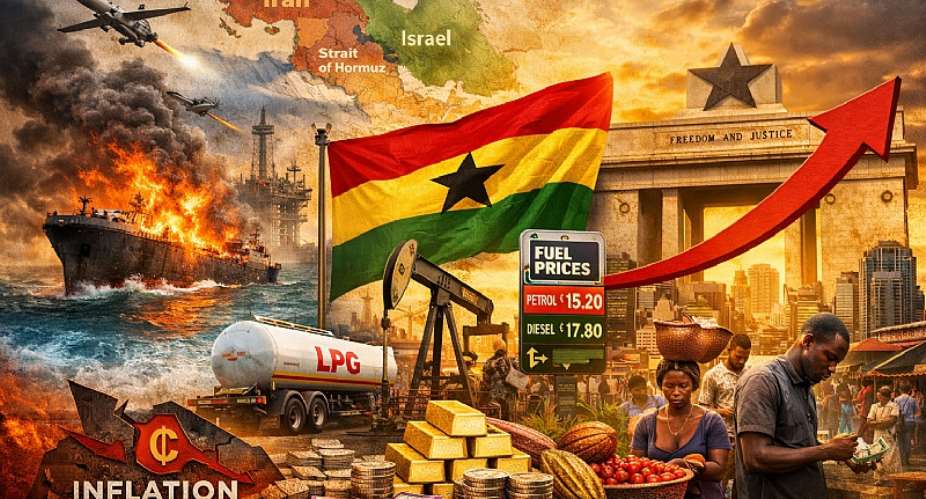
When Geopolitics Travels Faster Than Trade
In the 21st-century global economy, distance no longer shields nations from geopolitical shocks. A missile strike in the Middle East can reverberate through commodity exchanges in London, shipping corridors in Asia, and eventually the price of food in Accra’s markets. As tensions escalate between Iran, Israel, and the United States, the implications extend beyond military calculations into the delicate architecture of global energy supply chains.
At the center of this geopolitical theatre lies the Strait of Hormuz, a narrow maritime corridor between Iran and Oman through which roughly 20 percent of the world’s oil supply passes daily (U.S. Energy Information Administration, 2023). Any disruption—whether military confrontation, sanctions escalation, or shipping insecurity—can immediately trigger oil price volatility and financial market turbulence.
For Ghana, a country integrated into global commodity markets yet heavily reliant on imported refined petroleum products, the consequences could be swift and tangible.
The Strategic Energy Chokepoint
Energy security remains one of the defining variables in global geopolitics. Despite advances in renewable energy, oil continues to power transportation networks, industrial production, and agricultural supply chains worldwide.
The Strait of Hormuz therefore represents more than a geographic passage; it is a global economic pressure valve.
Escalation in the region typically produces three immediate consequences:
- Oil price volatility
- Maritime shipping disruptions and higher insurance costs
- Financial market uncertainty
History demonstrates the magnitude of such shocks. The 1973 oil crisis, triggered by geopolitical tensions in the Middle East, caused energy prices to quadruple and plunged several economies into recession. In a far more interconnected global economy today, similar disruptions can transmit even faster through financial and commodity markets (International Energy Agency, 2024).
Ghana’s Structural Exposure
Although Ghana is an oil-producing nation, the country imports a significant portion of its refined petroleum products, creating a structural vulnerability to global energy price fluctuations.
When oil prices surge internationally, the impact on Ghana typically follows a predictable chain reaction:
Global Oil Shock → Higher Fuel Import Bills → Transport Cost Increases → Food Price Inflation → Currency Pressure
Transport costs play an especially critical role in Ghana’s domestic economy. Rising fuel prices affect agricultural logistics, urban transportation, and manufacturing costs—ultimately translating into higher consumer prices.
Real-World Case Scenario: The Russia–Ukraine Energy Shock
A clear illustration of this vulnerability occurred following the Russia–Ukraine war in 2022. Global oil and gas prices surged dramatically as supply disruptions and sanctions tightened energy markets.
For Ghana, the consequences were immediate:
- Inflation rose above 50 percent in 2022, the highest in two decades.
- The Ghanaian cedi depreciated sharply, becoming one of the world’s weakest-performing currencies that year.
- Fuel prices increased significantly, pushing transport fares and food prices upward (Bank of Ghana, 2023).
The episode demonstrated how geopolitical conflicts thousands of miles away can cascade into domestic economic stress.
If tensions in the Persian Gulf escalate further, Ghana could face a similar transmission shock—though potentially with even faster market reactions due to heightened global uncertainty.
Inflation, Currency Pressure and the Cedi
Energy price shocks often place emerging-market currencies under intense pressure. When oil prices rise, countries dependent on fuel imports must allocate more foreign exchange to maintain supply.
For Ghana, this increases demand for U.S. dollars while widening the trade deficit, placing downward pressure on the cedi.
The result can be a complex policy dilemma for the central bank: raise interest rates to stabilize the currency or maintain accommodative conditions to support economic growth.
The World Bank has consistently warned that energy price shocks disproportionately affect emerging economies with limited fiscal buffers and high import dependency (World Bank, 2024).
Strategic Investment Windows
Geopolitical crises often generate uncertainty—but they also create strategic opportunities.
Historically, three sectors benefit from periods of energy volatility:
Renewable Energy
Rising fossil fuel prices make solar and wind power increasingly competitive. Northern Ghana possesses some of West Africa’s highest solar irradiation levels, offering a compelling opportunity for large-scale solar energy expansion.
Energy diversification could significantly reduce Ghana’s exposure to imported fuel shocks.
Agricultural Processing
Higher global fuel costs often translate into rising food prices. Countries capable of expanding agricultural production and processing capacity can benefit from increased export demand.
Strategic investments in irrigation, agro-processing, and logistics infrastructure could position Ghana as a regional food production hub.
Gold and Strategic Minerals
Geopolitical uncertainty typically drives investors toward safe-haven assets such as gold. As Africa’s leading gold producer, Ghana could experience significant fiscal gains during periods of global financial turbulence.
When properly managed, commodity revenues can finance broader economic transformation.
Lessons from Indonesia’s Recovery
Indonesia’s experience following the Asian Financial Crisis of 1997–1998 offers an instructive case study.
The crisis triggered:
- Severe currency depreciation
- High inflation
- Financial sector instability
Yet within a decade, Indonesia achieved sustained economic growth exceeding 5 percent annually.
The recovery strategy centered on:
- strengthening domestic energy production
- expanding export-oriented industries
- improving fiscal governance and financial regulation (Hill, 2018).
The key lesson for Ghana is clear: economic resilience requires structural transformation rather than temporary stabilization measures.
The Diplomatic Imperative
Economic resilience in a volatile world also depends on strategic diplomacy.
As the global system shifts toward a multipolar order, smaller economies must carefully balance relationships with competing geopolitical powers. Diversified trade partnerships, energy cooperation agreements, and diplomatic neutrality can reduce exposure to geopolitical conflicts.
Ghana’s long-standing reputation as a diplomatic bridge-builder in Africa positions it well to navigate these complex dynamics. However, diplomacy must increasingly align with economic strategy.
A Moment for Strategic Foresight
The tensions unfolding in the Middle East illustrate a broader truth about globalization: distant conflicts can rapidly become local economic crises.
For Ghana, the lesson is clear. Long-term resilience requires building an economy less dependent on imported energy and more anchored in domestic production, industrial capacity, and strategic resource management.
Investments in renewable energy, agricultural modernization, and commodity stabilization frameworks could transform external shocks into catalysts for national renewal.
The real challenge for policymakers is not simply responding to the next crisis—but preparing the country for a world where geopolitical disruptions are increasingly frequent.
“A resilient nation is not defined by its ability to avoid global shocks, but by its capacity to transform those shocks into engines of national renewal.”
Bismarck Kwesi Davis
References
- Bank of Ghana. (2023). Monetary Policy Report and Financial Stability Review. Accra: Bank of Ghana.
- Hill, H. (2018). The Indonesian Economy Since 1966: Southeast Asia’s Emerging Giant. Cambridge University Press.
- International Energy Agency. (2024). World Energy Outlook 2024. Paris: IEA.
- U.S. Energy Information Administration. (2023). World Oil Transit Chokepoints. Washington, DC: EIA.
- World Bank. (2024). Global Economic Prospects. Washington, DC: World Bank.


 Appointment of Emelia Agbenyo as EC deputy chair was well calculated, reasoned –...
 Relief for students as GAUA and TUSAAG call off strike; declare return to work o...
 Who gave Cabinet authority to decide for Ghanaians to join BRICS without parliam...
 Mahama urges Ghanaian businesses to tap CSIR innovations
 Partisan EC appointments could set dangerous precedent — NPP's Kamaldeen
 Winneba: Afenyo-Markin commissions police apartments at Fetteh-Osakam
 Council of State failed Mahama over Emelia Agbenyo’s EC appointment – Prof. Asa...
 CDD‑Ghana: EC Deputy Chair Should Step Down Now
 Family Announces October 23 Memorial Mass for Nana Konadu Agyeman-Rawlings
 Eduwatch Urges Nationwide Audit of Sexual Misconduct in Secondary Schools


