




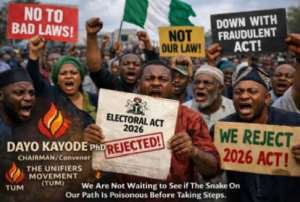
There is need to explore some pragmatic cautious conceptual wisdoms for an understanding of this thesis because, only the elders know where the path is slippery towards anticipating potential threats – as, the king’s protection comes from his eyes.
- If you see a snake on your path, don’t wait to see if its poisonous; just step aside – risks must be anticipated and mitigated rather than wait for crisis to unfold – forewarned is forearmed;
- The pains of past consequences teach the lessons of eternal vigilance;
- While the youths focus is on moving forward, the elderly with their experience (especially the painful ones) reflects on past actions to understanding outcomes in shaping their future approaches.
It is no longer news that, a new electoral act has been passed by the National Assembly which was accented to by the President on Wednesday the 18th of February, 2026. However, there are two specific areas of this act which are of great concern and thus requires some evaluations for proper clarity to both the opposition parties and the people of Nigeria.
The Specific Areas of Concern:
- Electronic Transmission of Results – the act mandates electronic transmission of results from the polling units into the INEC Results Viewing Portal (I-Rev) with manual collation as a fallback in case of network failures;
- Direct/Consensual Primaries in Selecting Party Candidates into Elective Positions – political parties must now select their candidates into elective positions through either direct primaries or choosing a consensus candidate by the political leaders.
Invariably, does these two provisions go far reaching enough in ensuring a widely accepted transparent elections? There is thus the need to have some analytical evaluations of these two critical areas of the act.
Considering the first concern whereby, the transmission of results to the I-Rev is mandated with a fallback to manual collation using the form EC8A if network or communication challenges occur, to what extent has this act clearly define what ‘transmission failure’ is or specify who determines it? To what extent will this word ‘discretion’ not be abused by the umpire bearing in mind the past experiences of 2023 elections where glitches were declared in the presidential election but was not on the other national assembly elections which were undertaken same day with same technology? – two different elections on same day, same collation tech but different collation experiences – what an impugned abuse of authority!
Equally, the untenable argument of Mr. Tinubu is of great concern here where, he posited that, credible elections are dependent on human management and public trust while not just technology. The question Mr. Tinubu need to answer is, who/what determines technological efficiency as well as performance if not human management? What trust remains of our electoral managers with the Nigeria public based on their past experiences of election management shenanigans of electoral umpire’s purposefully created glitch for result manipulations? – where a whole supposed university professor (in world glare) shamefully, could not read from a manually collated figures purportedly written by him due various forms of manipulated figures. How about the just concluded 2026 Abuja Municipal elections where specifically in Kwali area, 212 valid votes were reportedly recorded but seen altered to 1212 votes in favour of the ruling party APC.
Rather than envisaging technological systemic failures/glitches if such are not purposefully laid down banana peels towards manipulating the 2027 general elections, why not therefore ensure the strengthening of such system through the followings:
- Robust as well as reliable network infrastructure that will ensure internet coverage across the federation; in which case, the network providers have submitted that, if given the enabling environment, they can ensure such.
- Stable electricity supply for transmission equipment.
- Well trained personnel that will ensure technical support against any form of technical glitches.
- Design a well defined procedure to envisage as well determine transmission failures, its handling and transparent manual fallback.
- Real time public access to election results through I-Rev in ensuring transparency and consequent acceptability of election credibility.
Implications & Options for Opposition Parties and The People of Nigeria.
It should be acknowledged that, all of the above strengthening of our system are beyond INEC assurances as, our electoral umpires have lost the respect and trust of the people over the years based on past electoral biases. What options are therefore left for Nigerians in view of the ongoings?
- Opposition parties must ensure they have more than enough ‘BOLD, UNCOMPROMISINGLY DETERMINED’ (not chicken hearted or sellouts) and well trained personnel at all the polling units;
- This must equally be complimented with such ‘PARTY MANAGERS’ at the various levels of party management especially, at the grassroot of wards and local government areas;
- Electioneering campaigns and elections’ days management must be vigorously and tactically approached;
- Opposition parties must engage more than enough BRAVE and BRILLIANT lawyers that can immediately attend to any politically motivated arrests of their supporters during electioneering campaigns and election days;
- Must be ready to stay by their casted votes until when counted and transmitted immediately accordingly into the I-Rev;
- Must instantly view the I-Rev to ensure the exact counted results were transmitted before allowing the INEC supervisor depart the various polling units;
- Move en-mass with the INEC officials to any collation center to forestall any results alteration or manipulations;
- Nigerians as a whole must be resolute and resilient in demanding for credible elections without any form of intimidations or harassments as, no single individuals or groups of people has that monopoly of force.
Considering the other contentious issue within the act, which commands that, ‘political parties should choose their candidates for elective positions either through direct primaries or have a consensus candidate as it might be agreed by both the political party leaders and the contending aspirants.
As good as the first part might be in the area of total inclusiveness of party members in choosing their candidates, does this not smack of cumbersomeness as well as too much of financial resource involvement? Given that, the ruling party has an unfettered access to financial resources, is this act not an attempt to muzzle out the opposition through the excessive financial implications this aspect will entail? This can be considered to be a serious financial burden maliciously placed upon the contending oppositions by the ruling party.
On the second option and going by the different definitions of what a political is, which essentially, cannot be treated in isolation of the people. Consequently, the lacuna here is, this 2026 act has been intentionally silent on who or what constitutes the referenced ‘political leadership’ coupled with, what processes and or procedures laid down within this act to guide the directions upon which these leaders will follow in arriving at consensuses within their parties.
The ongoing is premised upon the fact that, party leadership exists at various cadres of party management – the national, regionals, states, local governments and wards. So, which one gets the prerogative of involvements at various consensuses to be made in a situation of adopting the consensual model of candidates’ selection; while bearing in mind the essentials of transparency with inclusiveness involvements by party members with other specific demographics within the party system?
Implications & Options for Opposition Parties and The People of Nigeria.
The opposition parties and the people of Nigeria must take extra and comprehensive caution here to the extent that, any eventual victory at any level against the ruling party can be nullified at the law court based on a guideline that was ab-initio intentionally made to be spurious with purposeful ambiguities.
Consequent upon this:
- Opposition parties, credible members of the Nigeria Bar Association and private individuals should quickly head back to the Supreme Court to ensure upholding of the judgement that once pronounced the internal independence of political parties whereby, no institution whatsoever should interfere in the internal workings of any political party – the ways and manner in which they choose their candidates inclusive;
- Likewise, the courts should be approached immediately for the interpretation of ‘party leadership’ as used in the 2026 electoral act; especially inclusive of the processes and procedures entailed in consensual candidate model;
- Opposition political parties must establish an encompassing robust internal rule that will be devoid of disputes, ensure transparency, inclusiveness and accountability;
- Nigerians should eschew and shy away from pecuniary offers from the ruling party towards being used as agents of disruptions within the opposition parties.
Perhaps, all these embedded ambiguities within this 2026 electoral act would not have existed if only Mr. Tinubu has allowed the expected constitutional 30days window before signing an act to allowing him take some cautious steps as follows:
- Proper evaluation, assessment and review of the bill in ensuring that, it aligns with the 1999 constitution (as amended) as not to infringe/tamper with both citizens’ and political parties’ rights;
- Consultations with legal experts (especially the AGF) regarding the bill’s constitutionality;
- Assessment of the bill’s implications on governance, economy with citizens’ acceptance;
- Ascertaining of national assembly’s procedural compliances in passing the bill despite all the internationally visible procedural aberrations of coercion and suppression of oppositions during the bill’s processes.
Surprisingly, it took Mr. Tinubu just about 24hrs to put his signature to this bill – passed by the NASS on Tuesday 17th February, 2026 and was assented to around 5pm on Wednesday, 2026. This rushing alone smacks some suspicion. This is coupled with all the negative intrigues exhibited by the Senate President Mr. Akpabio during this process coupled with the earlier singing of ‘on your mandate we shall stand….’ on the floor of the Senate led by same Akpabio. It can therefore be rightly insinuated that, the NASS has a pact with the president regarding the passage of such a repressive ambiguous bill with a view to perfectly assure him of his second term presidency; thus, making the credibility of 2027 to already be in doubt.
Well, to the opposition parties and Nigerians, I’ve said my own – don’t wait to see if the snake on your path is poisonous before taking a mitigative action.
Dr Dayo Kayode writes from Lagos – the Convener & National Chairman of The Unifiers Movement.


 Credit Godfred Dame for Ghana's US$393 million tax arbitration victory against T...
 How can EOCO be accused of wanting to kidnap Baffour Awuah in full glare of the ...
 'She is not party operative' – Kwakye Ofosu defends EOCO officer
 Baffour Awuah wanted over alleged financial loss, dissipation of public funds an...
 Brazil is the main source of cocaine in Ghana by sea concealed in sugar containe...
 'The cacophony of noises surrounding my comments were pure mischief' — Chief Jus...
 ‘Judges must not abandon their humanity because of their judicial office’ – Chie...
 GTEC flags over 100 tertiary institutions as unrecognised
 Political protection may be behind decline in visible cocaine trafficking in Gha...
 Ghana identified as source of explosives used in Sahel conflicts — Crime Index r...


