




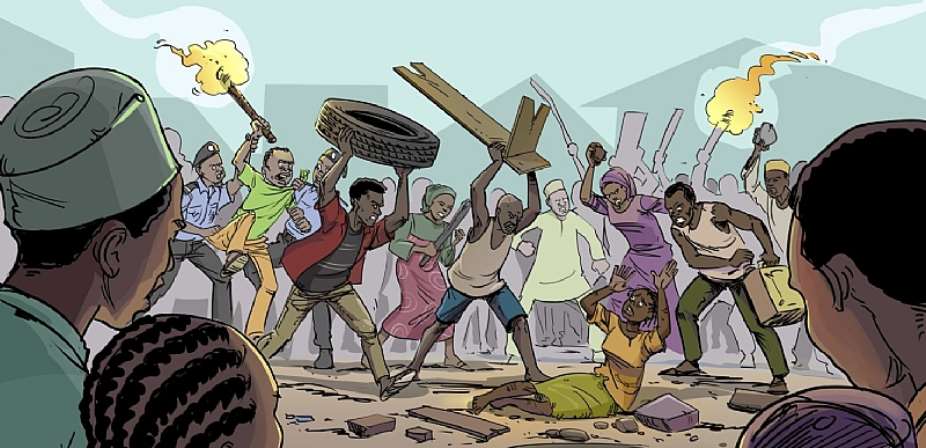
In parts of northern Nigeria, and even in the Federal Capital Territory, accusations of “blasphemy” real or alleged have increasingly triggered brutal mob violence. People, often from vulnerable religious groups or simply caught up in a dispute, are accused of insulting Islam or the Prophet Muhammad, and mobs exact extrajudicial “justice”. Two recent cases starkly illustrate this trend: the case of Deborah Yakubu in Sokoto State, and Ahmad Usman in Abuja’s Lugbe district. What is especially alarming: in both cases, there has been little meaningful accountability for the perpetrators.
The Lynching of Deborah Samuel Yakubu
On 12 May 2022, Deborah, a Christian second year Home Economics student at Shehu Shagari College of Education in Sokoto State, was accused of posting a blasphemous comment in a WhatsApp group. She reportedly told her classmates to stop posting religious messages in the academic group. A mob of predominantly Muslim students reportedly dragged her from a security room, stoned her, piled tyres and wood and set her body alight.
The state government closed the college. Two students were arrested and arraigned charged with “criminal conspiracy” and “incitement of public disturbance” (bail able offences) rather than murder. One year on, her family and rights groups continue to cry out for justice. The chief suspects remain unconvinced. International observers, including Amnesty International, have noted that the incident highlights how mob violence over blasphemy is rising in Nigeria and how perpetrators enjoy de facto impunity.
The Mob Killing of Ahmad Usman in Abuja
On 4 June 2022, in the Lugbe area of the Federal Capital Territory (FCT) a part of Abuja Ahmad Usman (also known as “Small Hundaru”), a 30‑year‑old vigilante group member, was lynched by a mob. He reportedly got into an argument with a cleric at a market vigilante office and was accused of blaspheming the Prophet Muhammad. He was beaten, stoned, then his body was set ablaze with tyres and petrol. Around 200 people are reported to have participated.
The FCT minister condemned the attack and said no one has the right to take law into their own hands. The police and media reported that 15 suspects were arrested in connection with the incident. But even with arrests, there is little evidence of successful prosecution or convictions. Amnesty International describes this as part of a trend of escalating mob violence with “emboldens impunity”.
Common Features & Patterns
These two cases share several troubling features:
Accusation of blasphemy is the trigger. Both victims were accused of insulting the Prophet Muhammad (SAW) or Islam a sensitive issue in Nigeria’s religiously plural context, especially in the North.
Mob violence extrajudicial: In both incidents, the formal law was bypassed; mobs acted as judge, jury and executioner.
Victim vulnerability: In one case, a female Christian student in a predominantly Muslim institution; in the other, a male vigilante in a market area, accused of insulting a cleric.
Slow or ineffective justice: Arrests may occur, but prosecutions either stall or charges are minimal (e.g., incorrectly framed, or bailable). In Deborah’s case, the charges were lesser offences, and no murder conviction appears yet. In the Usman case, arrests have been made but little transparency on outcomes.
State/official condemnation but limited action: Governments condemned the acts, ordered investigations, but the institutional follow‐through appears weak.
Social media & video evidence: In both cases, video or social media footage circulated and helped publicize the brutality, yet this hasn’t translated into accountability.
Broader human rights implications: These acts raise concerns about freedom of religion, expression, minority protections, and rule of law in Nigeria.
Why This Happens: Contributing Factors
- Legal and institutional gaps
While Nigeria has laws forbidding blasphemy in some states (especially where Shariʿa applies) and outlawing mob violence, enforcement is uneven. The arrests made often don’t result in strong prosecutions, or the charges are not commensurate with the violence (e.g., “public disturbance” rather than murder). The Amnesty report calls this impunity “emboldening” mob actors.
- Religious and social tensions
In places like Sokoto State and northern Nigeria in general, religious identity is salient. Minority Christians can feel vulnerable. A perceived insult to the Prophet Muhammad can rapidly inflame passions. In the Deborah case, the victim’s status as a Christian student in a Muslim majority context was highlighted.
- Vigilantism, mob justice culture
There is a pattern of “taking the law into one’s hands”. Mobs act when they believe formal justice is too slow or inadequate. The courts sometimes seem disconnected from these incidents. One article described how students overpowered the Department of State Services trying to help in Deborah’s case.
- Digital amplification & rumors
WhatsApp groups, video recordings, social media posts can act as triggers whether the actual allegation is fully verified or not. In the Deborah case, a WhatsApp group message is cited as the starting point.
What’s At Stake
Loss of life and human dignity: The brutality is horrific stoning, burning, and dragging victims.
Rule of law under threat: When mobs kill and there is no justice, the law is undermined. Citizens lose faith in the state’s ability to protect them.
Freedom of religion and expression compromised: The fear that a comment, message, or disagreement can lead to death this restricts religious minorities, dissenters, and even ordinary persons.
Inter‑communal tensions escalate: Such acts fuel distrust between religious communities.
International reputation: Nigeria is viewed as a democratic country with plural religion; mass impunity for mob killings damages that status and could affect foreign relations or investment.
What Has Been Done And What Needs Doing
What has been done:
Arrests: In both cases arrests were made (Deborah: two students; Usman: at least 15 suspects) although the nature of the charges remains weak.
Official condemnations: State governors, the FCT minister, etc., condemned the violence and ordered investigations.
Studies & reports: Organizations like Amnesty International documented the trend and called for reforms.
What still needs to happen:
Proper prosecution and sentencing: Charges should match the gravity (e.g., murder/homicide rather than mere disturbance). Victims’ families deserve justice and closure.
- Strengthening rule of law institutions: Police, courts, and investigative services must act swiftly and independently.
Protection of vulnerable groups: Religious minorities, students, market traders should have real protection from mob violence and false allegations.
- Education & public messaging: Religious leaders must speak clearly that vigilante mob justice is unacceptable, and that even allegations of blasphemy must be dealt with legally, not violently.
- Digital monitoring & early response: Since rumors and social media posts trigger these incidents, there should be mechanisms for rapid response to defuse situations.
Reforming blasphemy laws: Some state laws criminalize blasphemy in a way that creates ambiguity; clarity is needed to ensure due process.
Conclusion
The killing of Deborah Samuel Yakubu and Ahmad Usman in Nigeria over alleged blasphemy are grim reminders of how religious accusations can rapidly turn into mob violence and of how fragile justice can be when the law is bypassed. The fact that arrests have been made but that no major convictions appear to follow suggests a culture of impunity that threatens both individual lives and broader societal trust. These cases are not just about religion; they are about the fundamental question of whether the state protects its citizens and whether the law is equally applied to all. If justice is seen to fail repeatedly in such high profile cases, it risks inviting more violence rather than deterring it. By Mustapha Bature Sallama
Medical /Science communicator
International Conflicts management and Peace building
Alumni Gandhi- King Global Academy, United State Institute of Peace USIP
[email protected]
+233-555-275-880

 VIDEO: Watch the only community toilet carried away by floods
 Sedina Tamakloe unwell and currently under house arrest – Franklin Cudjoe disclo...
 Ofaakor Court remands suspect, grants GH¢70,000 bail to accomplice over vehicle ...
 We don’t owe Tema Motorway contractor any amount of money — Agbodza
 Swift response by Saki High Tension residents helps contain warehouse blaze in K...
 Bank of Ghana converts 147 rural and community banks into community banks
 Five fake soldiers grabbed for armed robbery at Ashanti mining community
 Bawumia appoints Kyei-Mensah-Bonsu as Chief of Staff as he restructure his offic...
 Sam George announces major reduction in MTN Fibre broadband prices effective Jun...
 Concerned citizen gives EC seven-day ultimatum over Anyako by-election delay


