




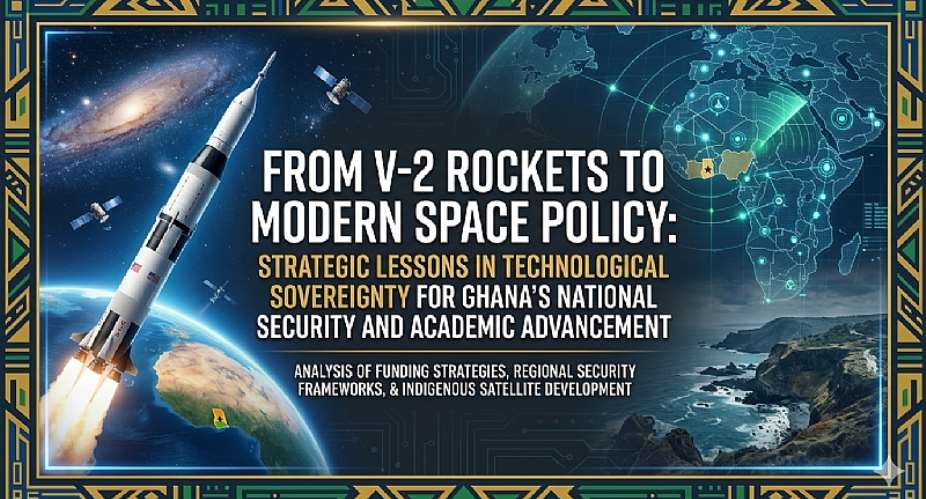
In an era dictated by rapid technological shifts and unpredictable regional realignments, true sovereignty is no longer determined solely by the size of a country's infantry, but by its mastery of strategic intelligence and industrial foresight. The history of rocketry—stretching from Nazi Germany’s devastating V-2 rocket to the continent-spanning Intercontinental Ballistic Missiles (ICBMs) of the Cold War—is often viewed as a narrative exclusive to global superpowers. However, the evolution of this technology contains critical, timeless blueprints for developing nations.
For Ghana, a beacon of democratic stability in a West African sub-region increasingly threatened by asymmetric warfare, violent extremism, and cyber-physical vulnerabilities, these historical lessons are highly relevant. Under the constitutional mandate for the Ghana Armed Forces (GAF) to actively contribute to national development, security can no longer be decoupled from technological innovation. True state independence also requires breaking foreign monopolies on our airwaves and classrooms. By analyzing how rocketry evolved through institutional design, dual-use technology, and localized research frameworks, Ghanaian military officers, national security architects, policymakers, and academics can extract a vital roadmap to fortify national defense and launch our own sovereign systems.
Core Historical Milestones & Technological Transformations
To inform our national baseline, we must understand the core phases that defined the global evolution of rocketry:
- The Genesis of Ballistic Missiles (The V-2 Era): Developed under aerospace engineer Wernher von Braun in Nazi Germany, the V-2 (Aggregat 4) was the world’s first long-range guided ballistic missile. Powered by liquid oxygen and an alcohol-water mixture, it achieved autonomous inertial navigation using electrical gyroscopes and early analog computers (Mischgerät).
- The Human and Strategic Cost: The V-2 program was a tragic paradox; it caused immense destruction in Europe, yet more slave laborers died under brutal conditions constructing it in the underground Mittelwerk tunnels than from the actual explosions. Strategically, it was an economic failure for Germany, absorbing vast resources that could have built conventional defensive assets.
- The Intelligence Scavenger Hunt: As World War II ended, the U.S. launched Operation Paperclip, extracting over 1,500 German scientists and sanitizing their active Nazi pasts to secure technological dominance. Concurrently, the Soviet Union reverse-engineered captured components to build the R-1 missile under the legendary, once-imprisoned chief designer Sergei Korolev.
- The Space Race vs. Military ICBMs: This captured technology split into two paths. The U.S. focused on precision, single-chamber engineering (culminating in the Saturn V Moon rocket), while the Soviets relied on robust, clustered multi-chamber designs (leading to the R-7 rocket and Sputnik). This proved that different engineering philosophies could achieve identical strategic breakthroughs.
- The Solid-Fuel Revolution: Early military missiles required hours of volatile, highly dangerous pre-flight liquid fueling, leaving them vulnerable to pre-emptive strikes. The transition to solid-fuel composites allowed missiles to be pre-packed, stored safely for years, and launched in under 60 seconds (seen in the American Minuteman and Soviet mobile launchers).
Strategic Recommendations for Ghana's Stakeholders
For Military Officers and Defense Strategists
- Align with the National Defence Policy: GAF leadership must integrate the lessons of structural tech transitions into reviews of the Ghana National Defence Policy, ensuring that defense paradigms keep pace with modern fluid threat landscapes.
- Prioritize Solid-State and Low-Maintenance Systems: Modernize defense artillery and tactical assets by phasing out hardware requiring complex, volatile liquid maintenance. Solid-fuel and solid-state systems ensure instant readiness, high reliability in tropical environments, and lower long-term storage overhead.
- Study Exhaust Steering and Guidance Mechanics: As drones and guided loitering munitions become prevalent in regional conflicts, officers must master the principles of vectoring control, inertial navigation, and electronic counter-countermeasures (ECCM) to protect Ghanaian airspace.
- Integrate Asymmetric Defense Doctrines: The V-2 history proves that massive, expensive systems can fail logistically if they drain the national treasury. Ghana must focus on cost-effective, high-yield asymmetric defensive technologies rather than overly complex, cost-prohibitive platforms.
Operationalizing Regional Security: The Accra Initiative Framework
- Deconstruct the Regional Threat Matrix: Security personnel must analyze the rising security risks at our borders. Data from the West African Network for Peacebuilding (WANEP) shows that terrorism-related and armed attacks in West Africa increased drastically to 2,197 incidents in 2024 (up from 1,715 in 2023 and 1,601 in 2022).
- Leverage the Accra Initiative Structure: Established in September 2017 with a permanent secretariat in Accra, the Accra Initiative links seven signatory states (Ghana, Benin, Togo, Côte d'Ivoire, Mali, Burkina Faso, and Niger) alongside Nigeria as an observer. This cooperative platform conducts joint border patrols and multinational task force deployments to stop the southward expansion of Sahelian extremism.
- Implement Targeted Capacity-Building: To overcome operational constraints, Ghana must actively maximize international defense partnerships. This includes the United Nations Development Programme (UNDP) security initiative supported by a $507,004 framework funded by Japan. This system trains state and non-state personnel to build border-community resilience against radicalization.
- Address Border Security Gaps: National security personnel must counter the geopolitical fallout from the exit of the Alliance of Sahel States (AES) from ECOWAS, which disrupted joint intelligence sharing. Security architects must use local technology to secure porous border zones against infiltration.
For Academic Institutions and STEM Students
- Establish Interdisciplinary Aerospace Tracks: Ghanaian universities, led by institutions like the Kwame Nkrumah University of Science and Technology (KNUST) and the University of Ghana, should expand specialized curriculums in aerospace engineering, advanced metallurgy, fluid dynamics, and synthetic polymer chemistry.
- Embrace the Korolev Pragmatism Philosophy: Lacking the massive budgets of Western nations, Ghanaian engineering students should study Sergei Korolev's design ethos. Focus on modular engineering, clustering existing technologies to create greater output, and iterative prototyping (building, testing, failing quickly, and refining).
- Bridge the Gap Between Chemistry and Defense: Solid-fuel breakthroughs were entirely a triumph of chemical engineering. Students focusing on industrial chemistry should be incentivized through national defense scholarships to research local composite materials, propellants, and heat-resistant shielding.
- Design and Launch Local Telecommunication Satellites: Under the guidance of Dr. Joseph B. Tandoh, Director of the Ghana Space Science and Technology Institute (GSSTI), our scientific academic bodies must shift focus from theoretical discussions to practical actions by prioritizing the development of indigenous satellite payloads.
- Deploy Aggressive Funding Strategies: To capture a slice of Africa's space economy, projected to reach $23 billion by 2026, Ghana must aggressively pursue capital. Historically, the nation sought $5 billion to $10 billion in infrastructure funding from a global consortium including the China Development Bank and HSBC. Academics must diversify funding by leveraging the GSSTI’s international frameworks, such as the European Space Agency (ESA) Earth Observation (EO) Africa R&D facility and bilateral technical MoUs signed with India’s SatCom Industry Association (SIA-India).
- Eradicate Foreign Telecom Dependency: Currently, Ghana’s educational sector heavily relies on foreign-dominated telecommunications giants like MTN and Telecel. By establishing a sovereign, state-owned satellite communications network overseen by a future Ghana Space Agency, Ghana can break free from external commercial monopolies that drain national capital through profit repatriation.
- Revolutionize and Equalize Basic Education: A dedicated Ghanaian educational satellite can broadcast high-speed, free e-learning data, virtual classrooms, and digital libraries directly to the most remote, underserved schools in rural communities, completely bypassing expensive, spotty commercial cellular coverage.
- Keep National Security Data Within Borders: Shifting state, military, and educational data routing to an indigenous satellite network designed by entities like the GSSTI Satellite Communications & Engineering Centre drastically reduces the risk of foreign cyber-espionage and data harvesting.
The trajectory of rocketry teaches us that technological supremacy is never born overnight; it is forged through deliberate institutional commitment, rigorous scientific application, and a clear-eyed understanding of strategic vulnerabilities. For Ghana to secure its borders and thrive in an increasingly complex global landscape, the nation cannot remain a passive consumer of foreign technology, nor can we allow multinational telecom giants to control the flow of our educational and national security data.
By applying the lessons of the past—transforming academic research into tangible defense capabilities, adopting resilient solid-state engineering, utilizing regional defense frameworks like the Accra Initiative, and designing indigenous satellites to power our schools—Ghana can cultivate a self-reliant security and technological apparatus. The choice is clear: we must either actively build our own technological future today or remain vulnerable to the strategic and economic maneuvers of tomorrow. Let this historical blueprint serve as a national call to action for the soldiers, scientists, and statesmen of our great republic.
✍️By A Concerned Retired Senior Citizen
For and on behalf of all Senior Citizens of the Republic of Ghana 🇬🇭
Teshie-Nungua
[email protected]


 'EOCO attempted arrest of Baffour Awuah was unprofessional' — James Agalga
 'Building a congregation of 20,000 will kill you' – Duncan-Williams tells young ...
 September 29: Cedi finishes day selling at GHS12.20 on forex market, GHS11.67 on...
 ‘We’ll explore another constitutional option for narcotics probe’ – Minority on ...
 Speaker Bagbin adjourns Parliament indefinitely after rejecting narcotics probe ...
 Food Buffer Stock seeks stronger liquidity buffer despite record GH¢91.7 million...
 Ex NAFCO Boss trial: Court adjourns trial to hear application for return of seiz...
 Bagbin backs Mahama’s call for national dialogue on social media insults


