




Introduction
Darfur, a region located on western Sudan is an epicenter of a protracted conflict punctuated by genocide or rumours of a genocide. Generally, Darfur has a tragic history, a history of ethnic war, ethnic violence and heart wrenching humanitarian catastrophes. Rewind to the early 2000s, to be exact between 2003_2005, Darfur was theatre to a deadly and brutal conflict which ended with hundred of thousands dead and millions displaced. And now again amidst the Sudanese civil war which broke out in 2023, Darfur is engulfed by an orgy of violence, genocide and rumours of genocide. In 2003, the conflict arose from long standing tensions between Arab millitias known as the Janjeweed (supported by the Khartoum central government admnstration) and ethnic African groups rebelling against marginalisation or neglect and resource competition. Now the conflict has been ignited by opposing fighting factions in Khartoum. One faction led by Sudanese Armed Forces (SAF) led by General Abdel Fattah al-Burhan and the other faction by a paramilitary wing, with roots in the Arab millitia, Janjeweed singled out in the Darfur violence of 2003_2005, the Rapid Sudanese Force (RSF) led by , General Mohamed Hamdan Dagalo known as "Hemedti".
DARFUR: "The Name".
Dar is arabic for "home". "Fur" is arabic for "black" . The word "Fur" is first mentioned in historical records in the account by a German traveller, J. M Vansleb who visited Egypt in 1664,(1).Vansleb writes like "sudan", fur means blacks"or black people". So Darfur was name given to black African original inhabitants of the country like the Binga, the Banda etc by arriving Arabs in the area.So Darfur means "realm of the fur", "home of black inhabitants". Therefore, Darfur simply means "land of the Blacks or land of Black people".
Darfur Geography
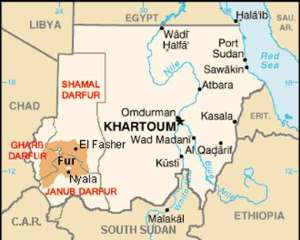
Darfur is Sudan’s largest region, on its western border with Libya, Chad, South Sudan and the Central African Republic.Darfur has been divided into East, South, West, and North since 1994 (2). Darfur's geography is dominated by vast semi-desert plateaus, featuring volcanic mountains like the Marrah Mountains (Jebel Marra) in the central region, and sandy plains in the east. Darfur encompasses areas of the Sahara desert to the north, savanna to the south, and wadis (seasonal riverbeds) crisscrossing the landscape. Darfur's climate is characterized by aridity and desertification.
Darfur Parallel Admnistrative Contradiction
The capital city of the Darfur region is Al-Fashir (or El Fasher). It also serves as the capital of North Darfur.Currently, Darfur's administration is complicated by a parallel government established by the paramilitary Rapid Support Forces (RSF) in the region amidst the ongoing Sudan Civil War, with the RSF's leader, Muhammad Hamdan Dagalo, heading the body. Of concern is this parallel administrative structure created by RSF which is a contradiction to the internationally recognized government in Khartoum.The parallel structure has been globally condemned.
Darfur Demography
Darfur is home to diverse indigenous groups: Arabs, (those who speak Arabic including African groups ) have long constituted the majority of the population in the northern part of Darfur, while Arabs and Fur (African ethnic groups_ non Arab speaking ) have predominated in the southern portion. Other ethnic groups have included the Beja (nomadic people) peoples.Other groups includes the Zaghawa, Nubian, Daju, Berti, Midob, Rezigat and Zayadia, who speak a variety of languages.
Issues of ethnicity
Human Rights Watch uses the term “African” mainly to describe the Zaghawa, Fur, and Masalit, the principal victims of the government’s military campaign against the rebel insurgency in Darfur in last two decades 2003_2004 and current victims of atrocities from the RSF. The term “Arab” is used to describe the Arabized, Arabic-speaking groups of nomadic and semi-nomadic people who have been recruited and deployed as Janjaweed militia. However, in between The so called African and Arabised lies a complex of the ethnic picture in Darfur. However, the population is predominantly Muslim.Issues of ethnicity have long troubled the Darfur region.
Darfur Humanitarian Crisis
In July 2025, United Nations (UN) released worrying statistics. Famine and claims of a genocide in the western Darfur region are the living realities. More than 150,000 people have died in the conflict across the country, and about 12 million have fled their homes in what the United Nations has called the world's largest humanitarian crisis at hand. And UN warns of worsening humanitarian crisis in Darfur as genocide, displacement, hunger and disease escalate. Close to nine million people need humanitarian assistance and reports suggest that some 4,000 people have been targeted and killed because of their ethnicity. Rising concerns are that Darfur is returning to the years of brutal fighting and increasing atrocities last witnessed two decades ago.The situation is particularly dire in El Fasher, the capital of North Darfur province.Those remaining in El Fasher are facing,
“extreme shortages” of food and clean water, with markets repeatedly disrupted", says Stéphane Dujarric, UN spokesperson,(3).
Across the Darfur city,
"nearly 40 per cent of children under five are suffering from acute malnutrition, including 11 per cent with severe acute malnutrition ", Stéphane Dujarric, UN spokesperson, (3).
Darfur is a region which has experienced massive displacements due to a number of reasons like conflict, floods, and drought, with millions of internally displaced persons (IDPs) and refugees. As of September 2024, the ongoing conflict in Darfur has killed over 20,000 people and displaced more than 10.9 million.
Darfur Genocide
According to United Nations report in April 2025, "darkest chapters" seem to lie ahead in reference to massacres and potential of more such massacres being carried out in parts of western Sudan (Darfur).
Zamzam and Abu Shouk Massacres, April 2025
The latest attacks, which began on 11 April, saw Rapid Support Forces (RSF)-affiliated forces launch coordinated assaults on Zamzam and Abu Shouk – two of the largest camps for internally displaced people (IDPs) in Darfur – as well as the regional capital, El Fasher. Among those killed were 23 children as well as nine humanitarian workers who were operating one of the last remaining health posts.
The UN Independent International Fact-Finding Mission (IFFM)
"The world has witnessed two years of ruthless conflict which has trapped millions of civilians in harrowing situations, subjecting them to violations and suffering with no end in sight,”, Mohamed Chande Othman, IFFM chair,(4).
"Amid the rising tide of hate speech and ethnically driven violence and reprisals, we fear the darkest chapters of this conflict have yet to unfold.” Mohamed Chande Othman, IFFM chair,(4)
And indeed, the darkest chapter is unfolding and Darfur is bleeding.
According to the IFFM, both sides (SAF & RSF) have committed serious violations of international humanitarian law, including deliberate attacks on civilians, rape and sexual violence, starvation tactics, mass looting and destruction of civilian infrastructure.
Brutality Against Civilians
Ten days of “brutal” attacks by Sudan’s paramilitary Rapid Support Forces (RSF) have left at least 89 people dead in the western region of Darfur.
"Brutal attacks by the RSF … resulted in the killing of at least 89 civilians over a 10-day period up to August 20", Jeremy Laurence,(5).
Jeremy Laurence,spokesperson for commissioner Volker Turk, said in a Geneva press briefing.
"We fear the actual number of civilians killed is likely higher. The dead include at least 57 people who were killed in attacks on August 11 and another 32 killed between August 16-20. We are particularly horrified that among the most recent spate of civilian killings, 16 appear to have been cases of summary executions,”, Laurence said,(5).
Among the dead were civilians from the African Zaghawa tribe and one from the African Berti tribe.
El_ Fasher under Siege
El-Fasher, the provincial capital is under siege from RSF. The RSF has bombed the city for more than a year now, and RSF has imposed a total blockade on its hundreds of thousands of people.The RSF has also repeatedly attacked Abu Shouk and another displacement camp, Zamzam, which was once Sudan’s largest, with more than 500,000 people. The two camps are located outside el-Fasher. The two camps have been hit by famine.The current war has killed more than 40,000 people , forced more than 14 million to flee their homes and left some families eating grass in a desperate attempt to survive as *famine swept* parts of the country.The conflict has also been marked by gross atrocities, including ethnically motivated killings and rape, according to the United Nations and rights groups. The International Criminal Court has said it was also investigating alleged war crimes and crimes against humanity.
Cholera outbreak
According to the World Health Organization (WHO) regions like El-Fasher have been hit by “a severe humanitarian and public health crisis ”, Mostly driven by the active conflict and mass displacements.
"all 18 states in Sudan were reporting cholera, with 48,768 cases and 1,094 deaths reported this year up to August 11", WHO spokesperson Christian Lindmeier,(6).
"Civilians have been facing severe food shortages, rising malnutrition deaths, and severely limited access to healthcare", WHO spokesperson Christian Lindmeier,(6).
Centrality Of Darfur In The Sudanese Civil War
Darfur is a resource - rich region, strategically sharing borders with South Sudan, Libya and Chad. Darfur region's resources include significant deposits of minerals like gold, copper, uranium, and rare earth elements, as well as arable land, water from rainfall and wadi systems, forests, and livestock , Nonetheless, it needs to be noted that these are often scarce and drives conflict over their use. Also the region's primary reliance on scarce land, water, and grazing areas for rural livelihood contributes to tensions and conflict within and among communities.
Gold; Fuel & Target of War
Gold in Darfur mines, like Al_Raddom gold mine in south Darfur are key in financing the war. Recent security reports have highlighted that "gold" has become the vital resource financing the war for both sides. It needs to be noted that "gold is a target of the war and helps fuel it". Both warring parties heavily rely on gold production as an integral means of financing the won effort. While the de facto government under military control in Port Sudan claims gold production in army areas has reached US$150 million in monthly revenue, their adversaries, the paramilitary Rapid Support Forces (RSF), may be accruing similar rates, according to gold smugglers and employees of the RSF gold mining and export company, Junaid. Last year, 2024, United States of America (US) sanctioned, Junaid company entirely RSF-owned, saying that gold had become a “vital source of revenue" for the RSF and their leader, Lt.-Gen. Hamdan Dagalo (aka “Hemedti”). It is pointed out that RSF exclusively concentrates on the process of milling and treating soil and stone from mining sites, known locally as “karta”, to extract gold, and then export the final product to their primary financiers, the United Arab Emirates,(UAE).
Again, Darfur is a stronghold for "Hemedti", leader of RSF. It is a fact that a number of RSF enlists are from Darfur and mostly from "Hemedti's own Rizeigat tribe. RSF controls significant infrastructure in Darfur that is, mines, air strips, major roads, water sources etc. If push comes to shove, "Hemedti" is expected to withdraw to Darfur, his base and observers point out that should Hemdti retreat to Darfur, he will become difficult to fight or get. It is a fact that after Khartoum, Darfur has witnessed serious fighting after the breaking out of Sudanese civil war in 2023. Worringly the civil war has given opportunity for rival ethnic groups to attack each other. Victims are mostly non_Arab populations (mostly Fur/African ethnic groupings) especially in camps of Internally Displaced Peopled (IDPs) who are in need of humanitarian assistance and are very vulnerable.
Crimes against humanity In Darfur
In this Sudanese war,mass sexual violence has been documented as rampant. According to UNICEF, armed men are raping and sexually children.Fighters are taunting non- Arab women during sex attacks with racist slurs and saying they will force them to have "Arab babies". A report from Human Rights Watch, evidence of ethnic cleansing (genocide) and other crimes against humanity have been committed against darker-skinned Massalit people and other non- Arab communities by the RSF and it's Arab allies. Citizens are being targeted because of their identity.UN genocide expert Alice Wairimu Nderitu told BBC that Sudan was,
"facing a growing risk of genocide as the world attention remained glued to conflict in Ukraine & Gaza", (7).
Woefully Inadequate International Response
International Media is awash with news on conflicts in Gaza & Ukraine but little on conflict in Sudan.The United Nations (UN) and other humanitarian bodies have accused the International Community " the African ". International response to "Sudanese War, especially so, gfglGENOCIDEsmuggl" has been under spotlight as not being good enough. According to International Crisis Group, diplomatic efforts to end the war has been "lacklustre" and Amnesty International labelled the world's response to Sudanese War as "woefully inadequate", (8).
Foreign Actors
Conflict in the Sudan which is also embracing Darfur has significant external actors involved. United Arab Emirates (UAE) has been singled out as the major primary funder of the war, providing weapons and support to the RSF in exchange for what?... Sudanese gold, some of it from Darfur gold mines. UAE is alleged to provide weapons, drones and artillery to the RSF in exchange for gold which is smuggled from Sudan and processed in the UAE. Sudan has time and again accused UAE at the United Nations (UN) and even filed complaints to the International Court Of Justice (ICJ),(9). Sudan accuses UAE of funding RSF to perpetrate genocide in the Darfur, an accusation UAE has flatly refuted.
Sudan took the United Arab Emirates (UAE) to the International Court of Justice (ICJ), accusing it of supporting Sudan's paramilitary Rapid Support Forces (RSF) in the civil war. Khartoum argues the UAE is "complicit in the genocide" of the Masalit community (African ethnic group), in West Darfur, through its military, financial and political backing for the RSF.
However, UAE has strongly rejected Sudan's allegations, calling the case a "cynical publicity stunt ", and UAE said it will seek an immediate dismissal.The RSF has been accused of committing a genocide in Darfur - against the region's non-Arabic groups (Blacks, African ethnic groups). According to news agency AFP, Sudan's submission to the ICJ says:
"The United Arab Emirates fuels the rebellion and supports the militia that has committed the crime of genocide in West Darfur ".
An unnamed UAE official said that,
"the allegations presented by the SAF representative at the ICJ lack any legal or factual basis, representing yet another attempt to distract from this calamitous war ".
Economic interest is the key driver for UAE activities in the Sudan even now during time of ongoing Sudan conflict. Benefits from gold trade, control of Sudan's natural resources, like gum arabic and gold. Strategic interests also lie behind U.A.E involvement.Strategic interests to gain influence in the Red Sea arena, with backing of the RSF. UAE is not alone, other foreign actors have been named; arms shipments from Russia, China, Turkey, Iran , Egypt, Yemen and Serbia which support both SAF and RSF, (10).
Why UAE so much involved in Sudan?
Observers have tried to explain why UAE is so much entangled and mostly singled out foreign player in the Sudanese civil war as well as Darfur genocide. Among possible reasons for such state of affairs five possible reasons have been advanced.
The Curious Case Of UAE In The Sudan
It is an open secret that UAE has been the most external factor heavily involved in the Sudan.
Possible reasons
1.) Economic interests
Over the past decades, well before the war, UAE had been playing a significant role in Sudan’s economy. A report by the French Institute for Research in Africa, titled “Gulf States: A Paradoxical Economic Lifeline for Sudan ”, (11) highlights how Gulf countries, especially the UAE, is deeply engaged in Sudan’s economy even during the era of international sanctions under former president Omar al-Bashir. And it appears UAE is willing to maintain its economic grip of the Sudan in spite and despite of the ongoing conflict.
2.Breadbasket of the United Arab Emirates
Gulf states including mostly, UAE have been considerably investing in Sudan’s agricultural sector as part of efforts to tackle regional food insecurity. The idea of Sudan serving as the “breadbasket of the Arab world” fueled a drive for agricultural mechanization, a vision formally backed by Gulf nations as early as 2003. And UAE has been a major Gulf state contributing to investments in mechanization of agriculture in the Sudan. Agriculture continues to be the cornerstone of Sudan’s economy, making up 60% of total exports and contributing one-third of the GDP in 2022, according to the African Development Bank (12). It needs to be noted that UAE as a country imports almost 90% of its food and most significantly from the Sudan due to limited arable land and water scarcity.To safeguard its food supply, the UAE has developed a global agricultural network covering around 1 million hectares of farmland, connected through ports and logistics hubs
3.Controlling strategic ports
With a 700 km coastline along the Red Sea, Sudan is strategically important for the UAE’s regional ambitions. Its location makes it a prime target for the UAE’s efforts to gain control over key ports. As seen elsewhere in the Horn of Africa, the UAE typically advances such interests through commercial fronts like Abu Dhabi Ports and Dubai Ports . It is said that Sudanese officials in 2020, speaking anonymously to Al Jazeera, pointed out that Khartoum administration negotiated a deal with UAE-based logistics giant Dubai Ports World (DP World) to manage the South Port Container Terminal at Port Sudan. However, the proposed agreement faced strong opposition from the Sudanese Ports Authority and Trade Unions , who firmly rejected the private operation of such a critical national asset. Therefore,maybe lingering desire to control such strategic ports may explain UAE's heavy involvement in the Sudan
4.Dominating Sudan’s financial infrastructure
During the time of United States of America (US) sanctions on former Sudanese leader Omar Hasan Albishir, Sudan’s banking sector was low partly because of prolonged (U.S) sanctions cutting Sudan off from the global financial system.These sanctions effectively banned most commercial and financial dealings with Sudan. It was only after 2017 that the (U.S) began easing restrictions, allowing Sudan to reconnect with international banking institutions UAE came and heavily invested in the Sudan financial market.Two decades ago, the government offered the state-owned Bank of Khartoum for sale. Founded in 1913, it is Sudan’s largest and oldest bank. In 2005, the government sold 60% of its shares to Dubai Islamic Bank, (13) which then merged with Emirates and Sudan Bank in 2008. The latter was founded by a consortium of UAE banks and became majority-owned by these entities*. It is also of interest to note that most foreign banks operating in Sudan are headquartered in Gulf states, primarily Saudi Arabia, the United Arab Emirates, and Qatar. Together, these seven foreign banks hold 23% of Sudan’s total banking assets. Their main goal is to support and facilitate Gulf investments throughout the Sudanese economy. One could argue that the UAE’s involvement in the war is to secure its financial position and control financial markets in the Sudan.
5.A Gulf proxy war
Some political and military commentators on my Sudan civil war point out that the Sudanese civil war has become a proxy conflict between two Gulf states UAE supporting RSF and Saudi Arabia supporting SAF. All these two Gulf states are vying to expand their influence in Africa. On the side of the Sudanese Armed Forces (SAF) is Saudi Arabia, which has built a close relationship with SAF leader General Abdel Fattah al-Burhan. Meanwhile, the United Arab Emirates has aligned itself with the Rapid Support Forces (RSF). Surprisingly, both UAE and Saudi Arabia have been allies, united by shared regional interests, including hostility towards Iran and a mutual opposition to Islamist movements.However, economic competition has strained their relationship.Hence, UAE is fighting Saudi Arabia and Sudan is the battleground and Darfur is taking much of the carnage, brutality and violence of the war.
Conclusion
Darfur is a region synonymous with ethnic conflict, violence and wars. Between 2003 _ 2005 ,the region experienced brutal genocide and here we are again, just two decades later, this time around ignited by the Sudanese civil war which started in 2023. Darfur is on the grip of another ongoing darkest chapter and as the UN warned, Darfur maybe entering another " darkest chapter", targeting and wantonly killings of targeted ,certain non_Arab populations, mostly, African or black ethnic groups....that is, GENOCIDE. As the power struggle rages on between SAF & RSF in Khartoum, Darfur is sinking deeper and deeper into a heart wrenching human catastrophe as certain millitias Android groups and sometimes both SAF and RSF, take advantage to attack and kill certain ethnic groups. A good example, is the Masalit genocide in which RSF was singled out. And UAE is the major financier of RSF. Right now Darfur is grappling with heart wrenching humanitarian crisis.Violence, gross human violations, sexual violence, rape are being at the "realm of the Fur" that is, at "the home of certain African ethnic populations", worringly, the world is quite, no media uproar, no media overdrive coverage on ethnic cleansing in the Darfur. African ethnic groups are being deliberately targeted. Its now three years into the conflict, since 2023, the Sudanese civil war is raging on and DARFUR IS BLEEDING.
F. Madondo (African Teacher) [email protected]
References
1. Petermann (1862–3). Mitteilungen, Erganzungsband II).
2. Richard Cocket, Sudan: Darfur and the failure of an African state. 2010. Hobbs the Printers Ltd., Totten, Hampshire
3. Stéphane Dujarric,8 July,2025, UN Warns of Dire Humanitarian Sitiuation in Sudan, Available at www.vaticannews.va
4. UN International Fact Finding Mission,14 April 2025, 37. Nashed, Mat. "'Corpses on streets': Sudan's RSF kills 1,300 in Darfur, monitors say". Available at www.ohchr.org
5. Jeremy Laurence,23 August,2025, UN Human Rights Spokesperson Jeremy Laurence on Sudan attacks, Available at www.unognewsroom.org
6. Christian Lindmeier, 24 May 2024,Sudan: Deteriorating situation in El Fasher, health system collapsing nationwide, Available at www.news.un.org
7. Alice Nderitu, 5 June,2024,SudanStatement by Ms. Alice Wairimu Nderitu, United Nations Special Adviser on the Prevention of Genocide, on the situation in El Fasher, North Darfur, Available at www.reliefweb.intl
8. International Crisis Group,The international response to Darfur, Available at www.fmreview.org
9. Sudan launches case against UAE at World Court,6 March,2025, Available at www.voanews.com
10. Zeinab Mohammed Salih,19 December 2024, Conflict in Sudan: A Map of Regional and International Actors, Available at www.wilsoncenter.org
11. Gulf States: A Paradoxical Economic Lifeline for Sudan,9 September,2024, Available at www.ifri.org
12. Food security: Can war-torn Sudan recover and help address the global food crisis?,19 March 2024, Available at www.weforum.org
13. Mohammad Khansa,17 July 2025, Five Reasons Why The UAE Is Fixated On Sudan, Available at www.peoplesdispatch.org


 'I couldn’t have refused an order' – Major Adjei-Ampofo explains why he took par...
 'Some NDC members are working with NPP to get your GoldBod job' – Kevin Taylor w...
 'It is too early for you to take this political heat' – Kevin Taylor cautions Ay...
 NPP knows GoldBod is our strength, that is why they want to bring it down – Suhu...
 Stop using radio airtime for greetings, talk about Mahama’s economy – Suhuyini t...
 IEA proposes binding long term national development plan to stop successive gove...
 Health Minister moves to prevent stockouts of HIV, TB and Malaria commodities
 IEA wants MPs, ministers barred from serving on State-Owned Enterprise boards
 Constitutional review: IEA warns against changes that could turn judiciary into ...
 Eastern Regional Minister orders temporary closure of two SHSs after violent stu...

