




It is one thing to live in Ghana and battle “dumsor,” it is another to wake up and discover that ECG wants to triple your burden while still giving you occasional darkness. The recent proposal by the Electricity Company of Ghana (ECG) to raise its Distribution Service Charge (DSC) from 19 pesewas to 61.8 pesewas per kWh—a 225% increase—for the 2025–2029 tariff period has sparked shock, satire, and soul-searching across the country.
Like every major Ghanaian economic announcement, it comes with a chorus of street humour. From kenkey sellers in Nima to bankers in Airport Residential, the refrain is the same: “ECG, so you won’t off only the lights, now you want to off our pockets too?”
But beneath the laughter lies a serious socioeconomic reality: this hike can shape the cost of living, the future of small businesses, and even the pulse of Ghana’s 24-hour economy.
The Human Angle – Households Under Siege
Imagine a single mother in Kasoa with three children. Her monthly prepaid card of GHS 100 already barely survives two weeks. With this proposed increase, she will need GHS 225 for the same consumption. That is not an adjustment; that is a restructuring of her entire household economy.
Families are already rationing electricity—ironing once a week, limiting TV hours, or swapping rice cookers for coal pots. This tariff could push electricity from a basic utility into a luxury commodity, forcing low-income households into deeper poverty (Ghana Statistical Service, 2024).
Business Angle – From Seamstresses to CEOs
For small businesses, electricity is oxygen. A seamstress in Kumasi now jokes that ECG is “sewing her profits tighter than kaba.” A barber in Madina has pasted a sign: “Haircut – GHS 40 (ECG surcharge included).” In a nation where SMEs contribute over 70% of GDP (World Bank, 2023), such jokes are only sugar-coating bitter realities.
Industries will not escape either. Energy-intensive businesses—mining, steel, agro-processing—may have to divert more cash to power costs, cutting expansion plans. The likely response? Higher prices for goods and services, feeding Ghana’s inflation spiral.
The Macroeconomic Picture – Inflationary Flames
Electricity is not just a bill; it is a production cost. A 225% rise in DSC will ripple across food, transport, education, and services. The Ghana Union of Traders Association (GUTA) has already warned that tariff hikes, without efficiency gains, could “wipe out many SMEs” (Channel1News, 2025).
If approved, the tariff hike risks pushing inflation beyond the Bank of Ghana’s policy target band (6–10%), worsening exchange rate pressures, and consumer confidence. In essence, the ECG proposal is not just an energy policy; it is an inflation policy in disguise.
The ECG Argument – Between Cost Recovery and Credibility
ECG is not blind to the backlash. Their rationale is familiar:
- Cost Recovery: The gap between actual operational costs and approved tariffs has created huge deficits.
- Macroeconomic Pressures: Cedi depreciation and inflation have inflated the cost of transformers, copper cables, and spare parts.
- Infrastructure Investment: Upgrading meters, reducing technical losses, and expanding distribution networks all require cash.
- Sustainability: Without adequate tariffs, ECG risks financial collapse, threatening national energy security (EnergyNewsAfrica, 2024).
These are legitimate concerns. But the credibility gap is where Ghanaians get stuck. Consumers often ask: “If we pay more, will we finally see efficiency, or are we only funding ECG’s inefficiencies?”
A Strategic Reset – Beyond Tariff Hikes
For Ghana, the answer can not be perpetual tariff escalations. To reset our power sector, we need:
- Efficiency First – Reduce ECG’s technical and commercial losses, currently estimated at 24–25% of distributed power.
- Transparency & Accountability – Publish periodic audits to show how tariff revenues are reinvested.
- Renewable Energy Integration – Solar and mini-grid solutions can relieve ECG’s dependence on expensive distribution upgrades.
- Social Protection Measures – Lifeline tariffs must be shielded to protect the poorest households.
- Productivity Linkage – Tie tariff adjustments to measurable improvements in service reliability, not just cost recovery.
The Ghanaian Coping Spirit
When Ghanaians joke that they will “go Rasta if barbers raise prices again” or iron only once a month, it is not mere humour—it is resilience in disguise. Yet, resilience is not policy. A 225% hike in the Distribution Service Charge, without parallel efficiency reforms, risks deepening poverty and stalling economic growth.
The ECG tariff debate is, in fact, a metaphor for Ghana’s development dilemma: do we balance short-term survival with long-term sustainability, or do we keep passing the cost to the consumer until hope itself becomes unaffordable?
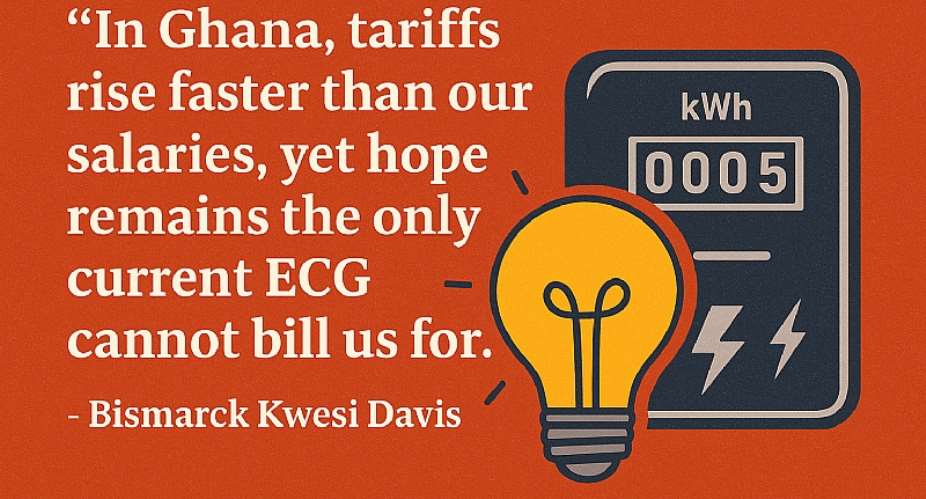
"In Ghana, tariffs rise faster than our salaries, yet hope remains the only current ECG cannot bill us for." — Bismarck Kwesi Davis
References
- Ghana Statistical Service. (2024). Household Living Standards Survey. Accra.
- World Bank. (2023). SME Contribution to GDP in Sub-Saharan Africa. Washington, DC.
- Channel1News. (2025, April 12). GUTA rejects utility tariff hikes, demands accountability at ECG.
- EnergyNewsAfrica. (2024). ECG, NEDCo justify proposed tariff adjustments.
- ModernGhana. (2025). 243% power tariff increase sparks outcry.

 Appointment of Emelia Agbenyo as EC deputy chair was well calculated, reasoned –...
 Relief for students as GAUA and TUSAAG call off strike; declare return to work o...
 Who gave Cabinet authority to decide for Ghanaians to join BRICS without parliam...
 Mahama urges Ghanaian businesses to tap CSIR innovations
 Partisan EC appointments could set dangerous precedent — NPP's Kamaldeen
 Winneba: Afenyo-Markin commissions police apartments at Fetteh-Osakam
 Council of State failed Mahama over Emelia Agbenyo’s EC appointment – Prof. Asa...
 CDD‑Ghana: EC Deputy Chair Should Step Down Now
 Family Announces October 23 Memorial Mass for Nana Konadu Agyeman-Rawlings
 Eduwatch Urges Nationwide Audit of Sexual Misconduct in Secondary Schools



Comments
The author expresses concern about the impact of a tariff hike on a single mother with 3 children. Respectfully, maybe the problem is the existence of single mothers with 3 children? How is that demographic practice possibly economically sustainable? ECG is, as FM Forson has indicated, the single biggest financial risk Ghana faces. When ECG is poorly run, with tariffs well below cost, somebody must pay. The consumers must face the cost and then, through the democratic process, demand reform of E...