




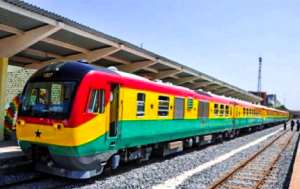
Once a source of pride and economic promise, Ghana’s railway network now sits at a pivotal moment. Years of underinvestment, incomplete projects, and infrastructure decay have left much of the system inoperable. Yet hope still glimmers on the horizon — if action replaces rhetoric, and if the Tema–Mpakadan line becomes the beginning of a wider transport revolution rather than another forgotten milestone.
🛤️ The Current Picture: Stalled Momentum
The Tema–Mpakadan railway line, a 97.6 km standard gauge corridor connecting the Port of Tema to Mpakadan near Akosombo, was inaugurated with great optimism in late 2024. Built to integrate into a larger Ghana–Burkina Faso interconnectivity project, its strategic potential is undeniable. However, as of mid-2025, the line remains non-operational.
Despite the infrastructure being mostly complete, persistent theft, vandalism, and the absence of a clear operational model have kept the trains idle. Similar inertia affects the broader railway ecosystem — of nearly 950 km of historical railway track, less than 70 km is reliably in service today.
💸 Economics on the Line
A modernized railway system is not just a transit solution — it’s an economic game-changer:
Lower transport costs would boost competitiveness for local businesses and exporters.
Freight-by-rail is five times more efficient per ton-kilometre than road transport, translating to savings for the economy.
Job creation extends from track laying to station management, stimulating thousands of livelihoods.
Reduced road damage from bulk haulage would save billions in highway repairs annually.
Decentralized development becomes achievable, with new growth hubs emerging along rail corridors.
🌍 African Rail Success Stories
Elsewhere on the continent, rail is experiencing a renaissance:
Kenya’s SGR has moved millions of tonnes between Mombasa and Nairobi, catalyzing trade and tourism.
Morocco’s high-speed Al Boraq has redefined intercity travel while lifting regional economies.
Tanzania’s rail revival is reshaping East African logistics, with plans to link Rwanda and Uganda.
These examples prove that the narrative can change — with leadership, financing, and execution.
🧱 Roadblocks at Home
Ghana’s rail struggles stem from well-documented issues:
Encroachment and unregulated mining have damaged tracks and delayed repairs.
Metal theft from the Tema–Mpakadan line has cost time and public funds.
Payments to contractors are overdue, creating a trust deficit across the sector.
Weak public engagement has resulted in low awareness of rail safety, delays in project buy-in, and misuse of right-of-way corridors.
🏗️ What Must Be Done — With Urgency
Ghana’s rail system can and should be modern, efficient, and reliable. To get there:
Activate the Tema–Mpakadan line without further delay, with reinforced security and local policing to prevent sabotage.
Introduce private operators under a transparent open-access model to reduce dependency on public funding.
Establish a national rail safety commission, tasked with inspections, signage, fencing, and enforcement.
Launch public awareness campaigns, targeting schools, communities, and truck operators, to promote safe and shared use of infrastructure.
Invest in logistics terminals and dry ports, allowing manufacturers and exporters to easily access rail services inland.
📢 Leadership Beyond Talk
President John Dramani Mahama’s administration now bears the responsibility — and opportunity — to restore Ghana’s railways to relevance. Campaign speeches must now give way to bold decisions. Cabinet ministers must shift from feasibility assessments to field inspections. Budgets must reflect a realignment of priorities.
This administration should:
Disclose realistic timelines for stalled projects and publish progress reports quarterly.
Empower the Ghana Railway Development Authority with legal and financial tools to operate independently.
Engage with trade unions, private logistics firms, and development banks to unlock capital and know-how.
Treat the railway not as a relic of the past, but the backbone of a 21st-century Ghana.
Recommendations for Engine and Coach Types in Ghana’s Railway Modernization
1. Locomotive Engines
Type: Diesel-electric or dual-mode (diesel + electric) locomotives.
Why: These offer flexibility across electrified and non-electrified routes, reduce emissions, and are cost-effective for mixed-use corridors.
Example Models: GE Evolution Series (EMD), Alstom Prima H3, or CAF hybrid locomotives.
2. Passenger Coaches with Market Women in Mind
- Design: Modular coaches with open-plan layouts, foldable seating, and secure storage compartments for baskets, crates, and goods.
Features:
Early boarding access
Overhead ventilation for perishables
Gender-sensitive sanitation facilities
Inspiration: India’s “Ladies Special” and Kenya’s market-day coaches.
3. Cargo Coaches for Dry and Wet Goods
Dry Cargo: Covered wagons with climate control for grains, textiles, and packaged goods.
Wet Cargo: Stainless steel tank wagons for liquids like palm oil or shea butter, with drainage systems and anti-spill technology.
Refrigerated Units: For fish, meat, and fresh produce—powered by solar or hybrid systems.
4. Operational Suggestions
Dedicated Market Days: Schedule special trains aligned with regional market days.
Cooperative Booking Systems: Allow women’s groups and cooperatives to pre-book space at subsidized rates.
Loading Infrastructure: Build low-platform loading bays and mobile ramps at key rural stations.
The roads are crumbling. Budgets are straining. Eyes are watching. And the trains? Still standing by.
This vision doesn’t just strengthen trade and safeguard food systems—it reinforces Ghana’s resolve to build infrastructure that includes everyone.
Retired Senior Citizen
Teshie-Nungua
[email protected]


 Germany's Merz vows to stick with reforms despite election drubbing by far right
 UN rapporteur says Israeli rubble-clearing in Gaza could erase 'atrocity crimes'...
 How far-right AfD breakthrough may ‘cause absolute chaos’ in Germany
 Anti-galamsey campaigner found dead in suspected suicide at Assin Amoabeng
 National smartphone penetration reached 71.8% as of June 2026 – Communications M...
 It will cost about US$20m to repair fibre cuts this year – Communications Minist...
 Aggressive Big Push road projects responsible for 49% of Ghana’s fibre cuts – Sa...
 How 21-year-old man dies after jumping into Volta Lake as cow struggles in canoe
 Over 12,000 national service personnel demand GH¢41 refund as NSA cites missing ...

