




In the landscape of Ghanaian politics, the role of information—and more dangerously, misinformation—has become a defining force in shaping national development and governance narratives. Over the years, it has become increasingly apparent that the New Patriotic Party (NPP) often engages in consistent and strategic condemnation of initiatives introduced by the John Dramani Mahama-led administration. These condemnations raise a serious question: are such reactions grounded in national interest, or are they a calculated effort to serve narrow political gains?
Evidence suggests that whenever the NPP harshly criticizes a policy or program—particularly those geared toward national improvement—it is often because that initiative holds real potential to uplift the country. Ironically, their opposition has become a barometer by which one can judge the value of a progressive policy.
One such policy is the energy levy, introduced to tackle critical issues in Ghana's energy sector. The energy levy is designed to address long-standing structural and financial challenges. Its objectives include paying off legacy debts amounting to GHC 3.1 billion, securing an additional GHC 1.8 billion for fuel procurement to support thermal power generation, and helping prevent future power shortages. Moreover, the levy will support the government's commitment to increasing electricity access, currently standing at 86.63%, especially in rural communities.
The levy is expected to generate approximately GHC 5.7 billion annually—funds that will be directly injected into strengthening Ghana’s energy infrastructure. What makes this policy even more commendable is the emphasis placed on transparency and accountability. Regular audits and public disclosures have been promised to ensure proper use of the funds. Such steps exemplify responsible governance and strategic planning.
Yet, despite this clear vision, the NPP’s blanket rejection of the policy raises serious concerns. Constructive criticism is necessary in any democratic society; however, the kind of partisan obstructionism displayed by the NPP does more harm than good. It politicizes development and distracts from national goals. Governance should not be a game of political football where development is the ball—kicked back and forth to score points instead of goals.
It is within this context that we must recognize the importance of tax compliance. Every Ghanaian has a civic and moral responsibility to pay taxes. Taxes are not penalties; they are the fuel that drives national development. Without them, roads cannot be built, hospitals cannot function, teachers and nurses cannot be paid, and lights cannot stay on. If we desire a better Ghana—a nation with stable infrastructure, healthcare, energy, and education—then we must all understand that taxes are the foundation. Development cannot materialize without revenue, and revenue cannot grow without our collective participation as taxpayers.
Equally vital is the need to ensure that tax revenue is used appropriately. This is where transparency and accountability become non-negotiable. Fortunately, the Mahama administration has demonstrated its willingness to uphold these principles, especially in the context of the energy levy.
On another front, one of Ghana’s biggest obstacles to progress remains corruption. The inability—or in some cases, unwillingness—to prosecute corrupt politicians severely undermines public confidence. Corruption knows no party colors. Whether one belongs to the NPP or the NDC, if they are found guilty of corruption, they must be prosecuted. Justice must be swift, fair, and impartial. As the saying goes, “justice delayed is justice denied.” Without this, our democracy will remain vulnerable and citizens will become increasingly disillusioned.
There is now a growing national consciousness that the NDC and the NPP are not the same. Ghanaians are beginning to see that the NDC, under the leadership of John Dramani Mahama, offers a different and more people-centered approach to governance. The NDC has consistently shown a commitment to transparency, social investment, and progressive reform. This momentum must not be lost. The party must remain focused and rise above political propaganda and misinformation.
This brings us to the core message of COFIIG-GHANA. As a civic organization, we are deeply concerned about the increasing use of propaganda and misinformation to manipulate public perception. Ghanaians deserve the truth. We must move away from politics based on distortion and division and instead build a culture of truth-based political engagement. The use of falsehoods and sensationalism for political advantage is not only unethical—it is dangerous. It divides our people and undermines our democratic foundations.
At COFIIG-GHANA, we believe in promoting truth, transparency, accountability, and good governance. We are a non-partisan group of Ghanaians from various professional and social backgrounds, united by one goal: to advocate for a better, fairer, and more informed Ghana. We believe that every citizen has the right to accurate information, and every political leader has the responsibility to communicate truthfully.
We therefore call on all Ghanaians to remain vigilant. Let us demand facts, question propaganda, and support leaders who put the nation first. Let us fulfill our responsibilities—including paying taxes—and insist that our leaders fulfill theirs. Together, through truth, transparency, and collective effort, we can build the Ghana we all dream of.
By Hon. Simon Yaw Awadzi, Executive Director – COFIIG-GHANA


 Mysterious illness leaves children struggling to walk, hear in Mafi Kope
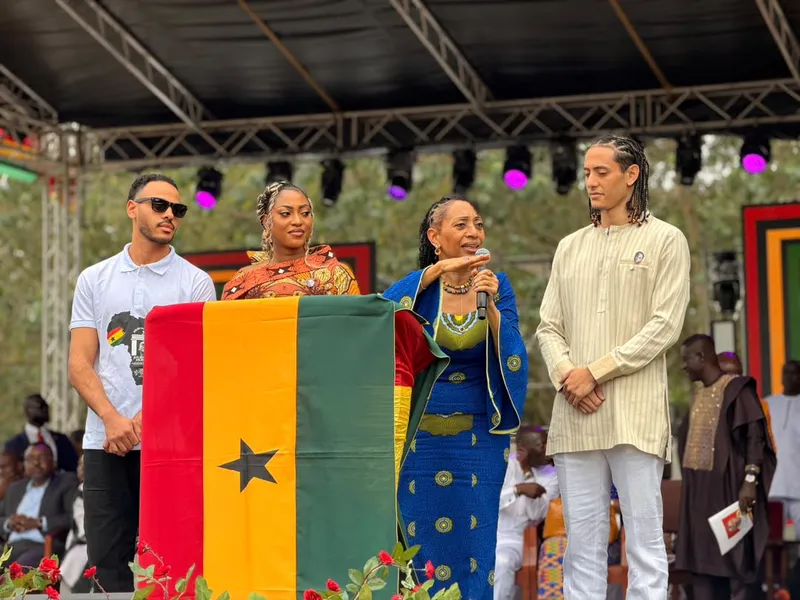 ‘We’ve come back to make sure our father's ideas never die’ – Nkrumah family
 Ghana Jollof: Akosua Manu appeals to Naana Jane to use her influence to free Sal...
 Yellow fever confirmed in Sissala East after 21 mysterious deaths
 Kenyasi man allegedly attacked by prison officers and inmates over yam theft cla...
 Germany’s far-right AfD makes strong gains in two state elections
 Savannah Regional Minister, IGP Yohuno visit Gbindabuor following lynching of po...
 Jehovah's Witnesses make blood component decisions a matter of personal conscien...
 Road contractors fed on contracts for years without completing projects – Alhass...
 Ghana Jollof saga: ‘She has no right to do what she’s doing’ – Inusah Fuseini


