




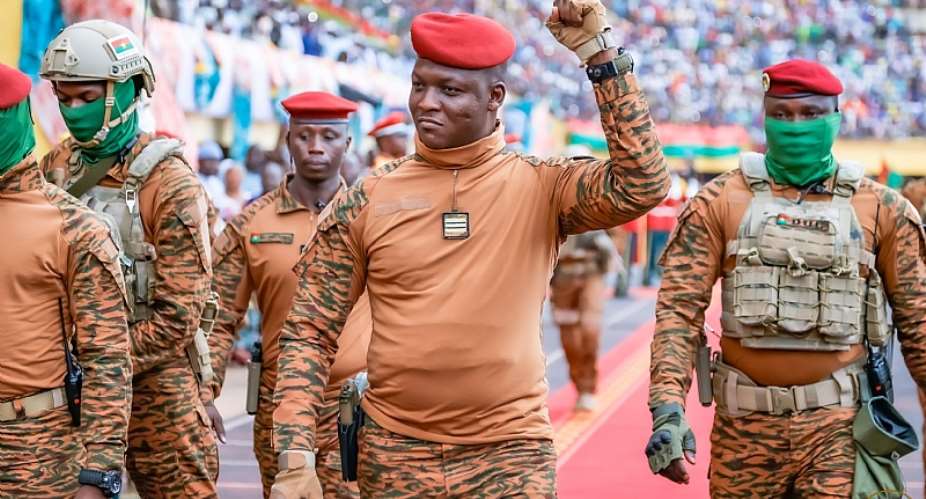
The Young Captain Who Reignited Africa
In a world where leadership often cloaks itself in age and foreign agendas, Burkina Faso has dared to break the mould. It has entrusted its future to a 36-year-old military captain, Ibrahim Traoré, whose fiery vision of independence is rewriting the rules of governance—not just for his landlocked nation, but for Africa and beyond. From Ouagadougou’s vibrant markets to London’s financial hubs, Traoré’s revolution is forcing a global rethink of what sovereignty means in an era still shadowed by neocolonial chains.
Yet, his radical moves—expelling foreign powers, challenging regional institutions, and forging new alliances—carry risks as bold as his ideals. Traoré’s story is one of defiance, but also of navigating a world where freedom comes with a price.
A Torch Lit Amid Turmoil
Traoré’s rise in 2022 was no ordinary shift. Emerging from a maelstrom of jihadist violence and political dysfunction, his military coup—framed by supporters as a “corrective surgery”—alarmed democratic purists. For many Burkinabè, however, battered by years of attacks that killed thousands and governance that enriched elites, Traoré’s beret symbolized resolve.
Drawing on the legacy of Thomas Sankara, the revolutionary assassinated in 1987, Traoré expelled French military bases and voided contracts that bled Burkina Faso’s gold wealth abroad. Western critics decried this as reckless nationalism, but across Africa, millions saw renewal—a rejection of a system where a nation stood on riches yet begged for scraps. From Bamako to Nairobi, his name is a clarion call for dignity.
This defiance has not come cheaply. The withdrawal of French forces left a security gap, with jihadist groups like JNIM exploiting the transition. Traoré has turned to local militias and Russian support, but taming Burkina’s insecurity remains a daunting task (International Crisis Group, 2024).
Sovereignty Over Subservience
Traoré’s creed is simple: a nation’s wealth must serve its people. Over 70% of Burkina Faso’s gold revenues—once siphoned by foreign firms—now fund schools, hospitals, and farms (World Bank, 2025). Foreign aid, often a leash disguised as a lifeline, has been sidelined for self-reliance. Reforms, once scripted by distant technocrats, now pulse with Burkina’s cultural heartbeat.
This shift ripples globally. In London, where commodity markets hum, Traoré’s policies are reshaping trade flows. The International Monetary Fund warns that Africa’s “resistance economies” could redraw global commodity pricing by 2026 (IMF, 2025). Yet, redirecting wealth inward has strained Burkina’s economy, with inflation and supply disruptions testing public resolve. Traoré’s dream of self-reliance is bold, but its endurance depends on navigating these economic headwinds.
Rewiring West Africa
Traoré’s vision is redrawing West Africa’s geopolitical map, challenging the lingering grip of external powers. His moves, however, stir tensions that echo far beyond the Sahel.
The Sahel’s Defiant Alliance
With Mali and Niger, Traoré forged the Alliance of Sahel States (AES), a pact to dismantle neocolonial military bases, reject the CFA Franc, and explore a gold-backed currency (Reuters, 2024). The AES seeks a future free from Western dominance, but its birth has fractured regional unity. The trio’s exit from ECOWAS risks economic isolation and weakens collective defenses against jihadist threats. Supporters see this as a necessary break; critics fear it destabilizes an already fragile region (African Union Commission, 2025).
A Regional Identity Crisis
Burkina Faso’s stance has pushed ECOWAS to a crossroads. Long viewed as a Western-aligned mediator, the organization faces accusations of prioritizing foreign interests over African unity. The suspension of Burkina Faso, Mali, and Niger has deepened this crisis, prompting calls for ECOWAS to reform or risk irrelevance (Chatham House, 2025). Traoré’s challenge raises a broader question: can regional bodies serve Africa without bending to external pressures?
The Eastern Pivot
As Western powers brandish sanctions—France and the US have condemned Traoré’s moves—he has turned eastward. Military ties with Russia, including controversial Wagner Group mercenaries, and Turkey bolster security, while resource deals with China and BRICS invitations signal economic diversification. This pivot challenges the West’s fading dominance, but it’s not without pitfalls. Russia’s involvement sparks human rights concerns, and China’s investments often carry opaque terms. Traoré frames these as pragmatic partnerships, not new masters, but walking this multipolar tightrope demands finesse (Foreign Policy, 2024).
A Flame That Inspires and Divides
Traoré’s spark is catching fire. Mali nationalized its uranium and ousted French troops. Niger grounded US and French drones. Senegal elected a youthful reformist, and Ghana’s youth question dependency models. As Le Monde Diplomatique observed, “Burkina Faso has made sovereignty a strategy, not a slogan.”
The Sahel, often misjudged as barren, brims with gold, uranium (7% of global supply), and rare earth metals. For decades, these riches enriched foreign powers. Traoré’s doctrine is redirecting wealth to development, not corruption (International Crisis Group, 2023). Yet, nationalization has provoked backlash—France has slashed aid, and Western firms have launched legal battles over lost contracts.
Globally, Traoré’s policies are reshaping markets. France’s loss of 40% of its uranium supply has forced the EU to seek new suppliers in East Africa and Central Asia. Africa’s minerals, now open to multipolar bidding, are driving up their value. But sanctions and reduced investment threaten Burkina Faso’s fledgling economy, testing Traoré’s vision.
“Neocolonialism thrives when Africa’s wealth is plundered under the guise of partnership. Traoré’s revolution dares to sever those chains, proving that sovereignty is not granted by foreign hands but forged in the fire of self-determination.”
|Bismarck Kwesi Davis|
The Soul of a New Era
Once dismissed as impoverished, Burkina Faso is now the heartbeat of African independence. Traoré, young but timeless in vision, is more than a leader—he’s a symbol of a generation demanding to dream in their own tongues and govern with their own values.
His path, however, is perilous. Military rule, however popular, raises questions about democratic legitimacy. Security challenges persist, and new alliances bring complexities. From South London’s African diaspora to global policy circles, Traoré’s revolution inspires awe and debate.
This is no fleeting moment. Burkina Faso is a beacon for the Global South, challenging the world to rethink power, justice, and independence. Traoré’s message—that sovereignty is a strategy, not a slogan—resonates from the Sahel to the streets of Brixton. Whether his flame endures will depend on balancing bold ideals with the gritty realities of governance. For now, the captain’s fire burns bright, and the world cannot look away.
References
African Development Bank. (2024). Economic performance and outlook: Burkina Faso country brief. Available at: afdb.orgAfrican Union Commission. (2025). Sovereignty and multipolarity: The Sahel’s shift. Addis Ababa: AUC Publications.
Chatham House. (2025). ECOWAS and the Sahel: A crisis of regional integration. Available at: chathamhouse.org
Foreign Policy. (2024). Russia’s shadow in the Sahel: Opportunity or opportunism? Available at: foreignpolicy.com
International Crisis Group. (2023). Who profits from Sahel’s gold? Resource management and rebellion. Available at: crisisgroup.org
International Crisis Group. (2024). Burkina Faso’s security gamble: Militias and mercenaries. Available at: crisisgroup.org
International Monetary Fund. (2025). Sub-Saharan Africa regional economic outlook: Resistance economies rising. Available at: imf.org
Reuters. (2024, 22 September). Sahel trio mulls gold-backed currency to exit CFA franc. Available at: reuters.com
World Bank. (2025). Burkina Faso economic outlook 2025–2026. Available at: worldbank.org
© Bismarck Kwesi Davis, 2025. All rights reserved.


 Appointment of Emelia Agbenyo as EC deputy chair was well calculated, reasoned –...
 Relief for students as GAUA and TUSAAG call off strike; declare return to work o...
 Who gave Cabinet authority to decide for Ghanaians to join BRICS without parliam...
 Mahama urges Ghanaian businesses to tap CSIR innovations
 Partisan EC appointments could set dangerous precedent — NPP's Kamaldeen
 Winneba: Afenyo-Markin commissions police apartments at Fetteh-Osakam
 Council of State failed Mahama over Emelia Agbenyo’s EC appointment – Prof. Asa...
 CDD‑Ghana: EC Deputy Chair Should Step Down Now
 Family Announces October 23 Memorial Mass for Nana Konadu Agyeman-Rawlings
 Eduwatch Urges Nationwide Audit of Sexual Misconduct in Secondary Schools


