




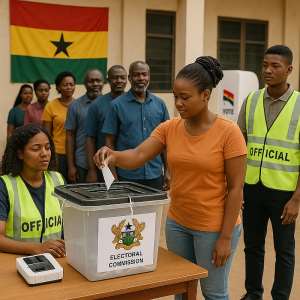
Introduction: A Nation United at a Crossroads
Ghana’s democratic experiment has long been a pillar of national pride and a beacon throughout Africa. Yet our democracy now faces challenges—voter apathy, technological failings, and persistent suspicions of political interference—that threaten to undermine the fairness of our electoral process. The Electoral Commission (EC) must evolve from a mere process facilitator into an institution that guarantees genuine accountability and transparency. This is a call for national unity: a reset that binds every Ghanaian under the shared ideals of justice, equity, and resilience.
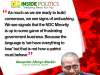
“Democracy is not just the right to vote, but the faith that your vote will count.”— Bismarck Kwesi Davis
||ACCRA||
Ghana’s Electoral Commission (EC), once the cornerstone of our democratic process, now faces significant challenges—from technological shortcomings and transparency deficits to perceptions of partisanship and inadequate voter education. This article, structured as a policy brief, outlines a robust reform agenda:
- Enhance oversight and accountability: Establish an Electoral Ethics Council and intensify Parliamentary oversight.
- Strengthen digital resilience: Pilot blockchain-enabled systems and real-time data dashboards for full transparency.
- Promote inclusivity and voter empowerment: Deploy mobile registration units and launch multilingual voter education campaigns.
- Bolster stakeholder dialogue: Set up regular electoral roundtables and institute annual independent procurement audits.
By adopting these reforms and learning from global best practices, Ghana can reengineer its electoral system to ensure every vote truly counts—uniting the nation as we move toward 2028 and beyond.
A Reality Check: Challenges to Our Electoral Integrity
1. Perceived Partisanship and Distrust
- Challenge: Political appointments perceived as biased have diminished trust.
- Data: Over 60% of citizens believe political partisanship skews EC operations (International IDEA, 2022).
- Implication: National unity demands an impartial system that transcends political divides.
2. Technological and Operational Hurdles
- Challenge: Malfunctioning Biometric Verification Devices (BVDs) hinder accurate voter identification.
- Data: In 2024, more than 1,000 devices failed, especially in rural areas (Ghana EC, 2024).
- Implication: Reliable technology is essential to guarantee that every Ghanaian can vote without impediment.
3. Transparency Deficits
- Challenge: Opaque procurement processes and delayed data release erode accountability.
- Data: Election data is released 15–20 days post-election, well beyond international benchmarks (World Bank, 2023).
- Implication: Immediate access to data is crucial for rebuilding public trust.
4. Inadequate Voter Education
- Challenge: Low electoral literacy among rural and first-time voters stifles participation.
- Data: Only 45% of rural voters accurately understand the voting process compared to 75% in urban centers (International IDEA, 2022).
- Implication: Informed participation is a cornerstone of a vibrant democracy.
5. Stakeholder Marginalisation
- Challenge: Civil society, traditional leaders, and youth voices are not sufficiently engaged.
- Data: Fewer than 30% of these groups are regularly involved in shaping electoral policies (Ghana EC, 2024).
- Implication: Broad stakeholder involvement is essential for a truly inclusive democratic process.
Global Case Studies: Innovations for National Renewal (2025)
Nigeria: Adoption of the BVAS and online result transmission restored public confidence after initial setbacks.
Kenya: Comprehensive post-2017 electoral reforms with judicial oversight and enhanced training improved system credibility.
Estonia: Blockchain technology in elections has set global benchmarks for transparency and security.
Ghana’s Pilot: In 2024, AI-powered facial recognition in select constituencies reduced fraud by 18% and expedited verification by 25%.
These examples illustrate how targeted reforms can restore integrity and unity in electoral systems worldwide—lessons that Ghana is poised to adopt.
Step-by-Step Strategic Guide to Reimagining the Electoral Commission
For a reset that guarantees fairness and nurtures national unity, the following actions are essential:
| Strategic Pillar | Action Steps & Timeline |
|---|---|
| Electoral Trust | - 2025-2026: Establish an Electoral Ethics Council with retired judges, clergy, and academics. - 2026: Institute mandatory conflict-of-interest disclosures and enhance Parliamentary oversight through Article 70 amendments. |
| Digital Resilience | - 2025: Initiate studies for blockchain-based electoral systems. - 2027: Pilot blockchain-enabled results transmission in selected regions to ensure data integrity and reduce fraud. |
| Inclusivity & Access | - 2025: Deploy mobile “rural registration buses” across all regions. - 2025-2026: Launch multilingual “Know Your Vote” campaigns to increase voter education by 30% by 2027. |
| Transparency & Education | - 2025: Develop and launch an open EC data dashboard for real-time election results and procurement details. - 2026: Implement a Real-Time Electoral Finance Disclosure Law. |
| Stakeholder Dialogue | - 2025: Initiate quarterly roundtables with political parties, CSOs, traditional leaders, and youth. - 2026: Publish annual consolidated reports from these engagements, coupled with independent procurement audits. |
Proposed Legal and Institutional Reforms
Enhanced Parliamentary Oversight: Amend Article 70 to require a Parliamentary Committee to vet the EC Chairperson, ensuring greater neutrality.
Real-Time Financial Transparency: Enact legislation by 2026 for continuous disclosure of electoral funding and expenses.
Mandated Annual Audits: Require independent, publicly available audits of all EC procurement processes.
Conclusion: Charting a National Future of Unassailable Democracy
Ghana must reframe elections as integral milestones in our shared democratic journey—not as isolated events. Through the comprehensive reforms outlined above, the reimagined Electoral Commission will stand as a beacon of fairness, accountability, and national unity. As we look ahead to 2028 and beyond, it is imperative that our electoral processes reflect the aspirations of a united Ghana, where every vote resonates with the promise of a just and prosperous future.
Together, we can ensure that our democratic system is as resilient as it is inclusive—a true testament to Ghanaian unity and national pride.
References
Ghana Electoral Commission. (2024). Post-Election Operational Report. Accra: EC Publications.
International IDEA. (2022). Global State of Democracy Report. Stockholm.
World Bank. (2023). Digital Democracy and Electoral Integrity. Washington, D.C.: World Bank Group.
INEC Nigeria. (2023). BVAS Impact Report. Abuja.
Estonian E-Governance Academy. (2022). Blockchain in Elections. Tallinn.

 Abu Trica's mansion, Lamborghini, Cybertruck among assets seized in alleged $8m ...
 Suspected drug-impaired motorbike rider found motionless in middle of road
 July 15: Cedi sells at GHS12.25 on forex market, GHS11.52 on BoG interbank
 Police must track down fugitive Bole SHS teacher — Education Ministry on alleged...
 Mayor did not compare KMA and Zoomlion sweepers' pay in Manasseh's interview — K...
 Constitutional reforms must unite Ghanaians, not deepen divisions — Barker-Vorma...
 There was no discussion of GH¢55 million during my EOCO detention — Miracles Abo...
 If the EOCO arrest was to break me, it has failed — Miracles Aboagye after relea...
 NPP eulogises late Yaa Naa Abukari Mahama II, extends condolences to Dagbon
 Kenya denies Rastafarians the right to smoke weed

