




Introduction
ACCRA- Ghana; A Roadmap or a Rough Patch?
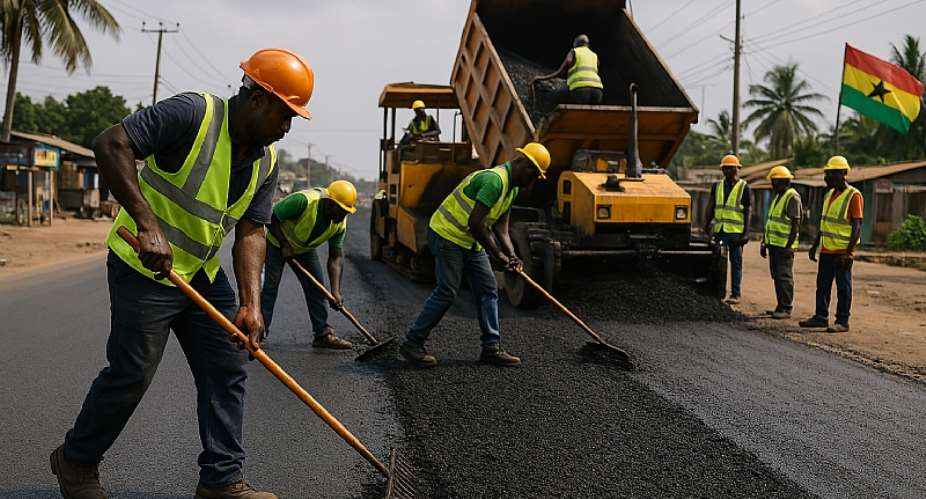
In Ghana, every election year is paved with promises—and occasionally, a few kilometres of actual road. From dusty feeder routes in Dormaa to the pothole symphonies of Adenta, our road infrastructure has become a metaphor for ambition unmet.
Ask the average Ghanaian what the Ministry of Roads and Highways does, and you might hear: “They start roads, but finishing is a spiritual gift.”
Yet, in a growing economy seeking to industrialize, digitalize, and export, roads are not just conveniences—they are the arteries of national transformation. The Ministry must evolve from a contract-heavy, bitumen-thirsty agency into a strategic infrastructure leader, delivering resilient, inclusive, and climate-conscious transportation systems.
Current State of Ghana’s Road Infrastructure
Only 13% of Ghana’s 78,000 km road network is paved, with major gaps in rural connectivity (Ministry of Roads & Highways, 2023).
The cost of road maintenance due to delayed repairs is estimated at over GHS 3 billion annually. Many contractors abandon projects due to delayed payments and lack of transparent project tracking systems.Urban congestion in Accra and Kumasi leads to an average loss of 4.6 hours per commuter weekly, reducing economic productivity.
Core Challenges
1. Over-Politicization of Road Projects
Road construction is often driven by electoral calendars rather than strategic economic planning, leading to uneven development and project duplication.
2. Poor Contractor Accountability
Several road contracts are awarded without robust performance monitoring systems, leading to shoddy workmanship and abandoned projects.
3. Unsustainable Funding Models
Heavy reliance on external borrowing and short-term loans has led to debt accumulation without sustainable infrastructure management.
4. Climate Vulnerabilities
Flood-prone areas like Weija, Cape Coast, and Tamale suffer from poorly engineered roads that wash away annually, costing millions in repairs.
Policy Reset:
A 5-Step Recovery Roadmap
1. Launch the National Infrastructure Transparency Portal (NITP)
Modeled after Kenya’s Open Contracting Data Standards (OCDS), this platform would publish real-time data on road projects—budgets, timelines, contractors—accessible to all citizens.
2. Decentralize Road Prioritization to Metropolitan and District Assemblies
Empower MMDAs to conduct local infrastructure audits and allocate resources based on productivity, not politics.
3. Create a Climate-Resilient Roads Task Force
Integrate engineers, environmental scientists, and hydrologists to develop climate-proof road designs, using lessons from Bangladesh and the Netherlands.
4. Introduce a Road Bond Framework on the Ghana Stock Exchange
Allow institutional investors and the diaspora to fund long-term strategic highways, backed by toll revenue and asset-backed guarantees.
5. Automate Contractor Grading and Payments
Deploy an AI-based system to track contractor performance, milestones, and quality—automating payments only upon verified delivery.
Case Study: Ethiopia’s Integrated Road Development Program (IRDP)
Ethiopia built over 120,000 km of rural roads between 2000 and 2020, linking over 80% of agricultural communities to markets. This success was due to decentralized planning, consistent funding from fuel levies, and strong donor coordination (World Bank, 2022). Ghana can adapt this model to prioritize productivity-linked road investments.
2025 Roads Projections
Central Region
Kasoa–Winneba–Cape Coast Dualisation: This project is being executed in three phases:Phase 1: Kasoa to Winneba (construction commenced in late 2024).
Phase 2: Winneba Roundabout to Mankessim Roundabout.
Phase 3: Mankessim to Cape Coast.
These subsequent phases are planned under the government's "Big Push" infrastructure program
Yamoransa–Praso Road and Cape Coast–Twifo Praso Road: These routes are also prioritized for upgrades to improve regional connectivity .
Ashanti Region
Healthcare Access Roads: To support the Agenda 111 health facilities, the government is reconstructing roads to improve access to healthcare services. Key projects include:
6 km of Emena–Apiadu–Donyina Feeder Roads.
3.3 km of Appiadu–Apromase Feeder Roads.
25 km of critical access roads within the Oforikrom, Ejisu, and Bosomtwe Districts
Western Region
Tarkwa–Bogoso–Ayanfuri Road: A 94.4 km road project is underway to connect these key mining towns, aiming to boost economic activities in the region
National Infrastructure Investment
2025 Budget Allocation: The government has earmarked GH¢13.85 billion for infrastructure development, focusing on roads, hospitals, and schools. This includes the expansion of major highways like the Accra–Kumasi Highway and the construction of key interchanges in Accra and Kumasi
These projects reflect Ghana's commitment to improving its transportation infrastructure, which is vital for economic growth and access to essential services.
In 2025, Ghana is undertaking several major road projects aimed at enhancing transportation, trade, and access to essential services across the country. Here are some of the key initiatives:
Conclusion:
From Potholes to Pathways
To reset the Ministry of Roads and Highways is to reset the foundation of national progress. Roads connect not just cities—but opportunities, dreams, and futures. A smart, transparent, climate-conscious ministry can turn Ghana into a logistics hub, linking rail, ports, and highways into a seamless trade corridor.
Let us not pave the road to the future with broken promises—but with durable asphalt, equity, and vision.
"In Ghana, we don’t just fix roads—we fix futures. A tarred road to a forgotten village is a paved path to national dignity."
— Bismarck Kwesi Davis
References
Ministry of Roads and Highways. (2023). Annual Sector Report. Accra: Government of Ghana.
World Bank. (2022). Ethiopia’s Road Sector Development: 20 Years of Progress. Washington, DC: World Bank Publications.
Ghana Statistical Service. (2023). Urban Mobility and Commuter Productivity Report. Accra: GSS.

 'Some NPP members did not vote in 2024 election because I left NPP' – Alan Kyere...
 How €225 million cocaine from Ghana traced to fugitive Dutch drug kingpin based ...
 'Galamsey remains an existential threat' – Gyampo demands more action
 'I’m like Akpeteshie, I don’t need adverts to win' – Hawa Koomson storms home tu...
 'Excessive bail conditions must be reviewed' – GBA President
 Ketu South: Four-year water crisis deepens hardship in Agbozume
 Show evidence of higher operating costs to justify fare hike – NPA CEO to transp...
 Four Ghanaians arraigned over alleged €225 million cocaine shipment to France
 Agbogbloshie: Police kill suspected robber, recover AK-47, 186 rounds of ammunit...
 DVLA opens 29 new offices in 18 months; 62 offices nationwide - CEO


