




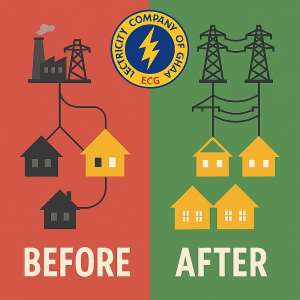
Introduction
Electricity is the lifewire of modern economies. In Ghana, it powers industries, sustains businesses, and fuels daily life. Yet, for decades, the Electricity Company of Ghana (ECG)—the nation's primary power distributor—has been synonymous with inefficiency, financial mismanagement, and service unreliability. The persistent power outages, billing inconsistencies, and operational challenges have turned ECG into a symbol of systemic dysfunction rather than national progress.
This case study dissects ECG's structural inefficiencies, governance failures, and financial woes while proposing a practical roadmap for reform.
Historical Context
The Electricity Company of Ghana traces its roots back to the colonial-era Electricity Department in 1947. Over the decades, ECG has undergone several transformations, evolving into a state-owned enterprise tasked with distributing power across Ghana. However, its monopoly status, combined with weak regulatory enforcement, has allowed inefficiencies to fester.
Despite multiple restructuring efforts—including attempted private-sector participation through the Millennium Challenge Compact (MCC)—ECG remains plagued by systemic inefficiencies. The failure of the Power Distribution Services (PDS) concession agreement in 2019 highlighted deep-rooted governance and contractual management issues, setting the company back in its modernization agenda.
Current Performance: Ailing Infrastructure, Billing Controversies, and Revenue Losses
1. Technical and Commercial Losses
ECG suffers from excessive power losses, a major contributor to its financial instability. Technical losses arise from outdated infrastructure and inefficient transmission lines, while commercial losses stem from power theft, faulty metering, and non-payment by consumers—including government institutions. As of 2023, ECG’s aggregate losses hovered around 30%, far above the 10–15% industry standard.
2. Cash Flow Crisis and Debt Burden
ECG remains heavily indebted to power producers such as the Volta River Authority (VRA) and Independent Power Producers (IPPs). The company’s inability to recover revenue from consumers has created a liquidity crisis, leading to mounting debts that threaten the entire energy value chain. In 2022, ECG owed IPPs over $1 billion, forcing power producers to threaten supply cuts.
3. Billing System and Customer Discontent
Over the years, ECG has faced widespread criticism for inaccurate billing, poor customer service, and a lack of transparency in its revenue collection processes. The introduction of smart meters and digital payment solutions has not fully addressed these concerns, with customers frequently reporting arbitrary bill increases and inconsistencies.
4. Institutional Inefficiency and Political Interference
ECG’s governance is hampered by excessive political interference, bloated management structures, and a lack of performance-based accountability. Successive governments have used the entity for political patronage rather than operational excellence, leading to unstable leadership and policy inconsistency.
Accountability and Governance Challenges
The ECG’s governance framework is weak, allowing inefficiencies to persist without serious consequences. The absence of an independent regulatory body with full enforcement powers enables the company to operate without strict performance oversight. Additionally, the lack of public-private partnerships (PPPs) has limited ECG’s ability to innovate and attract investment.
Global Comparisons: Learning from Others
1. Rwanda’s Energy Sector Reforms
Rwanda successfully restructured its power sector by unbundling electricity generation, transmission, and distribution, creating a competitive landscape that improved service delivery and financial sustainability. The country’s approach to digitization, transparent billing, and loss reduction offers key lessons for ECG.
2. Kenya’s Public-Private Model
Kenya Power, the country’s main electricity distributor, has leveraged public-private partnerships (PPPs) to reduce losses and modernize its infrastructure. ECG could benefit from a similar model, attracting private sector efficiency while maintaining public ownership.
3. South Africa’s Eskom Crisis and Reform Efforts
South Africa’s Eskom, like ECG, has faced financial instability and mismanagement. Recent efforts to decentralize its operations and promote renewable energy investment provide useful insights into how Ghana can address its power sector challenges.
A Roadmap for Reform: Fixing ECG for a Sustainable Future
Decentralization and Restructuring – ECG should be partially unbundled into smaller, regionally managed units to enhance operational efficiency and accountability.
Loss Reduction Strategy – Invest in smart grids, real-time monitoring, and aggressive anti-power-theft measures to cut technical and commercial losses.
Debt Restructuring and Financial Transparency – ECG must enforce strict revenue collection, including compelling government institutions to pay their electricity bills.
Independent Regulatory Oversight – Establish a truly independent energy regulator with enforcement power to hold ECG accountable.
Public-Private Partnerships – Introduce a controlled PPP model that allows private investment while maintaining government oversight.
Renewable Energy Integration – Shift towards decentralized solar and wind energy solutions to ease reliance on traditional grid infrastructure.
Conclusion:
A Call for Bold Action
The inefficiencies at ECG are not just an inconvenience; they are a major obstacle to Ghana’s economic growth. Fixing ECG is not a political option—it is an economic necessity. Without bold reforms, Ghana’s power sector will continue to drain public resources, suffocate businesses, and frustrate citizens.
The time for action is now. Ghana deserves a power sector that works for its people, not against them.
Bismarck Kwesi Davis
#ResettingGhanaSeries
#FactoryReset
#TheChangeJar
#DiamondInstitute
#bismarckinspires
#Q2M4/D2/2025

 'Some NPP members did not vote in 2024 election because I left NPP' – Alan Kyere...
 How €225 million cocaine from Ghana traced to fugitive Dutch drug kingpin based ...
 'Galamsey remains an existential threat' – Gyampo demands more action
 'I’m like Akpeteshie, I don’t need adverts to win' – Hawa Koomson storms home tu...
 'Excessive bail conditions must be reviewed' – GBA President
 Ketu South: Four-year water crisis deepens hardship in Agbozume
 Show evidence of higher operating costs to justify fare hike – NPA CEO to transp...
 Four Ghanaians arraigned over alleged €225 million cocaine shipment to France
 Agbogbloshie: Police kill suspected robber, recover AK-47, 186 rounds of ammunit...
 DVLA opens 29 new offices in 18 months; 62 offices nationwide - CEO



Comments
Nice piece!!