




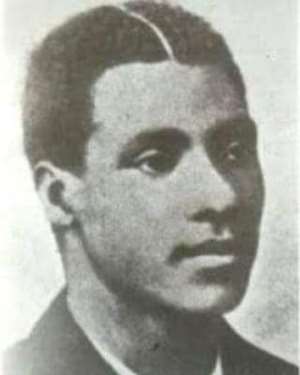
George Ekem Ferguson (14 July 1864 – 7 April 1897) was a remarkable Fante cartographer, surveyor, and civil servant whose contributions to the Gold Coast (modern-day Ghana) laid the groundwork for the nation’s territorial integrity and eventual independence. Despite his untimely death, Ferguson’s work in mapping, treaty negotiations, and fostering unity among diverse communities remains a cornerstone of Ghana’s history.
Early Life and Education
Born in Anomabo, a coastal town in the Central Region of Ghana, Ferguson was raised in a family that valued education and service. He attended primary school in Cape Coast before continuing his studies at the prestigious Wesleyan Boys High School in Freetown, Sierra Leone. There, he excelled in subjects such as mathematics, geography, and surveying, which would later define his career.
Ferguson’s academic brilliance earned him a government scholarship to study at the Royal School of Mines in London. During his time in England, he specialized in mining, geology, surveying, and astronomy, graduating with a First-Class diploma. His education equipped him with the skills to navigate the complex political and geographical challenges of the colonial era.
Career and Contributions
Upon his return to the Gold Coast in 1890, Ferguson joined the colonial service as a surveyor and cartographer. His work was instrumental in delineating the boundaries of the Gold Coast, particularly in the northern territories and areas that later became Trans-Volta Togoland. Ferguson’s maps were not only technical achievements but also tools for diplomacy, helping to resolve disputes and secure treaties with local chiefs.
One of Ferguson’s most notable achievements was his role in negotiating treaties with chiefs in the northern territories. His ability to communicate in multiple local languages and his deep understanding of indigenous cultures made him an invaluable asset to the British colonial administration. These treaties were crucial in preventing French and German encroachment, ensuring that regions like Wa and parts of the Volta Region remained within the Gold Coast.
Ferguson’s work extended beyond cartography and diplomacy. He was a vocal advocate for the abolition of human sacrifices and other inhumane practices, using his influence to promote social reforms. His efforts to unite diverse communities under a common cause laid the foundation for the territorial integrity that Ghana enjoys today.
Tragic Death and Legacy
Ferguson’s life was tragically cut short in 1897 when he was killed by slave raiders near Wa. His death marked the loss of a visionary whose contributions to the Gold Coast were unparalleled. Despite his relatively short life, Ferguson’s work has had a lasting impact on Ghana’s history.
His maps and treaties continue to be referenced in historical and geographical studies, and his role in shaping the boundaries of modern Ghana cannot be overstated. Ferguson’s contributions were instrumental in ensuring that the Gold Coast remained a cohesive entity, paving the way for its eventual independence in 1957.
A Call to Honor His Legacy
Given George Ekem Ferguson’s silent yet profound contributions to Ghana’s independence, it is fitting to honor his memory in a meaningful way. One recommendation is to rename the University for Development Studies (UDS) in Northern Ghana after him. This institution, with its focus on development and education in underserved regions, aligns perfectly with Ferguson’s legacy of service and unity.
Renaming UDS as the George Ekem Ferguson University for Development Studies would not only preserve his memory but also inspire future generations to value the principles of integrity, unity, and service that he embodied. Such a gesture would be a fitting tribute to a man whose work quietly but significantly shaped the destiny of Ghana.
President John Dramani Mahama, known for his commitment to honoring Ghana’s history, could take this initiative to ensure that Ferguson’s contributions are recognized and celebrated. This act would cement Ferguson’s place in the annals of Ghanaian history as a silent yet indispensable contributor to the nation’s independence and development.
You can find images and more information about George Ekem Ferguson on the following pages:
1. [Wikipedia - G. E. Ferguson](https://en.wikipedia.org/wiki/G._E._Ferguson)
2. [George Ekem Ferguson: Designer of the Map of Ghana](https://ghanaeducation.org/george-ekem-ferguson-the-designer-of-the-map-of-ghana/)
These sources provide visuals and detailed accounts of his life and contributions.
Retired Senior Citizen
Teshie-Nungua

 No room in our standing orders for reconsideration of anti-LGBTQ+ Bill – Sam Geo...
 Court threatens to struck out Mamprobi Baby theft case over disclosure delays
 How ex-convict allegedly sealed teenager's mouth with super glue, raped and murd...
 About 70% of buildings in Ada East lack permits, to be demolished – DCE
 Accra will no longer be sanctuary for indiscipline — Linda Ocloo declares after ...
 Bono Region: Police investigate murder of retired veterinary officer
 GMA says no emergency patient was denied care at KATH despite congestion concern...
 VIDEO: Fuel tanker driver burnt to death in fiery crash at Adubinso, seven shops...
 IMF boosting financial support for four African nations over war impact
 Anti-LGBTQ+ bill: Public clash between Speaker Bagbin and Majority Leader needle...


