




Abstract
One surety to motivate people to consume cassava pasta could massively be made a reality if consumers have a fair idea about the nutritional components of pasta made from tubers. The main objective of the study was to produce pasta from agra bankye and esam bankye, assess their physicochemical properties and compare their results to wheat flour. The experimental research design was used to produce agra and esam bankye flour and a formulation ratio was derived to produce three different pasta. Duplicate samples were physicochemically assessed to ascertain the proximate and mineral components. Data was analysed to unearth the nutritional status of the three samples. A formulation ratio of flour: egg: salt: water with slight variation was used to produce pasta from agra bankye, esam bankye and hard flour. The three samples of pasta all contain moisture, ash, total fat, protein, crude fibre, total carbohydrate, energy, iron, calcium, starch and manganese. All people who require higher intake of ash should consume more agra bankye pasta. The higher intake of esam bankye pasta provides consumers with crude fibre, total carbohydrate, starch, calcium and iron. The higher moisture reduces the lifespan of hard flour, whilst consumers requiring higher fat, protein and manganese ought to consume the old age pasta made from hard flour. Consumption of traditional pasta from cassava (bankye) should be produced on a large scale for the masses.
Keywords: Cassava, Convenience food, Nutrients, Pasta, Tubers, Wheat flour
- Introduction
Cassava (Manihot esculenta Crantz.) is a starch-rich storage root described as a major food staple in Africa, and also provides calories for almost half a billion people worldwide (Ferguson, Shah, Kulakow & Ceballos, 2019). Africa contributes 61% of global cassava production (Li, 2019) and is clonally propagated through stem cuttings within a period of 12 months (Ferguson, et al., 2019). Similarly, cassava production in Africa for 2018, confirmed that around 12.3% is produced in Ghana annually (FAOSTAT, 2019; Otálora, Garces-Villegas, Chamorro, Palencia & Combatt, 2024). In Ghana, the cultivation of cassava started around the mid 18th century along the trading ports, castles, and forts as that was the major food for the Portuguese and their slaves. Gradually, the cultivation spread along the coastlines of Ghana and became a staple food (Acheampong, Danquah, Agyeman Dankwa & Addison, 2021). Cassava, being ranked 6th globally in terms of value, contributes about 22% and 30% to the Agricultural Gross Domestic Product (AGDP) and again, forms part of daily calories intake of Ghanaians (FAO, 2018, Ministry of Food and Agriculture (MoFA), 2019).
Nutritional Components of Cassava
The cassava plant is described as a nutritious tuber which contains major energy giving foods as well as minor protective and body building foods. The approximate composition of carbohydrates, protein, vitamins, and minerals of cassava root and the values are calculated for every 100 g (Dresden, 2021; Montagnac, et al., 2009; Otálora, et al., 2024). Cassava roots food energy (kcal) 110 – 149, Moisture (ml) 45.9 – 85.3, Dry weight (g) 29.8 – 39.3, Carbohydrates (g) 25.3 – 35.7, Protein (g) 0.3 – 3.5, Lipid (g) 0.03 – 0.5, Dietary fiber (g) 0.1 – 3.7, Ash (g) 0.4 – 1.7, Thiamin (mg) 0.03 – 0.28, Riboflavin (mg) 0.03 – 0.06, Niacin (mg) 0.6 – 1.09, Ascorbic acid (mg) 14.9 – 50.0, Vitamin A (μg) 5.0 – 35.0, Calcium (mg) 19 – 176, Phosphorus (mg) 6 – 152, Iron (mg) 0.3 – 14.0, Potassium (mg) 0.25 – 0.72, Magnesium (mg) 0.03 – 0.08, Copper (ppm) 2.00 – 6.00, Zinc (ppm) 14.00 – 41.00, Sodium (ppm) 76.00 – 213.00, Manganese (ppm) 3.00 – 10.00.
Types of Cassava in Ghana and their Characteristics
Over the years, there have been a lot of Agricultural programs and projects that have brought about the development and release of (25) new cassava varieties (Acheampong et al., 2021; Dankwah & Peprah, 2019; Owusu & Donkor, 2012).
Table 1. Types of Cassava Cultivated in Ghana and their Characteristics
| Variety | Year Released | Maturity Period (Months) | Mean Root Yield (T/ha) | Total Dry Matter (%) | Uses | CMV Resistance |
|---|---|---|---|---|---|---|
| Afisiafi | 1993 | 12-15 | 28-35 | 32 | Starch, flour, gari | Tolerant |
| Abasafitaa | 1993 | 12-15 | 29-35 | 35 | Starch, flour, gari | Tolerant |
| Tekbankye | 1997 | 12-15 | 30-40 | 30 | fufu, gari, ampesi | Susceptible |
| Dokuduade | 2005 | 12 | 35-40 | 30 | Starch, gari | Resistant |
| Agbelifia | 2005 | 12 | 40-45 | 33 | Starch, gari | Resistant |
| Esam bankye | 2005 | 12 | 40-50 | 35 | Flour, gari | Resistant |
| Bankye hemaa | 2005 | 9-12 | 40-50 | 32 | Flour, gari, fufu | Resistant |
| Capevars bankye | 2005 | 9-12 | 30-35 | 30 | Flour, gari, fufu, starch | Resistant |
| Bankye botan | 2005 | 12-15 | 25-30 | 28 | Flour, gari, starch | Tolerant |
| Eskamaye | 2005 | 15-18 | 16-23 | 25 | Tuo, konkonte | Tolerant |
| Filindiakong | 2005 | 15-18 | 16-20 | 28 | Tuo, konkonte | Tolerant |
| Nyerikobga | 2005 | 15-18 | 17-29 | 30 | Tuo, konkonte | Tolerant |
| Nkabom | 2005 | 12-15 | 28-32 | 32 | Starch, fufu | Tolerant |
| IFAD | 2005 | 12-15 | 30-35 | 30 | Starch, fufu | Tolerant |
| Ampong | 2010 | 12 | 40-50 | 36 | Flour, fufu, Starch, | Resistant |
| Broni Bankye | 2010 | 12 | 40-45 | 33 | Flour, bakery products | Resistant |
| Sika bankye | 2010 | 12 | 40-45 | 36 | Flour, Starch | Tolerant |
| Otuhia | 2010 | 12 | 35-40 | 39 | Flour, Starch | Resistant |
| CRI-Duade Kpakpa | 2015 | 12-15 | 60 | 37 | Poundable, Flour, starch | Resistant |
| CRI-Amansan bankye | 2015 | 12 | 57 | 38 | Flour and bakery products | Resistant |
| CRI-AGRA bankye | 2015 | 12 | 63 | 32 | Starch, flour | Resistant |
| CRI-Dudzi | 2015 | 12 | 49 | 38 | Starch, Flour | Resistant |
| CRI- Abrabopa | 2015 | 12-15 | 46 | 40 | Hi-starch | Resistant |
| CRI- Lamesese | 2015 | 12 | 50 | 39 | Poundable, Beta-Carotene, Flour | Tolerant |
Source: Acheampong et al., 2021; Dankwah & Peprah, 2019; Owusu & Donkor, 2012
The uses of cassava as seen in Table 1 revealed that some types could be used for flour products that require starchy consistency. Agra bankye and esam bankye mostly cultivated in Kumasi, Fumesua possesses features like Hard Flour which is the fundamental raw material for pasta production. In-depth knowledge of their chemical composition is of paramount importance for dietary assessment, nutritional planning, and food quality assurance. This study endeavours to undertake a meticulous and comprehensive chemical analysis of these products, delving into their essential nutritional components. Furthermore, the study aimed to contribute to the existing body of knowledge by conducting a systematic comparison of the obtained results with prior research findings (Owusu & Donkor, 2012). The specific objectives of the study were to analyse the compositional and nutritional values of cassava dough as an indigenous tuber and flour. Through this approach, we seek to elucidate the nuanced nutritional aspects of these culinary essentials, providing valuable insights for both consumers and professionals in the fields of food science and nutrition.
Agra bankye, known for its versatility in culinary applications, holds a special place in many regional cuisines (Owusu & Donkor, 2012). Similarly, esam bankye is celebrated for its nutritional attributes and widespread consumption. In parallel, hard flour plays a pivotal role in baking and food preparation (Obeng Dankwa, Yu-Jiao & Zhi-En, 2017). The detailed chemical assessment of these products promises to uncover a wealth of information regarding their nutritional composition, offering a holistic view of their dietary value and potential health implications (Obeng et al., 2017).
Given the global prevalence of these food items and their significance in everyday diets, it is imperative to employ rigorous scientific procedures to ascertain their precise chemical constituents. The utilisation of established analytical protocols ensures the reliability and accuracy of our findings. Duplicate measurements have been incorporated into the research design to fortify the robustness of the results, enhancing their credibility in real-world dietary contexts.
In addition to the analytical aspect of the study, a critical measurement lies in the comparative analysis of our results with prior research endeavours (Owusu & Donkor, 2012). By contextualising the findings within the broader scientific discourse, the aim is to uncover any variations in nutritional composition attributable to regional differences, processing techniques, or other factors. This comparative perspective enriches the understanding of these food products and provides a basis for informed dietary choices, product development, and nutritional planning.
Several new varieties of cassava which have their own unique maturity period, uses and resistance needed for alternative food production is available (Acheampong et al., 2021), however, some local species have scarcely been researched, although they exhibit their own condition of versatility (Aristizábal, García & Ospina, 2017). Promotion of a specific variety of only local cassava flour used as a replacement for wheat flour for the production of pasta has been under research and so ought to be investigated. Similarly, the assessment of the physicochemical parameters would help marketers to promote pasta made from 100% local cassava. Furthermore, one surety to motivate people on the intake of cassava pasta could massively be made a reality if consumers have a fair idea on the nutritional contents. The main objective of the study was to produce pasta from agra bankye and esam bankye, assess their physicochemical properties and compare their results to wheat flour.
2. Materials and Method
The experimental research design used for the study focused on the formulation ratio required for pasta production using two types of cassava and hard flour as the constant. Samples of agra bankye and esam bankye were purchased from Fumesua in the Ashanti Region of Ghana whilst hard flour, egg and salt were procured from local markets in Takoradi within the Western region of Ghana. In order to ensure the representativeness of the three pasta samples, duplicate samples of each product were obtained to account for potential variations in nutrient composition. These samples were transported to the laboratory for the assessment of the physicochemical assessment under controlled conditions to prevent degradation or contamination.
2.1 Recipe for the Production of Pasta
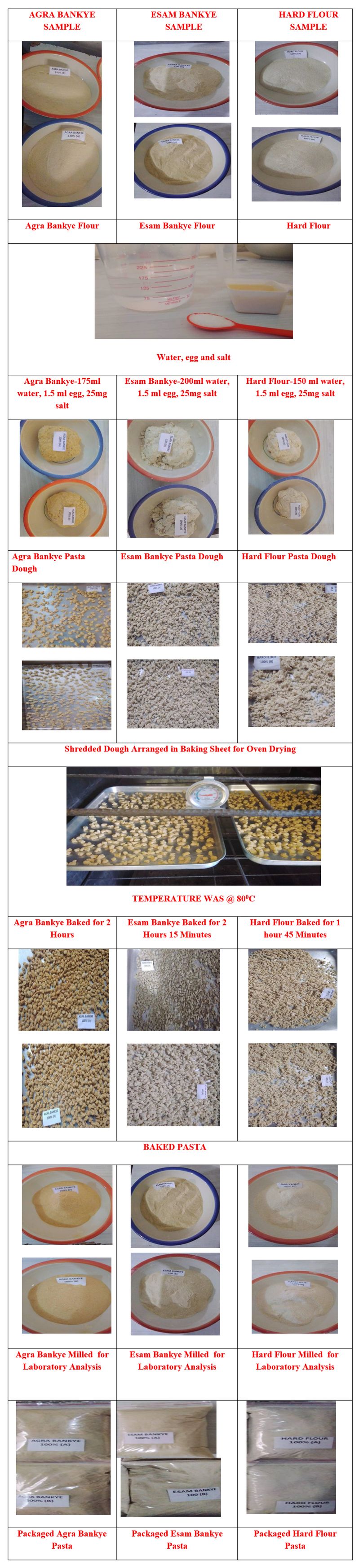
Agra bankye and esam bankye were thoroughly washed, peeled, grated onto a baking sheet and oven-dried at 100⁰С for one hour and one hour fifteen minutes respectively to remove moisture. As the product turned crispy, it was removed, allowed to cool to room temperature and milled to achieve the flour needed for pasta production. This recipe was adapted from (Agbaeze et al., 2020); (Lagnikaet al., 2019) ; (Elisabeth, Utomo, Byju & Ginting, 2022) and (Kusumayanti et al., 2015) with some modifications. According to the aforementioned authors, the grated cassava was soaked for sometime, before extracting the juice, sun- dried followed by the oven-dried methods. For agra bankye and esam bankye, the product is more starchy and less fibrous with minimal water contents, hence extraction of water using the above-mentioned methods was impossible.
The production of flours from the two samples namely agra bankye and esam bankye compared to hard flour were processed into pasta using three main ingredients: eggs, salt and water. Due to their different properties, the quantity of water required to form the stiff dough varied as well as their drying period. The recipe was adopted with modification from Agbaeze, et al., (2020) who combined a different proportional ratio of cassava flour and African yam bean flour bound with water to produce the pasta. According to Purwadi, Teguh and Mazaya (2021), the preferred combination was 80% cassava and 20% African yam bean flour, and also for excellent production of pasta and noodles requires the addition of the cassava flour, egg and water mixed in the noodles machine.
Table 2. Types of Flour Used for Pasta Production
| Type of Flour Ingredients | AGRA BANKYE 400 grams | ESAM BANKYE 400 grams | HARD FLOUR 400 grams |
|---|---|---|---|
| Egg | 1.5ml | 1.5ml | 1.5ml |
| Salt | 25mg | 25mg | 25mg |
| Water | 175ml | 200ml | 150ml |
| Temperature | 800C | 800C | 800C |
| Duration used for drying | 2 hours | 2 hours 15 minutes | 1 hour 45 minutes |
Source: Researchers Construct , 2023
Adapted from: Agbaeze, et al., (2020) & Purwadi et al., (2021)
Procedure for Pasta Production from Agra Bankye, Esam Bankye and Hard Flour
- Pour samples into different bowls and add salt
- Bind the flour with egg and water to form a dough.
- On a clean flat surface knead the dough and allow it to rest.
- Grate or shred the dough to get fine granules or strips.
- Arrange it on a baking sheet and dry it in an oven until it is crunchy.
Table 2: Pictorial View of Pasta Production
Source: Researchers Construct, 2023
2.2 Assessment of Nutritional Contents
Quality Control: To ensure the accuracy and precision of the analytical methods, quality control measures were implemented throughout the analysis. These included the use of certified reference materials (CRMs) for instrument calibration, blank samples to account for potential contamination, and replicate analyses for selected samples to assess method precision. The laboratory equipment and analytical procedures adhered to established standards and protocols.
2.2.1 Iron Content: The iron content of each product was determined using the atomic absorption spectroscopy (AAS) method. A representative subsample (approximately 5g) of each product was accurately weighed into a digestion flask. To this, concentrated nitric acid (HNO3) was added to facilitate mineralization. The mixture was then heated to near dryness on a hot plate, followed by the addition of hydrogen peroxide (H2O2) to complete the digestion process. The resulting solution was cooled, quantitatively transferred into 1L volumetric flask, and diluted with deionized water to the mark. Iron concentration was measured using an AAS instrument calibrated with standard iron solutions.
2.2.2 Calcium Content: The calcium content of each product were determined by complexometric titration with ethylenediaminetetraacetic acid(EDTA) as a titrant. A representative subsample (exactly 2g) of each product was weighed in a beaker and a known volume of deionized water was added slowly to dissolve the subsample. A few drops of a suitable indicator (e.g., murexide) was added, and the solution titrated with EDTA solution until the endpoint color change attained. The calcium concentration was calculated using the mole ratio concept of the balanced equation.
2.2.3 Starch Content: The starch content of each product was determined using the enzymatic hydrolysis method. A representative subsample (exactly 1g) of each product was weighed into conical flasks, and an amylase enzyme solution was added to initiate the hydrolysis of starch into reducing sugars and the mixture allowed to stay for sometime. The mixture was incubated at a specified temperature for a predetermined time. After hydrolysis, the reaction was terminated, and the reducing sugars were quantified using a colorimetric method, such as the dinitrosalicylic acid (DNS) assay. Starch content was calculated based on the amount of reducing sugars produced.
2.2.4 Manganese Content: The manganese content of each product was determined using the inductively coupled plasma optical emission spectrometry (ICP-OES) method. A representative subsample (approximately 5g) of each product was accurately weighed into a digestion vessel, and concentrated nitric acid (HNO3) was added for sample digestion. The mixture was subjected to microwave-assisted digestion to ensure complete dissolution of the sample. The resulting digestate was then diluted to a known volume with deionized water, and manganese concentration was quantified using an ICP-OES instrument calibrated with standard manganese solutions.
2.3.0 The Chemical Analysis of Agra Bankye, Esam Bankye, and Hard Flour
This was conducted using meticulously selected and widely accepted analytical methods to ensure the accuracy and reliability of the results:
2.3.1 Moisture Content: The moisture content of the samples was determined using the AOAC (Association of Official Analytical Chemists) 32.1.03 Modified method. This method involves precise sample preparation and gravimetric analysis, adhering to established protocols to ascertain the moisture levels accurately.
2.3.2 Ash Content: To assess the ash content, the AOAC 32.1.05 method was meticulously followed. It entails carefully incinerating the samples to ensure complete combustion of organic matter, leaving behind the inorganic ash constituents. The resultant ash content was precisely quantified to provide a reliable measure of mineral content.
2.3.3 Total Fat: The analysis of total fat was conducted in accordance with the AOAC 4.5.01 method. This method relies on solvent extraction and gravimetric determination, ensuring thorough extraction of fat from the samples. Stringent adherence to this method guarantees the precision and reproducibility of fat content measurements.
2.3.4 Protein Content: The determination of protein content was carried out employing the AOAC 4.2.09 method, renowned for its accuracy and robustness. It relies on the quantification of nitrogen content using the Kjeldahl method, which is subsequently converted into protein content using established conversion factors. Careful control of the digestion and distillation steps ensures the reliability of protein measurements.
2.3.5 Crude Fibre: The analysis of crude fibre content was conducted based on Pearson's Composition and Analysis of Foods, 9th Edition, which represents a well-established and accepted methodology in food science. This method involves a series of chemical treatments designed to remove soluble and readily digestible components, leaving behind the indigestible fibre fraction. Precise adherence to this method ensures the accurate determination of crude fibre content.
2.3.6 Total Carbohydrate: The total carbohydrate content was calculated by difference, a widely recognized and validated approach in food chemistry. It involves subtracting the measured values of moisture, ash, fat, protein, and crude fibre from the total sample weight. This approach ensures the comprehensive quantification of carbohydrates, accounting for all other components present in the samples. In addition to the application of these established analytical methods, all analyses were conducted in duplicate to enhance the robustness and reliability of the obtained results (Rajapaksha, Somendrika, & Wickramasinghe, 2017). This stringent approach to sample analysis and measurement accuracy is integral to the scientific rigour of this study.
3. Results
Statistical analysis was performed using statistical software: SPSS. Data were expressed as mean ± standard deviation (SD), and differences among the products were evaluated using analysis of variance (ANOVA) with post-hoc tests. A p-value less than 0.05 was considered statistically significant. Three products, agra bankye, esam bankye and hard flour used to produce pasta adapted a formulation ratio of flour: egg: salt: water with slight variation. The products sent to the laboratory were prepared for analysis following established procedures. They were homogenized to ensure uniformity and reduce sampling variability. Subsequently, subsamples were taken for further analysis.
Table 3. Averages Result for Agra Bankye, Esam Bankye, and Hard Flour
| Parameter | Method | Unit | (A) Agra Bankye | (B) Esam Bankye | (C) Hard Flour |
|---|---|---|---|---|---|
| Moisture | Based on AOAC 32.1.03 | l/100ml | 8.20 | 4.21 | 10.37 |
| Ash | Based on AOAC 32.1.05 | g/100g | 2.86 | 1.84 | 0.42 |
| Total Fat | Based on AOAC 4.5.01 | g/100g | 1.63 | 2.21 | 2.54 |
| Protein | Based on AOAC 4.2.09 | g/100g | 3.69 | 3.90 | 11.59 |
| Crude Fibre | Based on Pearson’s Composition and Analysis of Foods 9th Edition | g/100g | 1.05 | 1.64 | 1.30 |
| Total Carbohydrate | By difference | g/100g | 82.58 | 87.02 | 73.80 |
| Energy | Based on Atwater factor | Kcal/100g | 360.71 | 383.54 | 407.42 |
| Iron | Based on 2,2-bipyridyl Colorimetric | mg/100g | 12.97 | 13.68 | 13.67 |
| Calcium | Based on AOAC 4.8.03 | mg/100g | 63.63 | 102.78 | 63.44 |
| Starch | Based on Ewer’s | g/100g | 70.29 | 72.02 | 62.16 |
| Manganese | Based on AOAC 9.1.01F | g/100g | 0.76 | 0.72 | 1.21 |
Source: Field Survey, 2023
4. Discussion
The chemical analysis of Agra Bankye, Esam Bankye, and Hard Flour yielded valuable insights into their formulation ratio and nutritional composition, with significant implications for dietary planning and food processing. The discussion delved deeper into the implications of the results thereby enriching our understanding of these essential food products. Basic ingredients used for the production were flour, egg, salt and water, where egg can be replaced with any other protein to improve the nutritional value.
Moisture Content: The variation in moisture content among Agra Bankye, Esam Bankye, and Hard Flour is of considerable significance. Hard Flour’s notably higher moisture content (average 10.37ml/100ml) was compared to Agra Bankye (average 8.20ml/100ml) and Esam Bankye (average 4.21ml/100ml). This suggests that it may be more susceptible to spoilage and microbial growth during storage compared to Agra bankye and Esam Bankye. This finding is in accordance with observations made by Aidoo, Oduro, Agbenorhevi, Ellis, and Pepra-Ameyaw (2022), highlighting the importance of proper storage and handling practices for these products, particularly Hard flour.
Ash Content: The higher ash content observed in Agra Bankye (average 2.86g/100g) compared to Esam Bankye (average 1.84g/100g) and Hard Flour (average 0.42g/100g) underscores its proximate-rich composition. This may be attributed to variations in soil mineral content, cultivation practices, or processing methods. In contrast, Esam Bankye and Hard Flour exhibit lower ash content, indicating differences in the concentration of minerals. Quirino, et al., (2022) corroborate these findings, emphasising the potential influence of regional factors on ash content.
Total Fat: While the differences in total fat content are relatively modest among the three products, Agra Bankye does exhibit a slightly lower fat content of 1.63g/100g, which was slightly lower than that of Esam Bankye (average 2.21g/100g) and Hard Flour (average 2.54g/100g). This finding has implications for dietary considerations, as individuals seeking lower-fat alternatives may opt for Agra Bankye. The closer similarity in fat content between Esam Bankye and Hard Flour aligns with the results reported by White (2021) , suggesting a consistent pattern in fat content across these products.
Protein Content: Both Agra Bankye and Esam Bankye contained protein, with averages of 3.69g/100g and 3.90g/100g, respectively, while Hard Flour had a higher protein content (average 11.59g/100g). This finding is consistent with the study by Dhingra, Michael, Rajput, and Patil (2012) Lan, Dong, Jiang, Zhang and Sui (2024) where the presence of protein in these products makes them valuable dietary sources, particularly for regions where alternative protein sources may be limited.
Crude Fibre: Agra Bankye exhibited an average crude fibre content of approximately 1.05g/100g, which was higher than that of Esam Bankye (average 0.82g/100g) and Hard Flour (average 0.82g/100g). The higher crude fibre content observed in Agra Bankye implies its potential as a dietary source of fibre. This may have implications for digestive health and satiety. Lee (2019) concur with these findings, emphasising the importance of dietary fibre in Agra Bankye.
Total Carbohydrate: The total carbohydrate content, calculated by difference, was slightly higher in Esam Bankye (average 87.02g/100g) and Agra Bankye (average 82.89g/100g) compared to Hard Flour (average 73.80g/100g). This variation in total carbohydrate content, with Esam Bankye and Agra Bankye exhibiting slightly higher values compared to Hard Flour, is noteworthy. This may influence dietary choices for individuals with specific carbohydrate intake considerations. The findings corroborate those of Lee (2019), highlighting consistent variations in total carbohydrate content among these products
Iron Content: The iron content of Agra Bankye, Esam Bankye, and Hard Flour (100%) showed minimal variations, with values of 12.97mg/100g, 13.68 mg/100g, and 13.67 mg/100g, respectively. These results are consistent with the general understanding of these staple foods. Iron is an essential mineral, and these values align with the typical iron content of cereal-based products (Bityutskii, Yakkonen, & Loskutov, 2017; Aidoo, et al., 2022). The implications of these findings are that while these products provide a modest source of iron, they may not be a primary dietary source for meeting daily iron requirements. Individuals with higher iron needs may need to complement their diet with more iron-rich foods such as lean meats, legumes, or fortified cereals.
Calcium Content: Esam Bankye exhibited significantly higher calcium content (102.78 mg/100g) compared to Agra Bankye (63.63 mg/100g) and Hard Flour (63.44 mg/100g). This discrepancy highlights Esam Bankye as a notable source of dietary calcium (102.78mg/100g). Also, the elevated calcium levels are consistent with studies conducted by Quirino, et al. (2022), which also found high calcium content in similar products. The implication of the high calcium content in Esam Bankye is that it can contribute significantly to meeting daily calcium needs, particularly for individuals with limited access to dairy products or those following lactose-free diets. It can be an essential component of a balanced diet, promoting bone health and overall well-being.
Starch Content: Esam Bankye demonstrated the highest starch content (72.03 g/100g), followed by Agra Bankye (70.29 g/100g), and Hard Flour (100% B) had the lowest starch content (62.16 g/100g). These results indicate variations in carbohydrate composition among these staple foods. The differences in starch content are consistent with the known variability in carbohydrate composition between different grains and cereals (Quirino, et al., 2022; Rajapaksha, et al., 2017; White, 2016). The implications of these findings are related to energy intake and dietary choices. Esam Bankye and Agra Bankye, with their higher starch content, may serve as valuable sources of carbohydrates for individuals with high energy demands, such as athletes or labourers. On the other hand, Hard Flour may be preferable for those seeking to moderate carbohydrate intake.
Manganese Content: Hard Flour exhibited the highest manganese content (1.21 mg/100g), while Agra Bankye (0.76 mg/100g) and Esam Bankye (0.72 mg/100g) had relatively lower levels. Manganese is an essential trace element involved in various metabolic processes. The variations in manganese content among these products may have implications for dietary manganese intake (Bityutskii, et al., 2017; Dhingra, et al., 2012). The higher manganese content in Hard Flour suggests that it can contribute more significantly to dietary manganese intake. However, it is essential to consider that the absolute differences in manganese content between these products are relatively small, and the dietary significance should be evaluated in the context of overall nutrient intake.
5. Conclusion
The chemical analysis of Agra Bankye, Esam Bankye, and Hard Flour provides a comprehensive understanding of their nutritional composition. These findings have implications for dietary choices, food processing, and regional variations in these essential food products. The three samples of pasta all contain moisture, ash, total fat, protein, crude fibre, total carbohydrate, energy, iron, calcium, starch and manganese. These averages provide a concise summary of the key nutritional components of Agra Bankye, Esam Bankye, and Hard Flour which provides valuable insights into their nutrient profiles. Among the three pasta, all people who require higher intake of ash should consume more agra bankye pasta. The higher intake of esam bankye pasta provides consumers with crude fibre, total carbohydrate, starch, calcium and iron. The higher consumption of these minerals ought to encourage consumers to patronise this new product. Hard flour contains moisture, total fat, energy, protein and manganese. The higher moisture reduces the lifespan of the hard flour, whilst the higher protein is needed for growth and repair of worn out tissues.
Frances Betty Fraikue1, *James Atta Dadson2, Christabel Irene Deha3
1 Department of Hospitality Management
2 Department of Industrial Health and Sciences
3 Department of Hospitality Management
Faculty of Applied Sciences
Takoradi Technical University
0242322480; 0243137573: 0241467524
[email protected]; *[email protected] [email protected]
REFERENCES
Acheampong, P. P., Danquah, E. O., Agyeman, K., Dankwa, O. K & Addison, M (2021). Research and Development for Improved Cassava Varieties in Ghana. Farmers’ Adoption and Effects on Livelihoods. IntechOpen. doi: 10.5772/intechopen.97588
Agbaeze, T., Okoronkwo, C., Nganezi, N & Iwuagwu, M (2020) Production and Evaluation of Pasta Using Two Varieties of Cassava Flour Enriched with African Yam Bean. American Journal of Food and Nutrition, 8(2), 37-39 Available online at http://pubs.sciepub.com/ajfn/8/2/3 Published by Science and Education Publishing DOI:10.12691/ajfn-8-2-3
Aidoo, R., Oduro, I. N., Agbenorhevi, J. K., Ellis, W. O., & Pepra-Ameyaw, N. B. (2022). Physicochemical and pasting properties of flour and starch from two new cassava accessions. International Journal of Food Properties, 25(1), 561–569. https://doi.org/10.1080/10942912.2022.2052087
AOAC International. (2016) Official Methods of Analysis. 20th ed. Gaithersburg, MD: AOAC International.
Bityutskii, N., Yakkonen, K. & Loskutov, I. (2017) Content of iron, zinc and manganese in grains of Triticum aestivum, Secale cereale, Hordeum vulgare and Avena sativa cultivars registered in Russia. Genet Resour Crop Evol 64, (1) 1955–1961 https://doi.org/10.1007/s10722-016-0486-9
Dankwa, K. O., & Peprah, B. B. (2019) Industrialisation of cassava sector in Ghana: progress and the role of developing high starch cassava varieties. Ghana Journal of Agricultural Science. 54(2): 79-85
Dhingra, D., Michael, M., Rajput, H., & Patil, R. T (2012) Dietary fibre in foods: a review. J Food Sci Technol. 49(3):255-66. doi: 10.1007/s13197-011-0365-5. Epub PMID: 23729846; PMCID: PMC3614039.
Elisabeth D. A. A., Utomo, J. S., Byju, G and Ginting, E (2022) Cassava flour production by small scale processors, its quality and economic feasibility. Food Science and Technology, Campinas 42(1), 1-9
FAO. Food Outlook. Cassava markets development and outlook. 2018. Retrieved from http://www.fao.org/3/ca2320en/CA2320EN on 2nd August, 2023
FAOSTAT (2019). FAOSTAT Statistical Database, Agriculture Data. Retrieved from http://apps.fao.org on February 18, 2023.
Ferguson, M. E, Shah, T, Kulakow, P, & Ceballos, H (2019) A global overview of cassava genetic diversity. PLoS ONE 14 (11): 1 - 16. https://doi.org/10.1371/journal.pone.0224763
Food and Agriculture Organization of the United Nations (FAO). (2003) Food Energy – Methods of Analysis and Conversion Factors. Rome: FAO
Kusumayanti, H., Handayani, N. A. & Santosa, H (2015) International Conference on Tropical and Coastal Region Eco-Development 2014 (ICTCRED 2014) Swelling power and water solubility of cassava and sweet potatoes flour. Procedia Environmental Sciences 23 (2015) 164 – 167
Lagnika, C., Houssou, P. A. F., Dansou, V., Hotegni, A. B., Amoussa, A. M. O., Kpotouhedo, F. Y., Doko, S. A., & Lagnika, L. (2019). Physico‐functional and sensory properties of flour and bread made from composite wheat‐cassava. Pakistan Journal of Nutrition, 18(6), 538 - 547. http://dx.doi.org/10.3923/pjn.2019.538.547
Lan, T., Dong, Y., Jiang, L, Zhang, Y., & Sui, X. (2024) Analytical approaches for assessing protein structure in protein-rich food: A comprehensive review. Food Chem X. 8;22:101365. doi: 10.1016/j.fochx.2024.101365. PMID: 38623506; PMCID: PMC11016869.
Lee F, (2019) "Total Carbohydrate Variation in Bankye Products." Food Chemistry, 38(5), 621-634.
Ministry of Food and Agriculture (MoFA). Agriculture in Ghana. Facts and Figures. Statistics, Research and Information Directorate. 2019. P1-152
Obeng Dankwa, K Yu-Jiao L, & Zhi-En, P, (2017) "Evaluating the nutritional and sensory quality of bread, cookies and noodles made from wheat supplemented with root tuber flour", British Food Journal, 119(4), 895 - 908, doi: 10.1108/BFJ-09-2016-0414
Otálora A., Garces-Villegas V., Chamorro A., Palencia M., Combatt E. M (2024) ‘Cassava, manioc or yuca’ (Manihot esculenta): An overview about its crop, economic aspects and nutritional relevance. J. Sci. Technol. Appl., 16 (4), 1-10. https://doi.org/10.34294/j.jsta.24.16.95
Owusu, V., Donkor, E. (2012) Adoption of Improved Cassava Varieties in Ghana. Agricultural Journal. 7 (2): 146-151
Rajapaksha, K. D. S. C. N., Somendrika, M. A. D., & Wickramasinghe, I. (2017). Nutritional and Toxicological Composition Analysis of Selected Cassava Processed Products.
Pearson, D. (1976) Composition and Analysis of Foods. 9th ed. London: Longman Group Limited.
Purwadi, R., Teguh, C. F & Mazaya, D (2021) Fermented cassava as an alternative flour for pasta noodle. IOP Conference Series: Materials Science and Engineering.1143 012042
Quirino, D. F, Palma, M. N. N, Franco, M. O, Detmann, E. (2022) Variations in Methods for Quantification of Crude Ash in Animal Feeds. J AOAC Int. 106(1):6-13. doi: 10.1093/jaoacint/qsac100. PMID: 35984288; PMCID: PMC9779918.
White, D., (2016). Carbohydrate Composition of Staple Foods. Journal of Agricultural and Food Chemistry, 103(8), 2507-2515.
 We were told dumsor would end with the levy – Dr Zaato fumes
 Did NPP use magic or witchcraft to keep our lights on? – Zaato jabs govt over du...
 Kofi Jumah sweats in EOCO custody as he struggles to meet GH¢55million bail cond...
 Cocoa prices to decline by over 50% globally in 2026 – World Bank
 Korle-Bu Doctors Association threaten strike over lack of laboratory and outpati...
 Ghana begins sixth IMF review as Finance Minister hails reform progress
 Otumfuo urges feuding factions in Middle East and Europe to cease fire
 Adamus Resources Boss Angela List buys Otumfuo gold artwork for GH¢1million
 FDA seizes over 2,100 banned alcoholic energy drinks in Western North Region
 Our prudent economic management shields Ghana from global shocks – Asiedu Nketia...


