




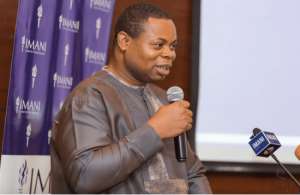
A high-level dialogue held at the Tang Palace Hotel focused on the critical theme: “Opportunities for Accelerating Financial Investment for Ghana’s Energy Transition Plan.” The event brought together key stakeholders, including government officials, financial institutions, energy experts, and international partners, to discuss strategies and opportunities to bolster financial support for Ghana's ambitious energy transition agenda.
In his opening remarks, Senior Research Associate of IMANI Center for Policy and Education (CPE) – Amprofi Agyemang provided an overview of the current energy transition- related project drawn from the existing partnership between the IMANI CPE and the Climate Compatible Growth (CCG) - a UK Foreign, Commonwealth & Development Office initiative aimed at promoting climate-compatible and inclusive growth in low and lower-middle-income countries. He highlighted the far-reaching aim of the project to include the consolidation of extensive research carried out by IMANI and the facilitation of several dialogues in order to streamline current stakeholder actions in support of achieving the goals contained in the existing energy transition policy documents of Ghana.
Presentation of Research Findings:
Presenting findings of research work carried out on the theme, Dr. Theo Acheampong- a senior fellow of IMANI CPE noted that the Government of Ghana has committed to cutting 15-45% of greenhouse gas (GHG) emissions by 2030 in order to reach net zero by 2070. He further noted that about US$562 billion (almost 8x Ghana’s US$73 billion 2022 GDP) would be required to implement the country’s energy transition plan. He emphasized the important priority the Government of Ghana has placed on the transition to sustainable energy sources as highlighted in multiple policy documents drafted by key government institutions, but indicated that the need to shore up efforts to close the current financing gap in funding required to finance Ghana’s energy transition plans was urgent, and remains relevant to the success of the country’s energy transition strategy.
Thus, exploring both domestic and foreign funding opportunities which may be currently challenging to assess- but which is a crucial component of the energy transition agenda- must be pursued comprehensively. Dr. Acheampong noted further that although the Government's commitment to reducing greenhouse gas emissions and promoting renewable energy to meet Ghana’s targets under the Paris Agreement is commendable, there is a lot of work to be done in ensuring that all goals set in relation to Ghana’s energy transition are adequately financed, whilst mechanisms required for effective coordination between relevant government institutions and other stakeholders are made effective in order to tackle expected constraints.
Panel Discussions
A panel discussion held after the delivery of research findings included views from Prof Francis Kemausuor, Co-coordinator of CCG activities in Ghana; Dr. Robert Sogbadzi, of the Ministry of Energy; Nana Amoasi VII, Executive Director - Institute for Energy Security (IES); Ing. Jabesh Amissah-Arthur, Managing Partner and Co-founder of Arthur Energy Advisors (AEA) and former Chief Executive Officer of Bui Power Authority; Syed Nauzer, Charge d’Affairs- High Commission of Malaysia; and Joseph Gyamfi of the Public Utilities Regulatory Commision; amongst other dignitaries.
The dialogue concluded with several key recommendations to accelerate financial investment in Ghana's energy transition:
- Enhancing Policy Frameworks: Strengthening regulatory policies to create a more conducive and predictable environment for investment in renewable energy- a key component of which will be the streamlining of the goals contained in the two major but divergent energy transition documents- Ghana’s National Energy Transition Framework (GH-NETF) and the Ghana Energy Transition and Investment Plan (GH-ETIP);
- Enhancing Public Financial Management: Ensuring effective public financial management to meet targets set in Ghana’s energy transition plans;
- Increasing Financial Incentives: Providing tax incentives and subsidies to encourage investment in clean energy projects;
- Encouraging Hybridization of both Solar and Existing Hydro Power Supplies: Using public policy as the basis for setting up commercial standard arrangements which will ensure the establishment of the hybridization of power supply options currently available to the country. The policy could spell out how much of the hybrid supply of power consumers will be allowed to have access to and how much consumers will pay for such intermittency support;
- Strengthening Public-Private Partnerships: Encouraging collaboration between the public and private sectors to leverage resources and expertise to tackle challenges;
- Promoting Capacity Building: Investing in education and training to build local expertise in renewable energy technologies, and;
- Fostering International and Domestic Cooperation: Strengthening partnerships with international and domestic financial institutions and development agencies, to secure funding and technical support during the transition.
Closing the session, Dr. Theo Acheampong reiterated the need for joint stakeholder action to achieve a sustainable and secure energy future for Ghana. He thanked participants for their valuable contributions and emphasized the importance of continued dialogue and collaboration.

 Brazil's President Lula da Silva beats Flavio Bolsonaro to win re-election
 Nurse rescues mother and baby after unplanned delivery in bush
 McCarthy-Mallam road rehabilitation begins amid commuters’ complaints of heavy t...
 TOR briefs IMF on recovery efforts, inherited debt and sustainability plans
 Aseidu Nketia urges NDC contestants to unite after constituency elections
 EC yet to announce Dormaa Central NDC constituency results
 Baaba Cann questions Obuasi SHTS handling of sexual misconduct allegations again...
 Obuasi SHS headmaster case: “It is better to pay for sex with prostitute than ra...
 NDC not worried about NPP’s Kojo Bamba, he is small boy – Azorka
 Resource exploitation fuelling Africa’s conflicts – Mahama


