




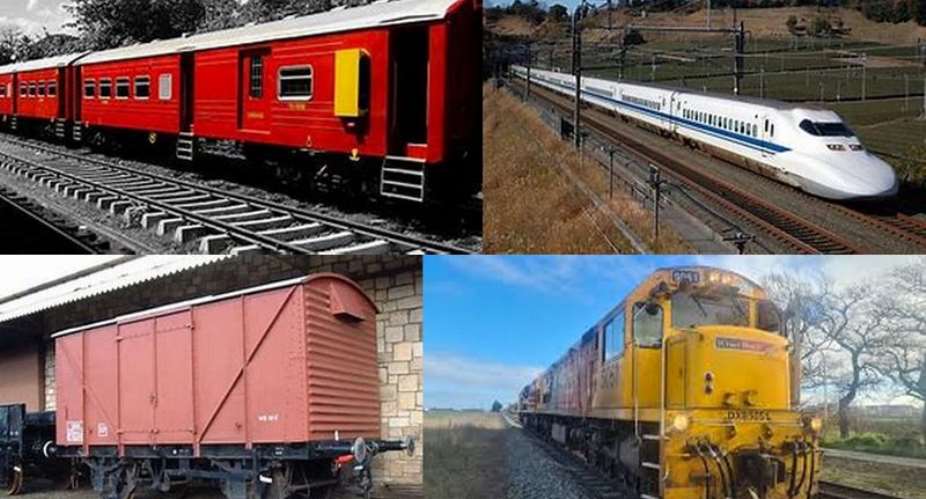
Since the Ghanaian government is eager to expand the nation's rail network, the purpose of this article is to inform the Ghanaian public about the proper use of railway terms.
The general public, particularly journalists, frequently employ railroad jargon incorrectly in their various reports. For instance, while writing about ballast—the hard stone fragments that are visible to the eye and form part of the track formation—it is usual to come across references to "chippings" on the track.
Ghanaians are looking forward to the arrival of a new train on the Tema – Mpakadan standard gauge line, which will be followed by the introduction of additional trains in future.
Remember railway is an industry with its own language.
The following terms should be helpful:
1 ROLLING STOCK: Refers to all the vehicles that move on a railway, including locomotives, freight wagons, passenger coaches, and other specialized vehicles used for maintenance or specific purposes within the rail system.
2. TRAIN: A connected series of vehicles that move along a railway track to transport passengers, freight, or empty vehicles from one location to another. It typically consists of locomotives to provide power and one or more cars for passenger or freight.
3. FREIGHT WAGON: A railway vehicle specifically designed for transporting freight (goods).
4. FLAT WAGONS: A type of freight wagon, with level deck and no sides or roof. Flat wagons are used for transporting of large oversized cargo that cannot fit inside an enclosed freight wagon.
5. CONTAINER FLAT WAGON: A freight wagon designed solely for the carriage of containers.
6. LOCOMOTIVE: A powered rail vehicle that provides the traction and motive power for pulling or pushing trains. It can be steam powered, diesel- electric or electric.
7. CABOOSE: A specialized railway vehicle traditionally used at the end of a freight train to provide a workspace and living quarters for train crews. It also serves as a vantage point to monitor the train’s operation. It was once common but has been largely phased out.
6. VAN: A type of freight wagon, enclosed with walls and a roof typically used for the transportation of general merchandise, manufacture goods, or other cargo that requires protection from the elements. E.g. cocoa.
7. HOPPER WAGON: A type of freight wagon with a bottom-discharge mechanism used for transporting bulk commodities such as ballast, grain, mineral ores such as manganese and bauxite.
8. TANK WAGON: A type of freight wagon designed to transport liquids or gases, such as petroleum products, chemicals, or liquefied gases. Tank wagons have cylindrical tanks mounted on flat wagons or specialized under frames.
9. WELL WAGONS: Also known as depressed center wagon or low-loader is a specialized type of freight wagon designed to transport heavy or oversized loads that cannot fit within the clearance profile of standard rail wagons. It depressed center allows the cargo to sit lower than the level of the wagon’s set of wheels known as bogies. It also helps to maintain stability due to its lower center of gravity.
10. PASSENGER COACHES: Type of rail vehicle designed for carrying passengers on longer journeys. Passenger coaches can feature various amenities including seating arrangements, sleeping arrangements, luggage storage, on board catering services, and lounge for families.
11. HIGH- SPEED TRAIN: A passenger train unlike conventional trains that is designed to travel at speeds above 200 kilometers per hour.
12. LIGHT RAIL PASSENGER VEHICLES (LRV): These are passenger vehicles used in light rail transit systems. They are smaller and lighter and are typically used for urban and suburban transit services.
13. MULTIPLE UNIT (MU) TRAIN: A train consisting of multiple self- propelled units coupled together and controlled from a cab. MU trains are commonly used in commuter rail and rapid transit services. A Multiple Unit runs without any locomotive attached.
14.MULTIPLE UNIT HIGH SPEED TRAIN: A type of high speed train characterized by the use of multiple self-propelled train sets coupled together to form a single train that is capable of running speeds of 250 to 320 km per hour or more in some cases. This is unlike a traditional train where power is provided by a locomotive at the front or rear of the train.
These are a few examples of the various types of railway rolling stock used around the world. The demand for any specific type of rolling stock depends on factors such as the type of railway operation, geographic location, freight requirement and passenger demand.
I acknowledge the use of language generation technology provided by ChatGPT, developed by Open AI, in the creation of this article.
By Joseph Sankah, MCILT [email protected]
The author is a retired Ghana Railway Company Deputy Managing Director in charge of Administration and Train Operations.
 We inherited legal system which is not relevance to our circumstances — Ansa-Asa...
 Minister appeals to government to urgently rehabilitate Tamale-Bolgatanga Highwa...
 Court orders psychiatric evaluation for man accused of stealing Police armoured ...
 Afenyo-Markin delivers powerful speech at ECOWAS Parliament in Abuja
 Police place GH¢100,000 bounty on man for killing two people in Tema
 Cocoa smuggling: Fiapre Circuit Court grants GHC10,000 bail each to four suspect...
 Tensions rise in Bogoso as youth block mine workers over employment dispute
 Police declare military officer wanted over alleged murder of couple, announce G...
 University of Ghana distances itself from unauthorised ‘UG Partner’ app, warns p...
 Ghana's inflation rises marginally to 3.4% in April, up from 3.2% in March — GSS


