




It does not matter how far and fast you go; you will never get to your destination if the map in your hand is wrong. There is nothing wrong with the car, and there is nothing wrong with the road; there is nothing wrong with the speed at which the car travels, except the map in the driver's hand is the wrong one. While the driver may be aware of the faulty map as a guide, he enjoys using it because it confers unlimited power, wealth, and glory on him.
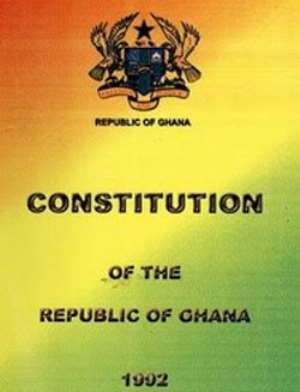
The map I am referring to here is the 1992 Ghanaian constitution. It is a faulty map in the hands of self-seeking drivers who have no intention of arriving at their destination. So far as the drivers continue to use this wrong map that confers benefits to them, we will continue to wander and never arrive at our destination. The constitution, which the framers drafted to lure a military dictator into transitioning from a military government to a civilian government, is the wrong guide for the everyday running of the country. It confers so much power to the President that it makes him a monarch or a king. The constitution limits the legislature's powers because only the President can initiate a bill.
The Presidents can use their power to initiate legislation strategically to shape the legislative agenda and to push through the President's priorities. If the President's party has a majority in Parliament, the President may succeed in getting their proposed legislation passed, whether they suit the country or not. Furthermore, the President can veto bills passed by the legislature, which means that the President can prevent legislation from becoming law. However, the legislature can override the President's veto with a two-thirds majority vote, which checks the President's power.
Another massive flaw with the 1992 Ghanaian constitution is the immunity clause to protect former presidents from prosecutions. Imagine telling sinful human beings that they can do anything they want and not suffer any future consequences. Niccolo Machiavelli, the first modern political theorist, believed that the fear of punishment is more effective than the promise of reward because people are more motivated to avoid pain than to seek pleasure. Telling would-be presidents that we will not hold them accountable for offenses they commit in discharging their duties is not the way to create a culture of integrity, probity, and accountability.
We all attest that human tendency toward immoral and unethical behaviors can adversely affect society. These behaviors can include acts such as theft, violence, and fraud. Punishment prevents these behaviors by making it clear that there are consequences for engaging in harmful actions. Retributions can include imprisonment, fines, community service, or other forms of punishment to discourage individuals from engaging in harmful behavior. In addition to serving as a deterrent, punishment can also provide justice to victims of harmful behavior. Punishment serves as a means of holding individuals accountable for their actions and providing closure for victims. Therefore, providing immunity to presidents engenders maladministration at the state's highest level.
This provision in the constitution has created a culture of impunity, where presidents feel that they are above the law and can act with impunity while in office. This has led to abuses of power, corruption, and other forms of misconduct, without fear of accountability. The immunity clause makes it difficult to hold former presidents accountable for any wrongdoing they may have committed while in office. This undermines public trust in government institutions and hinders efforts to promote transparency, accountability, and good governance. The immunity clause also creates a perception of inequality before the law, with ordinary citizens prosecuted for their actions while former presidents are exempt from prosecution for similar actions. Why shouldn't presidents use the power to amass wealth if they cannot be prosecuted after leaving office?
The Ghanaian constitutional scholar, Professor Henry Kwasi Prempeh, distinguished between what he describes as a "Permissive Constitution" and a "Regulatory Constitution." He argued that while the constitution grants power to the President in a regulatory constitution, it also regulates their powers. According to Prempeh, the Ghanaian constitution is permissive and does not regulate many things the President does.
A regulatory constitution is a type of constitution that seeks to limit the powers of the government, including the powers of the President. Such a constitution typically outlines specific restrictions on presidential powers and may provide checks and balances to prevent abuse of power. In a regulatory constitution, presidential powers are clearly stated and limited, and the President is often subject to oversight and accountability mechanisms.
In contrast, a permissive constitution grants broad powers to the government, including the President. Such a constitution may be less specific about presidential powers and lack the checks and balances characteristic of regulatory constitutions. In a permissive constitution, the President may be granted significant discretionary powers and have a relatively free hand to carry out their duties as they see fit.
Regarding presidential powers, the critical difference between regulatory and permissive constitutions is the extent to which the constitution limits the President's authority. A regulatory constitution seeks to curtail presidential powers and to provide oversight and accountability mechanisms, while a permissive constitution allows the President more latitude to exercise their authority.
The 1992 Ghanaian constitution does not spell out the number of ministers the President can or cannot create and the number of ministers he can or cannot appoint. The constitution does not regulate the number of regions he can or cannot create, leaving essential decisions that have grave financial consequences on the country in the hands of one person. The constitution does not say whether a Member of Parliament can sit on a board of public institutions for which they exercise oversight, leading to a possible conflict of interests.
Granting such broad powers to Ghanaian politicians in a country which remains one of the most corrupt and poorly governed countries is a recipe for disaster. In Ghana, such unregulated powers have granted the President the legal grounds to create more regions, ministries, and districts. They also tend to create more jobs for party cronies and veranda boys without challenge.
How can we get ahead as a nation if we continue to spend money we have not created or earned? Ghanaians have 28 government ministers and 95 deputy ministers, without even counting the regional ministers and their deputies, while a populous and wealthy country like the United States of America has 17 secretaries or ministers. We need to seek a regulatory constitution to limit the power of the government to prevent the abuse of excessive presidential powers. A regulatory constitution can establish checks and balances on the power of the President and other branches of government, ensuring that power is not concentrated in the hands of any individual or institution. This can help to prevent abuses of power and promote accountability.
A regulatory constitution can provide stability and predictability by establishing clear rules and procedures for government action. This can help to promote economic growth, investment, and political stability. A regulatory constitution can promote transparency and accountability by requiring government officials, including the President, to operate in the open and to be accountable to the public. This can help to prevent corruption and promote good governance.
The idea of recycling the two equally corrupt parties every four years will be futile or counterproductive. As Albert Einstein once said, "Insanity is doing the same thing repeatedly and expecting different results." We should demand to vote on constitutional amendments before the next general and presidential elections. We should demand the abolition of the payment of ex-gratia to elected and appointed government officials who fall under article 71. Why are we still paying ex-gratia, which is not required but voluntary? Ghanaians need less talk and more action. Democracy thrives well in countries where the citizens are well-educated on political matters and are well-organized to challenge bad political decisions.

 Creative Arts Agency Board Engages Lands Minister Over Welfare Project for Aged...
 I will rebuild demolished La Pleasure Beach if elected in 2028 to save jobs — Ba...
 Free primary healthcare requires recruitment of more nurses – GRNMA
 Ethiopia's Tigray rebels abandon regional capital as govt advances
 Mahama in Egypt for AU Mid-Year Summit
 SSNIT defends La Beach demolition, cites encroachment and security concerns
 Russia strikes another major bridge across Kyiv's Dnipro river
 Co-pilot on Flydubai flight was banned from flying by Oman for holding extremist...
 Spanish lawmakers vote down affordable housing bills in blow to Sanchez’s govern...


