




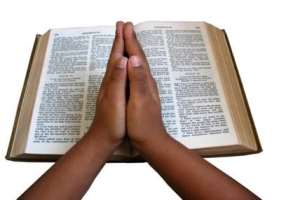
God does not expect us to substitute good governance and hard work with prayers; instead, he expects our corrupt leaders to repent and rule in righteousness and justice. I have often said that Ghana's economic problems stem from our moral failures: systemic corruption that has become a norm in our society. The economy will fix itself by default if our leaders repent and rule in righteousness and justice. To extricate ourselves from our economic quagmire, we need to repent. Rev. Duncan Williams and other Christian leaders ask Ghanaian Christians to "arrest" the cedi's value with prayers. The question to these men is: Why use prayers to arrest the cedi when one can use common sense economic policies and good governance to "arrest" the cedi? These Christian leaders are part of the problem, if not the source of the problem. Pronouncements like these absolve politicians and bureaucrats from their responsibilities as stewards of our resources. How can we blame our political and bureaucratic leaders if our economic problems are spiritual: something beyond their control?
These priests should ask themselves why many non-religious countries perform far better than us economically. The reason is that their leaders are law-abiding, honest, and dedicated in their efforts to work for their people even though they are not religious and do not pray. Nothing is more prayerful than using God's communicable attributes, like rational thoughts or rationality, to show the world the power of the mind, creativity, ingenuity, and hard work. Ghana would have been a paradise by this time if prayer is a substitute for good governance and hard work. Prayers will not cause God to rain gold or money on our land but gives us more profound and sharp minds to think, plan, and execute good economic policies. We are where we are not because we do not have enough resources or pray less than other countries but because we have wicked, corrupt, and selfish leaders. The professional prophets and the church leaders asking the exploited members of their churches to pray for the economy must first call the corrupt bureaucrats and politicians who attend their churches to repentance.
In 2 Chronicles 7:13-14, the Bible says, "When I shut up the heavens so that there is no rain, or command the locust to devour the land or send pestilence among my people, 14 if my people who are called by my name humble themselves, pray, seek my face, and turn from their wicked ways, then I will hear from heaven and will forgive their sin and heal their land." God says he will heal the land "If they turn from their wicked ways." The key phrase here is "turning from their wicked ways." If one diligently searches through the Scriptures, one sees that the promises of God to his people went along with hard work: Thinking, planning, executing, monitoring, and evaluating. God's promises to his people are often conditional. If-then statements, also known as a hypothetical syllogism, which is the basis of deductive logic, are tools that God employs when dealing with his people. Even the prophets who performed great miracles asked their beneficiaries to do something or fulfill some requirements.
When God revealed to Joseph the famine that was to take place in Egypt, he took practical steps to avert the situation. When God promised the people of Israel a land with milk and honey, he showed them practical steps to possess it. We often want to set aside rational thoughts and hard work and use prayers to solve practical problems: that is the laziest way to deal with problems because thinking is hard work for us.
The solutions to our economic problems are not that complicated or spiritual: it is basic arithmetic. It is simple: one cannot continue to spend money one does not have. Just look at the fleet of luxury vehicles following the president on his regional tours. Look at the number of ministers and deputy ministers and compare them to that of the United States of America or Britain. There is no need to disturb God, for all that Rev. Duncan Williams needs to do is to advise the government ministers, politicians, and bureaucrats that attend his church to be good stewards of public funds. Some clergies who pray for the cedi to rise keep collecting offerings in dollars, not knowing that collecting offerings in dollars puts pressure on the cedi. All these macroeconomic issues seem to escape Rev. Duncan Williams.
The president's recent address about the economy did not address the fundamentals of our economic problems. We are constantly spending more than we earn or produce. The whole IMF policies are based on the magical macroeconomic identity: Gross Domestic Product (GDP) must equal C+I+G+ (X-M), or GDP = C +I + G + (X-M). On the left side of the equation is the GDP—the value of all final goods and services produced in the economy. On the right side are the sources of aggregate spending or demand—private consumption (C), private investment (I), purchases of goods and services by the government (G), and exports minus imports (net exports). This means the government affects the economy (GDP) by controlling G directly and indirectly, influencing C, I, and (X-M) through changes in taxes, transfers, and spending.
All these variables affect the value of our currency. We have become an import-dependent country, importing everything from toothpicks to heavy machinery and equipment. We have started importing even gari from China because it is cheaper than gari produced in Ghana. When did our leaders educate people about the economic consequences of importing tomatoes from Burkina Faso or gari from China? Every good leader is supposed to be a teacher. When did our president or any minister educate the citizens that importing gari from China deprives the gari farmers, the gari processors, and the drivers who transport the gari from one place to another of their sources of income? Or, tell Gari importers that importers of Gari will have to obtain foreign exchange to import the Gari? We have allowed foreigners to import our essential needs into the country without restrictions. By doing so, our local business women and men cannot compete. Some of these foreign importers also retail at prices that the local retailers cannot match. They sell these inferior goods to Ghanaians and exchange their cedis often at black market prices: increasing the demand for dollars.
Public sector entitlements with huge wages and salaries undermine our economic development. Take, for example, the salaries of the Governor of the Bank of Ghana in 2017 and its USA counterpart: the US Federal Reserve Chairman. And bear in mind that the USA's current population is about 330 million, and Ghana's about 30 million. The Gross Domestic Product of the USA is about $20 trillion, compared to Ghana's GDP of $60 billion. Notwithstanding, the Governor of the Bank of Ghana's gross monthly salary was GHS 89,909 a month or GHC 1,078,908 a year.
That translates into $215,781.6 a year using the 2017 exchange rate when these figures were reported. That was in addition to other benefits like free accommodation, medical care, two vehicles, free utilities, a gardener, a security guard, a driver, a house help, and a cook. The chairman of the US Federal Reserve's annual salary was $203,500. This kind of behavior puts a wedge between integrity and leadership, where people in a position of trust sacrifice ethics for personal benefit.
This entitlement mindset seduces people to make poor choices sacrificing national interest for personal enrichment. After independence from the Europeans, one would have expected that the African elites would think about how to ameliorate the plight of their people. Nevertheless, they have been more exploitative than the Europeans: living lives of opulence and wealth while their people languish in poverty, misery, and hunger.
The public sector wage bill has become the most significant problem confronting the Ghana government because of our entitlement mindset. Every Ghanaian graduate believes the government owes him or her a job, the compensation of which does not depend on productivity. The public sector wage bill alone took about half of the total tax revenue in 2017. The total tax revenue was GHS 32.2 billion, but wages and salaries for the public sector amounted to 14.4 billion cedis.
One has to analyze these numbers against the fact that public sector employees constitute an abysmal 2.25% of the total population and about 4.26% of the active labor force in Ghana. In other words, about 50% of our tax revenue serves less than 3% of the total population. How can a country develop, given this lopsided income distribution?
What is the government doing to increase revenues and reduce expenditures? Tax holidays and lousy foreign investment contracts leave the foreign investors that mine our resources off the hook. It is reported that Ghanaians have zero shares in our Goldmines, yet these are the critical tax base, not the e-levy. One source of revenue that is not maximized is property taxes. Many people who do not pay taxes on their incomes end up using the money to put up houses that can be taxed. With many multi-million dollar houses in Accra-Tema, Kumasi, and Sekondi-Takoradi, the government can derive considerable revenue from property taxes if it plans and executes them well. What are we doing to increase exports and decrease imports?
Excessive borrowing to finance wasteful projects and the expanded, incompetent, inefficient public sector are also killing the country. Our debt to GDP ratio has now passed 100%. A considerable amount of the loans are wasted: the NDC comes to power and borrows money to start projects, then the NPP comes and sets them aside and starts its projects so they can access new funds. This cycle continues with many abandoned projects in the bush. What do you do with all the colossal government entitlements and ex gratia nonsense? Why are we abusing God by disturbing him with problems he has given us, the common sense or the mental capacity to solve?
Our merciful and gracious God did not only give us prayer as a spiritual tool to deal with the unseen realm but also gave us physical and mental capacities to deal with our common daily problems. We are created in the image of God and therefore possess God's communicable attributes: the cognitive power to think, reflect, and act. When the Bible says, " Give us our daily bread, it does not mean God should rain manna on us as he did in the desert, but to make our efforts fruitful. The Bible commands us to work six days a week. Our reformed or Presbyterian scholars remind us that labor is part of the divine covenant. Ghanaian Christians have prayed enough, and I think it is time to act justly and righteously.

 No room in our standing orders for reconsideration of anti-LGBTQ+ Bill – Sam Geo...
 Court threatens to struck out Mamprobi Baby theft case over disclosure delays
 How ex-convict allegedly sealed teenager's mouth with super glue, raped and murd...
 About 70% of buildings in Ada East lack permits, to be demolished – DCE
 Accra will no longer be sanctuary for indiscipline — Linda Ocloo declares after ...
 Bono Region: Police investigate murder of retired veterinary officer
 GMA says no emergency patient was denied care at KATH despite congestion concern...
 VIDEO: Fuel tanker driver burnt to death in fiery crash at Adubinso, seven shops...
 IMF boosting financial support for four African nations over war impact
 Anti-LGBTQ+ bill: Public clash between Speaker Bagbin and Majority Leader needle...



Comments
Dr. Gyesaw has opened our eyes and enlightened our minds again. Every word, statement made in his article is the gospel truth. Our nation is blessed with all resources you can ever ask from God, yet we live like beggars. Why? Prayer is God-given gift to mankind to seek His mind for revelation, instruction, and direction, so that we can utilize and implement, with hard work, ingenuity, knowledge, and wisdom, the ideas He give us to promote life, health, and welath. Thank you, Dr. Gyesaw, for sta...