




How the Ethical Society of Zambia Is Responding to Food Insecurity
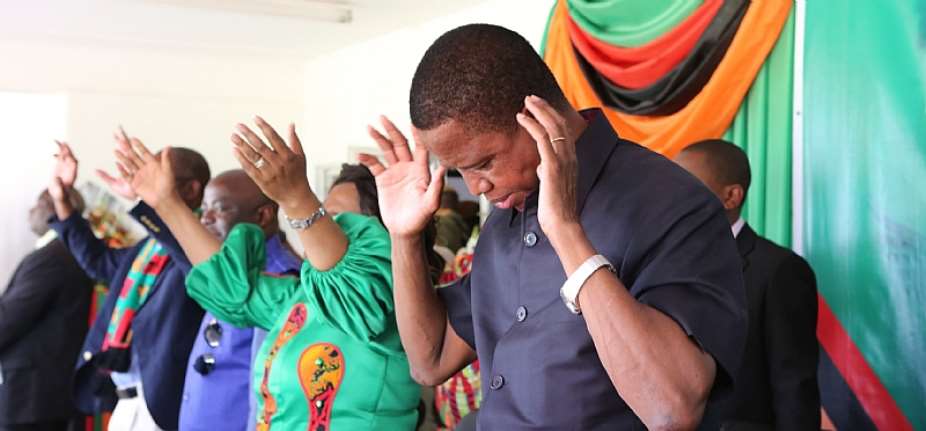
In 2019, Zambia found itself at the center of an international conversation about religious freedom and public leadership after then President Edgar Lungu made remarks that many interpreted as dismissive of the country's nonreligious citizens. During a public appearance in Vubwi District, while leading prayers for rain, the President lamented that there were Zambians who did not call upon God. Several media outlets summarized his comments with headlines that read, " Some Zambian fools think there is no God. "
Although he did not mention any individual or organization by name, members of Humanists & Atheists of Zambia, then led by Larry Tepa, believed the comments were directed at people like themselves. At the time, the organization had become one of the country's most visible voices for secular humanism and freedom of conscience, advocating for the constitutional rights of Zambians regardless of their religious beliefs.
The remarks were disappointing, but they also raised a deeper question that extends far beyond a disagreement about religion. When communities are facing drought, hunger, disease, and poverty, what actually changes people's lives? Is prayer, by itself, enough to solve these challenges, or must societies also invest in practical solutions that directly address human suffering?
Several years later, the answer is becoming increasingly visible in communities across Zambia.
Following the devastating El Niño-induced drought that affected much of southern Africa during 2023 and 2024, millions of Zambians experienced crop failures, rising food prices, water shortages, and increasing food insecurity. The crisis affected households regardless of religion. Christians, Muslims, traditional believers, humanists, and atheists all faced the same empty fields, shrinking harvests, and economic hardship.
The drought did not distinguish between belief systems, and neither did hunger.
Throughout the crisis, churches, community organizations, charities, and ordinary citizens all contributed in different ways to helping those in need. Prayer remained an important source of comfort and hope for many people. Yet alongside spiritual support, communities also required practical interventions that could put food on the table, improve sanitation, protect public health, and help families prepare for future climate shocks.
It is within this context that the Ethical Society of Zambia has developed a different model of humanitarian response.
Founded under the leadership of Larry Tepa, the Ethical Society of Zambia represents an evolution in Zambia's humanist movement. Rather than focusing primarily on philosophical debate about belief and nonbelief, the organization has increasingly directed its efforts toward community development, mutual aid, environmental sustainability, and evidence-based solutions to social problems.
Its philosophy is straightforward. Human compassion should be expressed through action.
Rather than asking whether a person believes in God, the organization asks what can be done today to reduce suffering.
One of its flagship initiatives is a community food security program that combines emergency food assistance with practical education. Instead of operating solely as a food pantry, the project transforms local schools into community learning centers where families can receive both immediate support and knowledge that helps them become more resilient.
Food parcels provide temporary relief, but education creates lasting change.
During each food bank event, participants are invited to learn practical skills that they can immediately apply in their own homes. Workshops demonstrate how to establish productive backyard vegetable gardens using inexpensive and locally available materials. Families learn simple composting techniques, methods for conserving water, and approaches to growing nutritious vegetables even in limited spaces.
The initiative also recognizes that food security cannot be separated from public health.
Volunteers and partner organizations provide demonstrations on household water purification, safe water storage, nutrition, sanitation, and the prevention of diseases such as cholera and diarrhoeal illnesses. Additional sessions focus on menstrual health, including practical instruction on producing reusable sanitary products that improve dignity while reducing household expenses.
These activities are not intended to replace emergency food assistance. They are designed to complement it by giving families the knowledge needed to become less vulnerable over time.
The Ethical Society of Zambia's approach reflects an important principle of disaster response. Humanitarian aid is most effective when it addresses both immediate needs and the underlying conditions that make communities vulnerable in the first place.
A bag of mealie meal may feed a family for several days. Learning how to establish a productive vegetable garden can benefit that family for years. Clean drinking water prevents disease long after an emergency has passed. Better nutrition strengthens children, improves educational outcomes, and reduces long-term health costs. These are practical interventions with measurable results.
The organization's work also challenges long-standing assumptions about morality and public service.
For many years, atheists and humanists in Zambia have often been portrayed as people who reject religion but offer little in its place. The Ethical Society of Zambia presents a different picture. Through food security projects, educational workshops, environmental initiatives, and community partnerships, it demonstrates that ethical responsibility can be expressed through service to others.
This is not an argument against prayer or against the religious convictions held by millions of Zambians. People are free to draw strength, hope, and comfort from their faith, and many humanitarian organizations inspired by religion have made significant contributions to their communities.
The lesson from recent years is something different.
When drought destroys crops, communities ultimately recover through practical action. Food banks feed hungry families. Agricultural education helps households produce food. Clean water initiatives reduce disease. Nutrition programs improve children's health. Community partnerships strengthen resilience. These are the interventions that directly address the consequences of climate change and poverty.
Faith may inspire people to help one another, but it is the helping itself that changes lives.
Looking back, the suggestion that nonbelievers were "fools" because they did not pray for rain says less about the character of Zambia's humanist community than it does about a misunderstanding of what motivates them. The years since those remarks have shown that humanists are not defined by what they reject but by what they build.
Under Larry Tepa's leadership, the Ethical Society of Zambia has sought to demonstrate that the most meaningful response to human suffering is not found in labels or ideological divisions, but in communities coming together to feed the hungry, educate families, improve public health, and create sustainable solutions for the future.
As climate change continues to present new challenges across southern Africa, this practical approach may prove to be one of the most valuable forms of hope. It does not wait for circumstances to change on their own. It begins by asking what ordinary people can do for one another today and then gets to work.

 Govt to distribute first batch of 129 vehicles to MMDCEs in 12 regions
 UG Vice-Chancellor calls for oral exams, project-based assessment to deal with A...
 'I will use everything I have to clear my name' – Obuasi SHTS headmaster fights ...
 NPA to strengthen ties with UMaT to drive downstream petroleum sector
 'Report school abuse directly to Education Ministry' – Deputy Minister tells stu...
 'It's a curse on you' – Water Minister badmouths 'malware' workers sabotaging Gh...
 Tap water no longer drinkable near South Africa capital
 96 health facilities under construction in Ashanti Region
 GoldBod reforms create 4,866 direct jobs in less than two years — Sammy Gyamfi


