




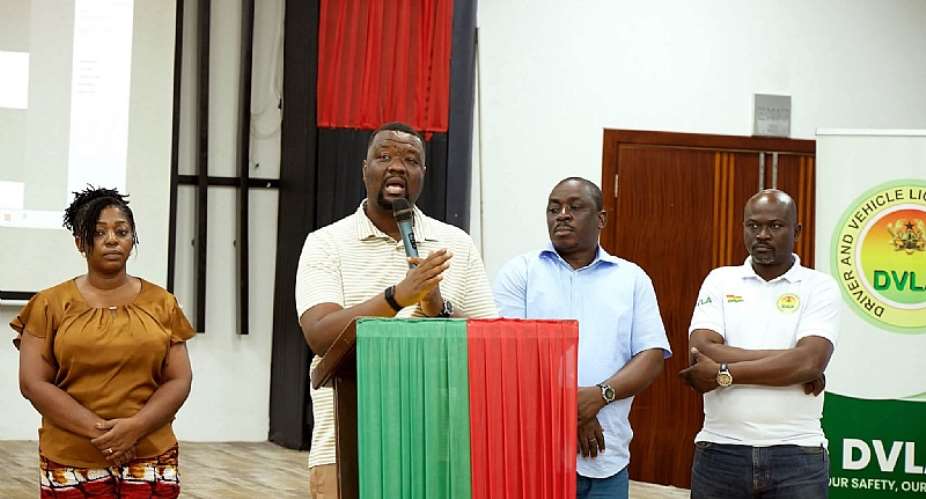
The Chief Executive Officer of the Driver and Vehicle Licensing Authority (DVLA), Mr. Julius Neequaye Kotey, has announced that the Authority will introduce a new generation of smart vehicle number plates as part of sweeping reforms aimed at strengthening national security, improving road safety and modernising Ghana's vehicle registration system.
Speaking at the official presentation of the new registration regime, Mr. Kotey said the initiative was conceived after the Authority recognised that many crimes in Ghana and elsewhere are committed using vehicles whose ownership cannot easily be established because of outdated or incomplete registration records.
He explained that although the DVLA is legally mandated to maintain a comprehensive database of all registered vehicles, there are still vehicles on Ghana's roads with inaccurate, outdated or no registration records at all. According to him, the situation has made it difficult for law enforcement agencies to quickly identify and trace vehicles involved in criminal activities.
Mr. Kotey said requests from the Ghana Police Service, the Customs Division of the Ghana Revenue Authority and other state institutions for vehicle information sometimes expose gaps in the country's vehicle database. He stressed that the new registration regime would address these shortcomings by ensuring every vehicle can be accurately identified and traced.
As part of the reforms, the DVLA has already rolled out a Vehicle Identification Number (VIN) clone detection system before registration. Mr. Kotey disclosed that within the first month of the exercise, about 80 cloned or suspicious vehicles had been intercepted and handed over to Customs for further investigation and the payment of applicable duties. He added that another five vehicles had recently been impounded under the same exercise.
He said the smart number plates would feature scannable technology capable of providing relevant vehicle information to authorised agencies, making it more difficult for criminals to use cloned or illegally registered vehicles. He therefore appealed to motorists, transport unions and the general public to support the nationwide implementation of the project.
Mr. Kotey noted that beyond fighting crime, the new registration system would help restore order and dignity on Ghana's roads, reduce road traffic offences and enhance governance through accurate vehicle data management. He described the reforms as a necessary step towards aligning Ghana's vehicle registration system with modern global standards.
Delivering a technical presentation, Director of Driver Training, Testing and Licensing (DTTL), Mr. Kafui Semeve, explained that the new smart number plates would be embedded with Radio Frequency Identification (RFID) chips capable of storing information about the registered owner and other essential vehicle details. The chips would enable law enforcement officers to retrieve vehicle information electronically without physically stopping every motorist for inspection.
According to Mr. Semeve, the technology would significantly improve traffic management, facilitate future electronic toll collection systems and enable police officers to identify vehicles with expired roadworthiness certificates, insurance or other registration irregularities in real time. He said compliant motorists would no longer be subjected to unnecessary delays during routine road checks.
He also announced a major policy shift under which vehicle number plates would now be assigned to individual owners rather than the vehicles themselves. Under the new arrangement, whenever ownership of a vehicle changes, the existing number plate will be removed and transferred back to the original owner, while the new owner will receive a separate number plate registered in his or her name. The former owner's plate can later be reassigned to another vehicle owned by that individual within five years before returning to the general registration pool.
Mr. Semeve further outlined several new categories of number plates, including distinctive designs for private, commercial, government, diplomatic, electric vehicles, trailers, heavy equipment, motorcycles, tricycles and commercial motorcycles (Okada). He explained that each category would have unique colours, security markings and registration codes to improve identification and support effective regulation.
He said the DVLA would also tighten controls on the issuance of dealer (DV) plates, which have long been abused for private use. New QR codes, RFID technology, expiry dates and company identification details would be incorporated into dealer plates to improve accountability and traceability. Temporary registration stickers valid for six months would also be introduced for imported vehicles awaiting registration. Mr. Semeve said the overall objective of the reforms was to ensure that every vehicle operating on Ghana's roads can be accurately traced to its lawful owner, thereby enhancing public safety and national security.


 DVLA to introduce smart number plates to boost security, improve vehicle traceab...
 Maame Grace petitions Mahama to investigate Mosquito Lab Ghana at University of ...
 Passage of Community Service Bill not enough, Ghana must modernise prisons — Mar...
 June 29 floods a clear case of Mahama's incompetence — Egyapa Mercer
 Nkoko Nkitinkiti policy will fail, can't solve Ghana's poultry problem — Kofi Be...
 Ghana's tallest man spared leg amputation after Ibrahim Mahama's intervention
 Iran strikes Gulf neighbours after new US attacks
 US senator and Trump ally Lindsey Graham dies after 'brief and sudden illness'
 Trump and Iran's supreme leader trade threats as mediators try to save deal
 More than 1 million evacuated as Typhoon Bavi makes landfall in China

