




Introduction
The decision by Ghana's Ministry for the Interior to suspend the operating licence of Kantanka Security Services Limited has become one of the most significant private security controversies in recent years. What initially appeared to be a family and succession dispute within the Kristo Asafo Mission has evolved into a national conversation about firearms control, private security regulation, public safety, and institutional accountability.
The suspension followed a shooting incident at Kwabenya on June 21, 2026, during which former Dome-Kwabenya Member of Parliament, Sarah Adwoa Safo, sustained a gunshot injury. The incident has sparked public outrage and raised difficult questions about how private security companies operate, who supervises them, and whether Ghana's regulatory institutions are adequately enforcing the law.
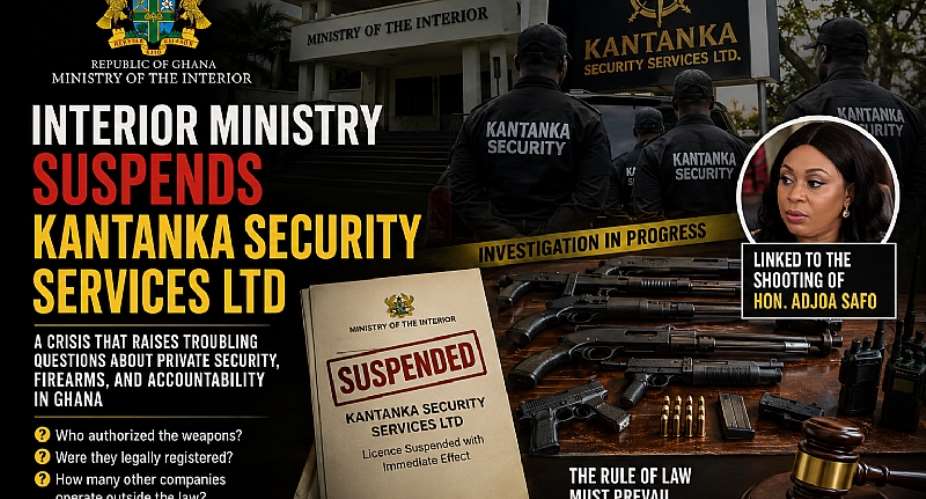
Why Did the Interior Ministry Suspend Kantanka Security Services?
According to the Ministry for the Interior, preliminary investigations indicated that personnel of Kantanka Security Services were allegedly operating with unprescribed uniforms and were in possession of firearms and ammunition while providing private security services. The Ministry concluded that these actions may constitute violations of the Police Service (Private Security Organisations) Regulations, 1992 (L.I. 1571).
The Ministry described the alleged unauthorized possession and use of firearms, ammunition, and security accoutrements as a serious breach with direct implications for public safety and national security. As a result, the company was ordered to cease operations immediately pending the outcome of investigations.
Is the Suspension Linked to the Shooting of Adwoa Safo?
Yes.
The suspension is directly connected to the shooting incident involving Sarah Adwoa Safo at Kwabenya. The Ministry's action followed reports that armed private security personnel allegedly discharged firearms during the confrontation, resulting in injuries to the former MP.
While some representatives associated with Kristo Asafo have claimed that only warning shots were fired, police investigations are ongoing and authorities have not accepted any version of events as final.
How Many Suspects Have Been Arrested?
The Ghana Police Service has confirmed the arrest of six private security personnel in connection with the incident. The suspects are assisting police with investigations and were expected to face court proceedings.
The arrests indicate that law enforcement agencies considered the matter serious enough to warrant immediate criminal investigations rather than treating it solely as a regulatory breach.
How Many Weapons Were Found?
Police searches reportedly led to the recovery of:
- Five pump-action guns
- One Taurus pistol
- Seven rounds of 9mm ammunition loaded in the pistol
- One additional magazine containing five rounds of 9mm ammunition
- Communication equipment
In total, authorities recovered six firearms and multiple rounds of ammunition during the operation.
Did Kantanka Security Services Operate Outside the Law?
That is currently the central question being investigated.
Under Ghanaian law, private security companies operate under strict regulations. Unlike the Ghana Police Service, Ghana Armed Forces, and other state security agencies, private security organizations have limited powers and must comply with licensing, uniform, equipment, and operational requirements established by law.
The Interior Ministry's preliminary findings suggest possible violations regarding:
- Unauthorized possession of firearms.
- Unauthorized use of ammunition.
- Use of unapproved uniforms.
- Use of security accoutrements not prescribed by law.
Whether these actions amount to criminal offences will ultimately be determined by investigators and the courts.
The Questions Nobody Wants to Ask
The controversy raises uncomfortable questions that extend far beyond one company.
Question 1:
If six firearms were recovered from private security personnel, who authorized their possession?
Question 2:
Were the weapons legally registered, and if so, under whose authority?
Question 3:
How long had these firearms allegedly been in use before this incident?
Question 4:
If private security guards can allegedly carry such weapons, how many other private security companies might be doing the same?
Question 5:
Were previous inspections conducted, and if they were, why were these alleged violations not detected earlier?
Question 6:
If a former Member of Parliament can allegedly be shot during a family dispute, what protection exists for ordinary citizens?
Question 7:
Have Ghana's private security regulations kept pace with the rapid growth of the private security industry?
Question 8:
Could this incident expose broader weaknesses in Ghana's firearms monitoring systems?
These are questions that regulators, policymakers, and security experts cannot afford to ignore.
What Role Should the National Commission on Small Arms and Light Weapons Be Playing?
The controversy inevitably places attention on Ghana's National Commission on Small Arms and Light Weapons.
The Commission's mandate includes monitoring, controlling, and preventing the proliferation of illegal firearms. If investigations confirm that firearms were possessed or used without proper authorization, questions will naturally arise regarding how such weapons entered private security operations and whether existing monitoring mechanisms are sufficient.
However, it is important to note that no evidence has yet been publicly presented showing that the Commission failed in its duties regarding this specific case. Investigations are still ongoing.
Effects on Kantanka Security Services
Negative Effects
1. Loss of Business
The Interior Ministry has instructed institutions and individuals to suspend dealings with the company until investigations are completed. This could lead to substantial financial losses.
2. Reputational Damage
For any security company, trust is its most valuable asset. Allegations involving firearms and a high-profile shooting can significantly undermine public confidence.
3. Possible Legal Exposure
Depending on investigation outcomes, the company could face sanctions, licence revocation, fines, or additional legal consequences.
4. Employee Uncertainty
Workers who depend on the company for their livelihoods may face employment instability while operations remain suspended.
Possible Positive Outcome
The crisis could compel the company to undertake significant reforms, strengthen compliance systems, improve training, and adopt more transparent operational procedures if it survives the investigation.
Effects on the Kantanka Family
The incident has intensified an already sensitive succession dispute linked to the late Apostle Kwadwo Safo. What should have been a private family disagreement has become a national issue involving police investigations, political attention, and media scrutiny.
The consequences include:
- Increased public scrutiny.
- Potential reputational damage to family members.
- Deepening divisions within the family.
- Negative publicity surrounding the broader Kristo Asafo legacy.
- Possible legal battles that could continue for years.
Broader Implications for Ghana
This case could become a watershed moment for Ghana's private security industry.
If regulators respond decisively, the incident may lead to:
- Stronger enforcement of private security laws.
- More rigorous inspections.
- Better firearm accountability systems.
- Improved training standards.
- Enhanced public confidence in security regulation.
However, failure to address the underlying issues could create concerns about the growth of poorly regulated armed private security operations.
Conclusion
The suspension of Kantanka Security Services is not merely a corporate disciplinary action. It is a test of Ghana's commitment to the rule of law, firearms regulation, and public safety.
The critical issue is no longer only who fired the shots or who authorized the weapons. The larger question is whether Ghana's regulatory institutions can ensure that private security organizations operate within clear legal boundaries.
As investigations continue, Ghanaians should demand facts rather than speculation, accountability rather than influence, and transparency rather than secrecy.
Because if armed private security personnel can allegedly operate outside established regulations without detection, then the real issue extends far beyond one company, one family, or one incident it becomes a national security concern.
By:
Patrick Belebang Yagsori
+233240292413
[email protected]
 SHS graduation was never part of the GES calendar – Kwadwo Poku
 World Cup 2026: We know how England play, and we know how to control them – Ghan...
 GES must sanction SHSs that allowed flamboyant, extravagant graduation celebrati...
 NDC is stealing from Ghanaians over utility tariff adjustment — Miracles Aboagye
 2026 World Cup: We are highly motivated - England boss Thomas Tuchel fires warni...
 Israel's 'deliberate targeting' of children part of ongoing Gaza 'genocide': UN ...
 Diaspora membership key in sustaining NPP's strength — NAPO
 Adwoa Safo to be flown abroad for further treatment over gunshot wounds — Aide
 If Kennedy Agyapong leaves NPP will not collapse — Kwadwo Poku
 Will the age of AI become a new Tower of Babel?


