




Introduction
Once again, Ghana is counting the cost of devastating floods.
Images emerging from Cape Coast and reports from Samreboi have shown submerged homes, stranded residents, destroyed property, collapsed structures, and communities struggling to recover after heavy rains. The scenes have become painfully familiar. Every rainy season brings headlines of destruction, official visits, promises of solutions, and then silence until the next disaster.
But this time, Ghana must ask questions many people would rather avoid.
Is this really a natural disaster?
Or are we witnessing the consequences of decades of poor planning, environmental destruction, weak enforcement, illegal mining, and collective neglect?
Because if the disaster is man-made, then somebody must be held accountable.
What Happened?
In Cape Coast, more than seven hours of continuous rainfall caused severe flooding across multiple communities. Roads became rivers, homes and businesses were submerged, residents were displaced, and hundreds were left stranded. Major areas including Abura, Interbeton Junction, Abura Market, Akyem, Aggrey Memorial Junction, and surrounding communities were heavily affected. Floodwaters overwhelmed drainage systems and carried large amounts of plastic waste through the city.
The situation became even more tragic when a mudslide at Tantri caused three structures to collapse. A 20-month-old child, Hanson Mensah, lost his life, while three women sustained serious injuries.
This was not an isolated event. Just weeks earlier, another heavy downpour submerged more than 50 houses in Cape Coast and displaced numerous residents.
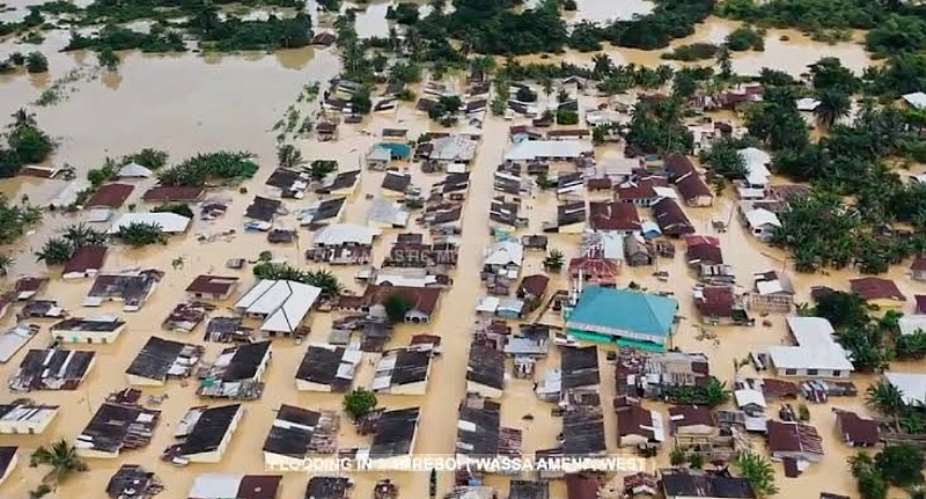
Reports from Samreboi indicate similar flooding concerns affecting communities, roads, farms, and local livelihoods, raising concerns about environmental degradation and land-use practices.
The Historical Background
Flooding is not new to Ghana.
For decades, communities across the country have suffered recurring flood disasters. Accra, Kumasi, Cape Coast, Sekondi-Takoradi, and several mining communities experience annual flooding.
The problem has become so predictable that citizens often know which roads will disappear underwater before the rains even begin.
The question is:
If flooding happens every year, can authorities still describe it as an unexpected disaster?
Or has it become a governance failure?
Is This a Natural Disaster or a Man-Made Disaster?
The rain itself is natural.
The destruction often is not.
Experts repeatedly point to:
- Poor drainage systems
- Building on waterways
- Unapproved construction
- Choked gutters
- Poor waste management
- Deforestation
- Environmental degradation
- Weak enforcement of planning regulations
NADMO officials recently attributed flooding in other parts of Ghana largely to unauthorized construction, blocked waterways, and poor sanitation practices.
This raises a difficult question:
If authorities know the causes, why do the same communities continue to flood year after year?
Is Galamsey Playing a Role?
This is perhaps one of the most uncomfortable questions.
Samreboi is located in the Western North Region, an area heavily affected by illegal mining activities, commonly known as galamsey.
Illegal mining destroys forests, removes vegetation that naturally absorbs rainwater, alters river courses, weakens soil structures, and increases erosion.
When forests disappear, floodwater has fewer natural barriers.
When riverbanks are excavated, rivers become unstable.
When topsoil is removed, landslides become more likely.
The question nobody wants to answer is:
How many floods currently being blamed on climate change are actually being worsened by environmental destruction caused by galamsey?
Even more troubling:
How many politicians, financiers, traditional leaders, security officials, and business interests have benefited from illegal mining activities that may be contributing to these environmental disasters?
Are Citizens Taking Environmental Responsibility Seriously?
Government failures are real.
But citizens also have difficult questions to answer.
Why are drains continuously filled with plastic waste?
Why do people continue building in flood-prone zones?
Why are waterways used as dumping sites?
Why do communities often wait until disaster strikes before organizing clean-up exercises?
Many residents across Ghana frequently identify indiscriminate waste disposal and blocked drainage channels as major contributors to flooding.
The uncomfortable truth is that environmental destruction is often a partnership between failed leadership and irresponsible behavior.
What Are the Chiefs Doing?
Traditional leaders remain custodians of large portions of land throughout Ghana.
This raises critical questions:
- Who allocated flood-prone lands?
- Were environmental assessments conducted?
- Were river buffers respected?
- Have chiefs publicly opposed illegal mining operations?
- Have traditional authorities enforced environmental rules within their jurisdictions?
Many chiefs have spoken against environmental degradation.
However, critics argue that stronger action is needed where illegal activities continue openly.
What Are Authorities Doing?
Authorities have responded with emergency interventions, damage assessments, rescue operations, and public warnings.
NADMO officials have visited affected communities and conducted assessments. Emergency services have assisted victims and coordinated relief efforts.
Yet the larger question remains:
Why do interventions mostly occur after disasters rather than before them?
Prevention remains significantly cheaper than recovery.
How Many Properties Were Destroyed?
As of the latest reports, authorities are still assessing the full extent of damage in Cape Coast.
Reports confirm:
- Numerous homes submerged.
- Businesses flooded.
- Vehicles damaged.
- Multiple structures affected by mudslides.
- More than 50 homes flooded during previous recent flooding incidents.
The final damage bill is expected to run into millions of cedis.
Were There Any Deaths?
Yes.
A 20-month-old child, Hanson Mensah, tragically lost his life after a mudslide triggered by the prolonged rainfall caused a building collapse in Cape Coast. Three women were seriously injured.
Every flood statistic eventually becomes a human story.
A family has lost a child.
And that loss cannot be repaired by relief items or official statements.
Who Should Be Punished?
This may be the most important question.
If investigations reveal:
- Illegal construction on waterways,
- Unauthorized land allocation,
- Environmental violations,
- Negligence by regulatory agencies,
- Illegal mining activities contributing to environmental degradation,
then accountability should follow.
Not symbolic accountability.
Real accountability.
Because disasters that are preventable should have consequences.
Who Is to Blame: Citizens or Government?
Many Ghanaians frame this as an either-or question.
That may be the wrong approach.
The evidence suggests responsibility is shared.
Government must:
- Enforce planning regulations.
- Improve drainage infrastructure.
- Combat galamsey effectively.
- Strengthen environmental protection.
Citizens must:
- Stop dumping waste into drains.
- Respect environmental regulations.
- Refuse to build in dangerous locations.
- Participate in community environmental protection.
Traditional authorities must:
- Protect land resources.
- Prevent illegal developments.
- Support environmental enforcement.
The reality is that floods often occur when multiple failures converge.
The Question Nobody Wants to Ask
If Cape Coast floods again next year, and again the year after that, and again after that, can anyone honestly claim that the disaster was caused by rain?
Or should we admit that Ghana has normalized preventable tragedies?
Because rain falls in many countries.
Not every country turns rainfall into a national emergency.
Conclusion
The flooding in Cape Coast and concerns emerging from Samreboi should not simply be viewed as weather events.
They are warnings.
Warnings about environmental management.
Warnings about urban planning.
Warnings about illegal mining.
Warnings about governance.
Most importantly, they are warnings that nature eventually sends a bill for every environmental debt accumulated over decades.
The question is no longer whether Ghana knows the causes.
The question is whether Ghana finally has the courage to confront them.
By:
Patrick Belebang Yagsori
+233240292413
[email protected]
 We're pushing for specialized courts to enforce rent laws — Rent Commissioner
 'The country needs to be governed' — Kemi Badenoch criticises Starmer's resignat...
 Lavish post-WASSCE celebrations show some parents can pay fees — Hamza Suhuyini
 Why this lavish post-WASSCE celebration when results are not yet out? -- Hamza S...
 Take a cue from Starmer and resign over your monumental failure — Obi tells Tinu...
 How NACOC picked up five Central University students on campus over cannabis inf...
 Kantanka family says Adwoa Safo attempted to serve court injunction on Akofena w...
 Kennedy Agyapong ought to have been questioned over 'contracts for sale' allegat...
 ACFO II Semey Mawuko bows out after 37 years in GNFS
 US cracks down on visa holders accused of abusing system and defrauding citizens


