




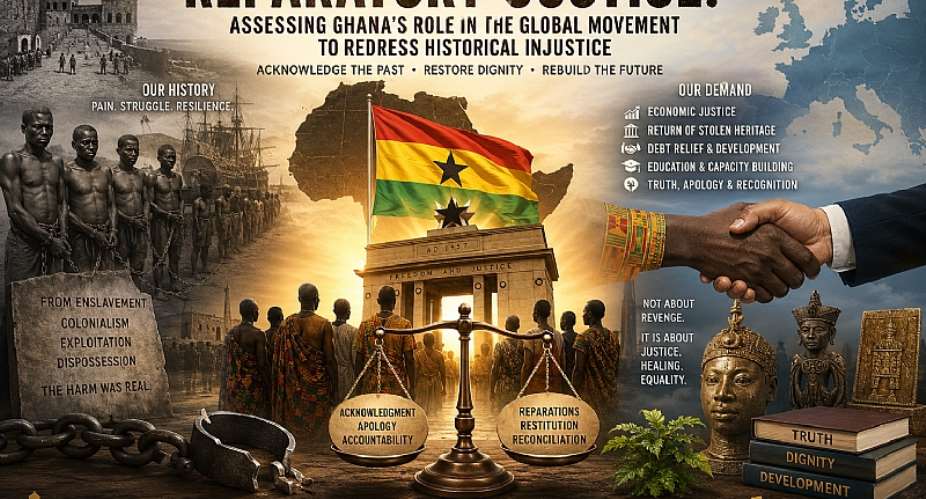
Introduction
For more than four centuries, millions of Africans were captured, sold, transported across oceans, enslaved, colonized, and systematically exploited. The economic foundations of many modern Western nations were built, at least in part, on wealth extracted from Africa through slavery, colonialism, forced labor, and resource exploitation.
Today, a growing movement known as reparatory justice seeks to address these historical wrongs. Across Africa, the Caribbean, and parts of the African diaspora, calls for reparations have become louder and more organized than at any time in modern history.
At the center of this movement stands Ghana—a country increasingly positioning itself as a global advocate for historical justice, accountability, and healing.
But what exactly is reparatory justice? Why is it controversial? What does Africa want? And could this movement reshape relations between Africa and Europe?
What Is Reparatory Justice?
Reparatory justice refers to measures taken to repair harm caused by historical injustices.
These measures may include:
Financial compensation
Debt cancellation
Development funding
Return of stolen cultural artifacts
Official apologies
Educational investments
Institutional reforms
Memorialization and historical recognition
Importantly, reparatory justice is not solely about money.
Many advocates argue that it is fundamentally about acknowledgment, accountability, dignity, and restoring opportunities lost through centuries of exploitation.
The principle is simple:
If harm was done and its effects continue today, those responsible have a moral obligation to help repair that harm.
Historical Background: How Did We Get Here?
The Transatlantic Slave Trade
Between the 15th and 19th centuries, an estimated 12–15 million Africans were forcibly transported across the Atlantic.
Many died before reaching their destinations.
Families were destroyed.
Entire communities were depopulated.
Economic systems that could have developed independently were disrupted.
European powers including Britain, Portugal, France, Spain, the Netherlands, Belgium, and others—played major roles in the trade.
Colonialism
After slavery, colonialism intensified Africa's exploitation.
During the late 19th century, European powers partitioned Africa during the infamous historical event known as the Berlin Conference.
African lands, resources, labor, and political systems were placed under foreign control.
Colonial governments extracted:
Gold
Diamonds
Cocoa
Rubber
Timber
Agricultural products
while investing minimally in African industrial development.
Many scholars argue that today's economic inequalities between Europe and Africa cannot be understood without examining this history.
Why Is Ghana Taking a Leading Role?
Ghana occupies a unique place in African history.
It was the first sub-Saharan African country to gain independence from colonial rule in 1957 under Kwame Nkrumah.
The country also contains important slave-trade sites such as Cape Coast Castle and Elmina Castle.
These sites have become symbols of remembrance for Africans and the global African diaspora.
Recent Ghanaian governments have actively promoted initiatives such as:
Year of Return (2019)
Beyond the Return
Pan-African dialogues
Reparations conferences
Ghana argues that addressing historical injustices is essential for meaningful global equality.
Why Do Some Support Reparations?
Supporters advance several arguments.
1. Historical Responsibility
Many believe nations that benefited from slavery and colonialism should acknowledge and help repair the damage.
2. Continuing Effects
The consequences of slavery and colonialism did not disappear when those systems ended.
Many African countries still struggle with:
Underdevelopment
Weak infrastructure
Economic dependency
Unequal global trade structures
Supporters argue these challenges are partly linked to historical exploitation.
3. Moral Justice
If modern societies compensate victims of war crimes, genocide, or state abuses, proponents ask:
Why should slavery and colonialism be treated differently?
4. Symbolic Healing
Official recognition can help address intergenerational trauma and restore dignity.
Why Do Others Oppose Reparations?
Critics raise several concerns.
1. Who Pays?
Many Europeans argue that current generations did not personally participate in slavery or colonialism.
They question whether descendants should be held financially responsible.
2. Measuring Harm
Calculating the economic cost of centuries of exploitation is extraordinarily difficult.
How does one place a monetary value on lost lives, cultures, and opportunities?
3. Governance Concerns
Some critics worry that financial reparations could be mismanaged by governments.
They argue development assistance should focus on transparency and accountability.
4. Shared Historical Responsibility
Others point out that some African leaders and kingdoms participated in aspects of the slave trade.
This argument remains controversial because supporters note that European powers created and profited most from the global system.
What Is Europe Saying?
Europe is not united on reparations.
Several European governments have acknowledged historical wrongdoing.
For example:
Germany has acknowledged atrocities committed against the Herero and Nama peoples in present-day Namibia.
Belgium has expressed regret over abuses linked to colonial rule in Congo.
Various European institutions have supported returning stolen African artifacts.
However, most European governments stop short of supporting large-scale financial reparations.
Their position generally favors:
Historical acknowledgment
Development partnerships
Educational initiatives
Cultural cooperation
rather than direct compensation.
Has Europe Accepted It Did Wrong?
Broadly speaking, yes.
Most European governments and academic institutions now recognize that slavery and colonialism caused profound suffering.
The debate today is no longer primarily about whether injustices occurred.
The disagreement centers on:
What should be done about them now?
Acknowledgment is increasingly common.
Compensation remains contested.
What Is Africa Looking For?
Contrary to popular belief, many African leaders are not seeking only cash payments.
Demands often include:
Economic Justice
Fair trade arrangements
Debt relief
Development financing
Cultural Justice
Return of stolen artifacts
Preservation of African heritage
Educational Justice
Scholarships
Research funding
Historical education
Political Recognition
Formal apologies
International acknowledgment of wrongdoing
Is Africa United on Reparations?
Not entirely.
African countries generally support the principle of reparatory justice, but they differ on:
Priorities
Strategies
Negotiation approaches
Organizations such as the African Union have increasingly backed discussions on reparations.
However, economic realities, political differences, and varying national interests mean there is no single African position.
Nevertheless, there is greater unity today than at any previous point in modern African history.
What Are Ordinary Africans Saying?
Public opinion across Africa is diverse.
Many Africans support reparations because they view them as a matter of justice and historical accountability.
Others express skepticism.
Common questions include:
Will reparations actually reach ordinary citizens?
Can money truly compensate for centuries of suffering?
Should African governments focus more on current governance challenges?
Could reparations become a distraction from domestic reforms?
Among younger Africans, there is growing interest in combining reparations with broader conversations about economic sovereignty, technology, education, and industrialization.
Is Europe Afraid That Africans Are Coming Together?
The evidence does not suggest fear in the traditional sense.
However, European policymakers are paying increasing attention to African unity.
A more coordinated Africa could possess:
Greater bargaining power
Stronger diplomatic influence
Larger economic leverage
Increased control over critical minerals and resources
The concern for some European governments is less about reparations themselves and more about changing global power dynamics.
Africa's population, strategic resources, and growing markets make the continent increasingly influential.
What Could Be the Effects on Europe?
If significant reparatory measures were adopted, potential effects could include:
Positive Effects
Improved Africa-Europe relations
Greater diplomatic trust
Enhanced economic partnerships
Improved global reputation for European nations
Potential Challenges
Political backlash from taxpayers
Legal claims from other groups seeking reparations
Debates over historical responsibility
Budgetary pressures
Most experts believe that any future reparatory framework would likely focus on partnerships and investments rather than massive direct cash transfers.
Ghana's Strategic Opportunity
Ghana has emerged as one of the leading voices in the global reparations movement.
Its historical significance, democratic stability, and strong connections to the African diaspora provide unique advantages.
The country's challenge is to transform moral arguments into practical outcomes.
Key questions remain:
Can reparatory justice improve education and healthcare?
Can it support industrial development?
Can it strengthen Africa's bargaining power globally?
Can it create lasting opportunities for future generations?
The answers will determine whether reparatory justice becomes merely a symbolic movement or a transformative force for African development.
Conclusion
The debate over reparatory justice is not simply about the past. It is about how the world chooses to confront the consequences of history in the present.
For supporters, reparations represent long-overdue recognition of centuries of exploitation and a pathway toward greater global fairness. For critics, they raise difficult questions about responsibility, practicality, and implementation.
Ghana's growing leadership in this movement reflects a broader African determination to ensure that the stories of slavery, colonialism, and exploitation are neither forgotten nor ignored.
Whether reparatory justice ultimately results in financial compensation, institutional reforms, cultural restoration, or new development partnerships, one fact remains undeniable:
The global conversation about historical injustice is no longer confined to history books. It has become a defining question about justice, accountability, and the future relationship between Africa and the world.
By:
Patrick Belebang Yagsori
+233240292413
[email protected]
 SHS graduation was never part of the GES calendar – Kwadwo Poku
 World Cup 2026: We know how England play, and we know how to control them – Ghan...
 GES must sanction SHSs that allowed flamboyant, extravagant graduation celebrati...
 NDC is stealing from Ghanaians over utility tariff adjustment — Miracles Aboagye
 2026 World Cup: We are highly motivated - England boss Thomas Tuchel fires warni...
 Israel's 'deliberate targeting' of children part of ongoing Gaza 'genocide': UN ...
 Diaspora membership key in sustaining NPP's strength — NAPO
 Adwoa Safo to be flown abroad for further treatment over gunshot wounds — Aide
 If Kennedy Agyapong leaves NPP will not collapse — Kwadwo Poku
 Will the age of AI become a new Tower of Babel?


