




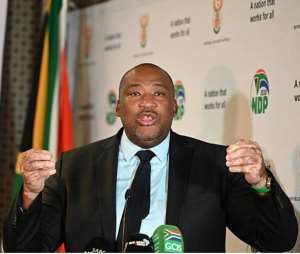
Few politicians in modern South African history generate as much controversy, fascination, admiration, and outrage as Gayton McKenzie.
To his supporters, he is proof that redemption is possible. A man who emerged from prison, built businesses, wrote books, created a political party, and rose to become a government minister.
To his critics, he represents something far more troubling: a convicted criminal whose rhetoric on foreigners has repeatedly sparked accusations of xenophobia and division.
The question South Africans and Africans across the continent must ask is simple:
Does a criminal past automatically disqualify someone from leadership, or should society judge a person by who they become afterward?
And perhaps an even harder question:
When a former armed robber speaks about law, order, patriotism, and who belongs in a country, should citizens celebrate the transformation or remain cautious about the messenger?
Was Gayton McKenzie Really An Armed Robber?
The answer is yes.
McKenzie has openly admitted his criminal past and has never hidden it.
Historical records show that he was convicted of armed robbery and served approximately eight years in prison before his release. He has repeatedly spoken publicly about his involvement in crime during his youth and has described his life before prison as one filled with gang activity, robberies, and criminal behavior.
Unlike many politicians who deny embarrassing chapters of their past, McKenzie built part of his public image around acknowledging his criminal history.
However, an important distinction must be made:
There is public evidence of convictions for armed robbery, but there is no verified court record showing that he was convicted of murder. Claims that he personally killed someone have never been proven in court.
That distinction matters.
A democracy should be guided by evidence, not rumors.
The Gang Connections
McKenzie has spoken publicly about his involvement with prison gang culture and has been associated historically with the notorious 26s prison gang structure. Various reports and political controversies have linked him to gang networks over the years, though allegations and proven criminal convictions are not the same thing.
This raises another uncomfortable question:
Can someone truly leave gang culture behind, or does society forever judge them through the lens of their worst mistakes?
How Did He Rise To Power?
After prison, McKenzie became a businessman, motivational speaker, author, and eventually politician.
He later co-founded the Patriotic Alliance and gradually built a political following by presenting himself as a straight-talking outsider willing to address issues many mainstream politicians avoided.
His message resonated with voters frustrated by:
- Crime
- Corruption
- Unemployment
- Illegal immigration
- Government failures
Whether one agrees with him or not, his rise reflects a broader frustration within South African society.
Can A Convicted Criminal Become President In South Africa?
Many Africans are surprised to learn the answer is not automatically "no."
South Africa's Constitution does not permanently ban every person with a criminal conviction from holding public office.
Certain disqualifications exist, particularly for people sentenced to long prison terms without the option of a fine, but these restrictions are not necessarily lifelong.
This explains why McKenzie was legally able to serve as mayor, become a Member of Parliament, and later become a cabinet minister.
The bigger democratic question becomes:
Should legality alone determine eligibility, or should citizens apply a higher moral standard?
Did McKenzie Really Say He Would Turn Off Oxygen For Foreigners?
Yes.
The statement was widely reported.
During a discussion about healthcare and foreign nationals, McKenzie stated that if a South African needed oxygen and a foreign national was already using it, he would switch off the foreign national's oxygen supply to save the South African.
The remarks sparked outrage.
Medical professionals, legal experts, civil society organizations, and human rights advocates condemned the statement.
Healthcare experts argued that medical decisions should be based on ethics and clinical need not nationality.
The statement remains one of the most controversial comments of his political career.
What Are South Africans Saying?
The answer is complicated.
Some South Africans support McKenzie because they believe illegal immigration places pressure on jobs, housing, healthcare, and public services.
Others strongly reject his language and accuse him of encouraging xenophobia.
Public discussions reveal deep divisions.
Many online comments criticized his remarks as unconstitutional, dangerous, and morally unacceptable, while others defended tougher immigration policies.
This suggests that South Africa is not united behind McKenzie on this issue.
The country itself remains deeply divided.
Do South Africans Hate Other African Countries?
No.
That would be an inaccurate and unfair conclusion.
Millions of South Africans work, marry, trade, study, worship, and build friendships with people from across Africa.
However, xenophobic violence has occurred repeatedly over the years.
Why?
The causes are complex:
- High unemployment
- Poverty
- Housing shortages
- Crime fears
- Competition for informal-sector opportunities
- Political scapegoating
When governments fail to solve structural problems, outsiders often become convenient targets.
History shows this is not unique to South Africa.
It has happened in Europe, America, Asia, and elsewhere.
Who Is Sponsoring This Agenda?
Evidence does not support claims that a secret organization is sponsoring anti-foreigner sentiment.
The more likely explanation is political opportunism.
Across the world, politicians have often gained support by promising stronger borders and prioritizing citizens over immigrants.
The strategy is not unique to South Africa.
The real question is:
Are foreigners the cause of South Africa's problems, or are they being blamed for problems created by decades of economic inequality and governance failures?
What Does President Cyril Ramaphosa Say?
There is no verified evidence that President Cyril Ramaphosa endorsed McKenzie's oxygen-switching remarks.
South Africa's constitutional framework emphasizes human dignity, equality, and access to healthcare.
Government policy generally does not support denying emergency healthcare based solely on nationality.
What If Gayton McKenzie Became President?
No one can predict the future.
However, several possibilities emerge.
Supporters believe he would:
- Crack down on illegal immigration
- Pursue tougher crime policies
- Challenge political elites
- Speak more directly than traditional politicians
Critics fear:
- Increased tensions with African neighbors
- Damage to South Africa's diplomatic reputation
- More xenophobic incidents
- Constitutional conflicts
- Greater social polarization
The outcome would ultimately depend on whether rhetoric translated into policy.
The Hard Questions Nobody Wants To Ask
What does it say about a nation when former criminals become leaders?
Does it demonstrate forgiveness?
Or does it reveal public desperation for alternatives?
If a convicted armed robber can become a minister, is that evidence of democratic maturity or democratic failure?
Why are politicians often rewarded for inflammatory statements that ordinary citizens would be condemned for making?
Can South Africa afford another era of division when it already struggles with unemployment, crime, corruption, and inequality?
And perhaps the biggest question of all:
If leaders convince citizens that foreigners are the problem, what happens when the foreigners leave and the problems remain?
Conclusion
Gayton McKenzie remains one of South Africa's most controversial political figures.
The facts are clear:
- He was convicted of armed robbery.
- He served years in prison.
- He rebuilt his life after prison.
- He entered politics and rose to national office.
- He made highly controversial statements regarding foreign nationals and healthcare.
What remains unclear is how history will ultimately judge him.
As a remarkable example of redemption?
As a populist who tapped into public frustrations?
Or as a politician whose rhetoric deepened dangerous divisions?
The answer may determine not only his legacy, but also the future direction of South Africa itself.
By:
Patrick Belebang Yagsori
+233240292413
[email protected]
 Sedina Tamakloe is in prison — NDC lawyer confirms
 UE/R: Bolga notorious robber, accomplice busted in Zorbisi after dawn attack on ...
 Gunfire at airport in Niger's capital: residents
 New wave of anti-LGBTQ laws sweeps Africa
 Tehran and Washington sign interim peace deal to end US-Israeli war on Iran
 Why are Kenyan kids burning schools and killing their classmates?
 Yirenkyi's late flourish launches Ghana's World Cup party
 World Cup 2026: Ghana break Panama resistance with stoppage-time winner
 VIDEO: Watch the only community toilet carried away by floods
 Bank of Ghana converts 147 rural and community banks into community banks


