




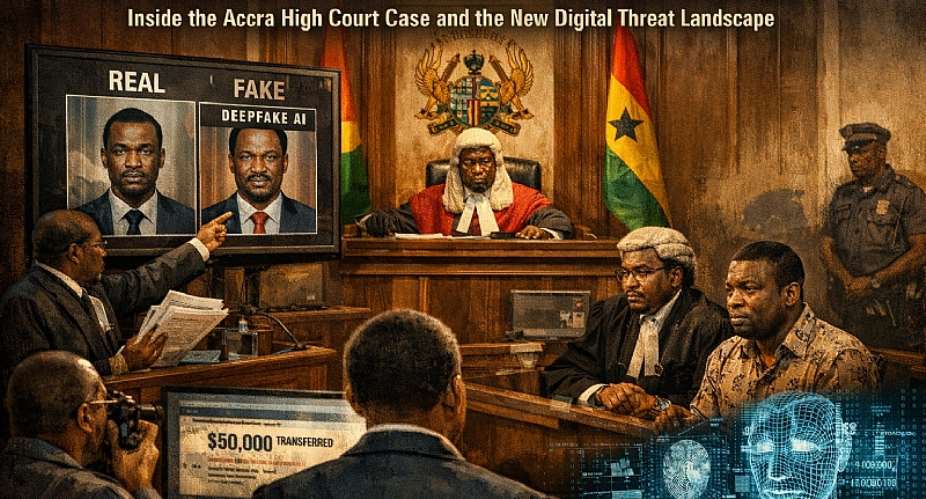
In an era where seeing is no longer believing, the concept of “truth” is being quietly rewritten by artificial intelligence. The recent case involving five suspects allegedly linked to AI-powered deepfake fraud, currently before the Accra High Court, has brought Ghana face-to-face with one of the most unsettling realities of the digital age: identity itself can now be forged with frightening precision.
At the center of the allegations is the reported impersonation of high-profile figures, including the President of Ghana, John Dramani Mahama, and former First Lady Lordina Mahama, alongside other public personalities in an alleged online scam operation.
But beyond the courtroom headlines lies a deeper, more urgent question: Is Ghana prepared for a world where AI can convincingly fabricate authority, trust, and identity?
What Exactly Is Deepfake Technology?
Deepfake technology refers to the use of artificial intelligence, particularly deep learning models, to create highly realistic but fake audio, video, or images of real people.
In simple terms, it allows someone to:
Make a public figure appear to say words they never said
Clone voices with alarming accuracy
Create entirely fabricated video meetings or endorsements
Fabricate “evidence” that looks authentic to the human eye
What once required Hollywood-level production is now accessible with software, a smartphone, and enough data scraped from the internet.
And that accessibility is what makes it dangerous.
The Alleged Case in Accra: What We Know So Far
According to court proceedings referenced in public reporting, five suspects were arrested and brought before the Accra High Court over allegations involving AI-generated impersonation scams.
However, several critical details remain legally sensitive or unconfirmed in public records, including:
The full identities of the accused (beyond court listings)
The exact technical tools used
The total number of victims and financial losses
The specific digital platforms involved
What is known is that the suspects are alleged to have engaged in online impersonation schemes using AI-generated content, targeting public trust in political figures.
Authorities believe the operation exploited the credibility of well-known leaders to manipulate unsuspecting individuals into fraudulent transactions or deceptive communications.
How Deepfake Fraud Operations Typically Work
While the specifics of this Ghana case are still emerging, global cybercrime patterns show a consistent method:
1. Data Harvesting
Fraudsters collect:
Public speeches
Social media videos
Interviews and voice recordings
2. AI Model Training
Using deepfake tools, they train models to mimic:
Facial expressions
Speech tone
Gestures and movement patterns
3. Content Creation
They generate:
Fake video messages from leaders
Voice notes instructing financial actions
“Urgent appeals” designed to bypass skepticism
4. Social Engineering
The final stage is psychological manipulation:
Urgency (“act now” messaging)
Authority (“this is the president speaking”)
Emotional triggers (national crisis, donations, or support requests)
This combination is what makes deepfake fraud so effective it doesn’t just hack systems, it hacks human trust.
How Were the Suspects Arrested?
Although full investigative details have not been publicly disclosed, cybercrime cases of this nature are typically uncovered through:
Digital forensic tracking of IP addresses
Monitoring suspicious online financial flows
Reports from victims or whistleblowers
Cyber intelligence collaboration between telecom providers and national cybersecurity units
In Ghana, the Cyber Security Authority plays a central role in identifying and coordinating responses to such incidents.
Were Victims Involved?
Authorities have indicated that the case involves online victims, though:
Their identities have not been publicly released
The extent of financial or reputational damage is still under investigation
Many victims of impersonation scams often remain silent due to embarrassment or fear
In many deepfake cases globally, victims only realize they were defrauded after money has been transferred or sensitive data has been compromised.
What Was Found at the Time of Arrest?
While official inventories have not been fully published, cybercrime suspects in similar cases are often found with:
Laptops and high-performance computing devices
Mobile phones with encrypted applications
AI software or deepfake generation tools
Cryptocurrency wallets or digital payment trails
Stored media files used for impersonation training
Whether these exact items were recovered in this case remains part of ongoing judicial proceedings.
What Are People Saying?
Public reaction has been intense and divided:
1. Shock and disbelief
Many Ghanaians are still grappling with the idea that AI can convincingly mimic national leaders.
2. Fear of digital misinformation
Others worry about future elections, where fake audio or video could influence political sentiment.
3. Calls for stronger regulation
There is growing pressure on government institutions to:
Strengthen cyber laws
Improve digital literacy
Invest in forensic AI detection tools
What Is the Cybersecurity Authority Saying?
The Cyber Security Authority has consistently warned that:
AI-driven fraud is increasing globally
Ghana is not immune to synthetic media attacks
Public awareness is currently the weakest defense
They emphasize that cybersecurity is no longer just technical it is social, psychological, and institutional.
Do Ghanaians Truly Understand Cybersecurity?
This case exposes a difficult truth: cybersecurity awareness remains limited among the general population.
Many users still:
Trust unsolicited messages from “official” accounts
Do not verify video or audio authenticity
Assume digital content is inherently real
Yet cybersecurity experts argue that the biggest vulnerability is not technology it is human behavior.
The Bigger National Lesson
This case is not just about five suspects or one courtroom.
It raises fundamental questions:
What happens when AI can impersonate the President flawlessly?
How do you defend democracy when audio and video can lie?
Are institutions prepared for information warfare at digital speed?
Should digital identity verification become as important as physical ID?
A Warning, Not Just a Trial
The Accra case represents more than alleged criminal activity it is a preview of a new era of cyber conflict, where:
Truth is programmable
Identity is editable
Trust is the primary target
As the court continues its proceedings, Ghana is also on trial in another sense: a test of readiness for the AI age.
Final Reflection
Deepfake technology does not just challenge law enforcement it challenges perception itself. And as this case unfolds, one uncomfortable reality becomes clearer:
In the digital world, the question is no longer “Is it real?”
But rather: “Who benefits from you believing it is?”
By:
Patrick Belebang Yagsori
+233240292413
[email protected]

 Mysterious illness leaves children struggling to walk, hear in Mafi Kope
 ‘We’ve come back to make sure our father's ideas never die’ – Nkrumah family
 Ghana Jollof: Akosua Manu appeals to Naana Jane to use her influence to free Sal...
 Yellow fever confirmed in Sissala East after 21 mysterious deaths
 Kenyasi man allegedly attacked by prison officers and inmates over yam theft cla...
 Germany’s far-right AfD makes strong gains in two state elections
 Savannah Regional Minister, IGP Yohuno visit Gbindabuor following lynching of po...
 Jehovah's Witnesses make blood component decisions a matter of personal conscien...
 Road contractors fed on contracts for years without completing projects – Alhass...
 Ghana Jollof saga: ‘She has no right to do what she’s doing’ – Inusah Fuseini


