




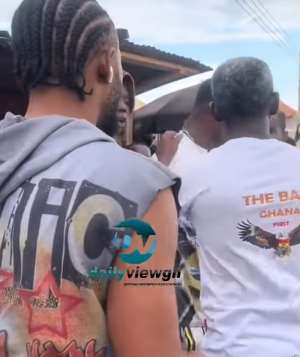
In the heart of the Ashanti Region, tension erupted in Obogu when a political outreach visit by Kumawood actor and public figure Agya Koo and members of his political movement, The Base Party, reportedly ended in confrontation with local youth.
What was meant to be a campaign engagement quickly turned into a moment of anger, accusations, and community pushback. But beneath the surface of this incident lies a far deeper set of uncomfortable questions that many are hesitant to ask.
What Exactly Happened in Obogu?
According to accounts circulating from residents and local reports, Agya Koo and his team visited Obogu as part of a political outreach effort. The goal, as stated, was to engage residents and share the vision of The Base Party.
However, tensions reportedly escalated after an alleged remark attributed to a member of the campaign team described the youth of Obogu as “lazy villagers” and suggested they could be easily influenced politically.
That single phrase if accurately reported became the spark in a dry political bush.
Within moments, anger spread among sections of the youth, culminating in a confrontation with the visiting delegation.
But here is where the story stops being just about one insult and starts becoming about something much larger.
Were They Properly Received or Did They Walk Into a Charged Space Unprepared?
One of the most critical questions that has not been fully explored is simple:
What were they doing there, and how prepared were they for the realities of that engagement?
Campaign visits are not neutral events. In communities like Obogu, political memory is long, emotions run deep, and respect is non-negotiable.
So another question emerges:
Did the team announce their arrival in a way that genuinely engaged community leadership?
Were traditional authorities and youth leaders properly consulted before the visit?
Or was this a sudden political appearance in a sensitive environment already saturated with distrust?
Because in Ghanaian political culture, especially at the grassroots level, visibility without preparation can quickly be interpreted as provocation.
What Exactly Was Said and Why Did It Cut So Deep?
The alleged phrase “lazy villagers” is not just an insult it is a historical trigger.
It carries layers of resentment: urban superiority narratives, political stereotyping, and long-standing frustrations between rural communities and elite political actors.
So we must ask:
Was this a careless remark, or a deeper reflection of how some campaign teams perceive rural youth?
Why do campaign seasons so often expose hidden contempt instead of genuine connection?
And most importantly how often are communities disrespected in ways that never make the headlines?
Because if even one member of a political delegation used those words, the question is not only what was said, but what kind of political culture allows such language to exist in the first place?
What Did Agya Koo Say to the People?
Reports suggest that Agya Koo and his team were in Obogu to promote the vision of The Base Party and engage residents on political participation.
But the critical gap in this narrative is this:
Did Agya Koo personally address the crowd before tensions escalated?
Did he distance himself from the alleged remark?
Or was silence interpreted as approval in the heat of the moment?
In volatile community settings, leadership is not only measured by presence but by response under pressure.
And so another uncomfortable question rises:
When the situation turned tense, was leadership present or was it absent at the moment it mattered most?
Is The Base Party a Political Party or a Personality Movement?
This incident also exposes a broader structural question:
What exactly is The Base Party?
Is it:
A formally structured political party with ideology and institutional grounding?
A personality-driven movement built around public figures?
Or a hybrid that is still defining itself in real time?
Because how a group is perceived determines how it is received.
And if a movement is seen as informal, unstructured, or celebrity-led, then communities may react not just to messages but to perceived intrusion.
So we must ask:
Does the movement fully understand the political terrain it is entering?
Or is it assuming that fame automatically translates into political legitimacy?
Why Did the Youth React So Strongly?
The reaction from Obogu youth cannot be dismissed as mere “overreaction” without deeper reflection.
The youth of many rural Ghanaian communities are navigating:
Economic pressure and unemployment
Political fatigue from repeated campaign cycles
A sense of being spoken about, rather than spoken with
So the anger raises another question:
Was this confrontation about one insult or years of accumulated frustration finally finding a target?
Are young people reacting to words or to a deeper sense of political neglect?
Because sometimes, the surface trigger is never the real cause.
The Questions Nobody Wants to Ask
Beyond the headlines, the most important questions remain uncomfortable:
Why do political campaign teams still enter communities without fully understanding local sensitivities?
Why is respect often optional in political communication at the grassroots level?
At what point does “campaign messaging” become cultural disrespect?
And who is accountable when political engagement turns into public humiliation?
Most importantly:
Are political actors building bridges or unknowingly burning them in real time?
A Moment That Demands Reflection, Not Just Reaction
The Obogu incident is no longer just a local confrontation. It has become a mirror reflecting how politics, respect, and communication collide in Ghana’s democratic space.
Whether the alleged remarks are fully verified or not, the reaction reveals something undeniable: trust between political visitors and local communities is fragile and easily broken.
And once broken, it raises one final question that lingers long after the crowd disperses:
In the race for political influence, who is truly listening and who is simply passing through?
By:
Patrick Belebang Yagsori
+233240292413
[email protected]
 Thunderstorm, heavy rain and strong winds expected across Ghana — GMet warns
 Tema Police intercept truck loaded with suspected Indian Hemp, arrest two
 World Bank approves US$300 million to support phase out of SHS double track syst...
 World Cup 2026: 'Play for the flag, the children who dream of following in your ...
 SHS students storm teacher’s residence to rescue female classmate found in his r...
 Ghanaian youth now turning to politics as 'shortcut to success' — Mary Addah
 About 18,000 premature child deaths would be averted with 7.2% GDP investment — ...
 June 17: Cedi sells at GHS12.30 on forex market, GHS11.16 on BoG interbank
 Prosecute Ofori-Atta in absentia if you have evidence — Ahiagbah tells OSP
 It's incompetent to claim NPP is responsible for bringing back Ofori-Atta — Ahia...


