




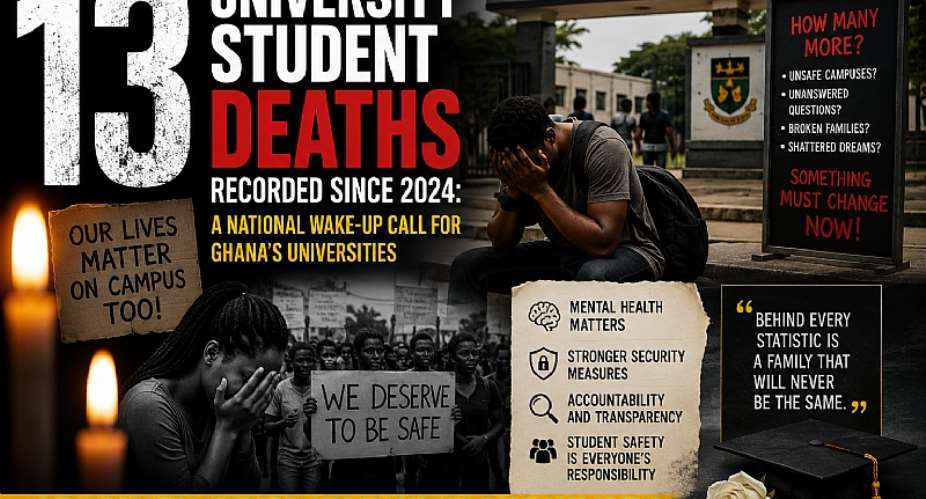
The death of a student is never just a statistic. It is a shattered dream, a grieving family, an empty seat in a lecture hall, and a future that will never be fulfilled.
Reports of university student deaths across Ghanaian campuses since 2024 have sparked growing concern among students, parents, university authorities, and the wider public. Incidents ranging from suspected murders and accidents to unexplained deaths and mental health-related cases have raised difficult questions about safety, security, student welfare, and accountability in Ghana's higher education system. Recent cases at institutions such as Kwame Nkrumah University of Science and Technology and University of Cape Coast have intensified public concern and prompted investigations.
The Question Nobody Wants to Ask
If 13 university students have died since 2024, are these isolated tragedies, or are they warning signs of deeper problems within our universities and society?
Many discussions focus on finding who is responsible after a tragedy occurs. But perhaps the more uncomfortable question is:
Why are we repeatedly reacting after deaths instead of preventing them before they happen?
A Historical Perspective
Universities were once viewed as some of the safest places in Ghana. Parents sent their children to institutions hundreds of kilometers away with confidence that they would return home educated, responsible, and safe.
Historically, student security concerns were often limited to theft, occasional campus violence, or political demonstrations. Today, however, universities are dealing with a more complex mix of challenges:
Increasing student populations.
Expansion of off-campus hostels.
Mental health pressures.
Social media-related risks.
Relationship-related violence.
Substance abuse concerns.
Weak monitoring in some student communities.
The university environment itself has changed dramatically over the last decade.
Are Campus Deaths Becoming a Trend?
No responsible analyst should conclude that university deaths are becoming "normal."
However, the frequency with which tragic incidents are being reported has created a perception among students and parents that something is changing.
Recent investigations involving student deaths at KNUST and UCC demonstrate that these incidents are not limited to one institution. Authorities have repeatedly launched investigations while universities have pledged to strengthen safety measures.
The truly frightening question is:
How many warning signs existed before these deaths occurred?
Did friends notice unusual behavior?
Did security systems fail?
Did someone see something suspicious and remain silent?
Are Ghanaian Universities Safe?
This question deserves an honest answer.
Most universities in Ghana have security departments, surveillance systems, campus patrols, and collaboration with the Ghana Police Service.
Yet security experts often point out that no security system can fully protect students who spend significant amounts of time outside controlled campus environments.
Many students live in private hostels, rent apartments off-campus, travel at night, and interact with individuals unknown to university authorities.
Therefore, while institutions have responsibilities, personal security remains equally important.
Should We Always Blame Authorities?
This is perhaps the hardest question.
Whenever tragedy strikes, public anger naturally turns toward university management.
Sometimes this criticism is justified.
But should every death automatically be blamed on university authorities?
Not necessarily.
Students are adults. They make independent decisions daily:
Where they go.
Who they meet.
When they travel.
Which social activities they engage in.
A university can provide security personnel, cameras, and emergency systems, but it cannot follow every student everywhere.
The uncomfortable reality is that personal responsibility and institutional responsibility must work together.
What Are Students Saying?
Across campuses and online discussions, students frequently express concerns about:
Poor lighting in some areas.
Security gaps around private hostels.
Slow emergency response times.
Mental health struggles.
Academic pressure.
Financial hardship.
Some students have also raised concerns that mental health support remains inadequate compared to the growing pressures students face. Discussions among Ghanaian students online suggest increasing concern about stress, depression, isolation, and the lack of visible intervention systems.
What Are Universities Doing?
Many universities have responded by:
Increasing security patrols.
Collaborating with police investigators.
Installing additional surveillance systems.
Strengthening student support services.
Expanding counseling initiatives.
Conducting awareness campaigns.
Following recent incidents, university authorities have repeatedly emphasized their commitment to student safety while cooperating with police investigations.
Yet another critical question remains:
How do universities measure whether these interventions are actually working?
Should Students Sign Exit Permissions Before Leaving Campus?
This idea occasionally surfaces after major incidents.
While it may sound attractive from a security perspective, practical challenges exist.
Universities are institutions for adults, not boarding secondary schools.
Requiring exit permits could raise concerns about:
Personal freedoms.
Privacy rights.
Administrative burden.
Practical enforcement.
However, universities could explore voluntary safety systems, including:
Student safety applications.
Emergency check-in systems.
Location-sharing options.
Night transportation support.
Anonymous reporting channels.
Why Are Parents So Worried?
Because every phone call now carries fear.
Every delayed response to a message creates anxiety.
Every news report about a university student death reminds parents that the child they sacrificed to educate could become the next headline.
Many parents increasingly ask:
If universities cannot guarantee safety, where can young people truly feel secure?
This emotional burden is becoming part of the university experience for families across Ghana.
What Is Government Doing?
Government agencies, security services, and educational authorities continue to work with universities when major incidents occur.
Police investigations have been launched in several recent cases involving university students. Senior law enforcement officials have also deployed specialized investigative teams in certain cases.
Yet many observers argue that prevention deserves as much attention as investigation.
The focus should not only be on solving deaths after they occur but also on reducing the likelihood of future tragedies.
The Scariest Part of All This
The most frightening aspect is not simply that students are dying.
It is that many incidents begin as ordinary days.
A student attends lectures.
Chats with friends.
Makes plans for the future.
Calls home.
And then something goes terribly wrong.
Every tragic case leaves behind unanswered questions, unfinished dreams, and grieving families searching for meaning.
The Bigger Question Ghana Must Answer
Perhaps the question nobody is asking loudly enough is this:
Have we invested enough in protecting the mental, emotional, and physical well-being of our university students, or have we focused almost entirely on academic success while neglecting safety and welfare?
The deaths of 13 students should not merely become another statistic in a report.
They should serve as a national moment of reflection.
Because universities are not only places where students learn.
They are places where futures are supposed to begin not end.
By:
Patrick Belebang Yagsori
+233240292413
[email protected]
 Ofori-Atta is still a citizen of Ghana, amenable to be extradited — OSP
 We were in power for eight years but couldn't complete Afari Military Hospital y...
 NUGS condemns alleged sexual misconduct involving teacher and student at Bole SH...
 Ken Ofori-Atta grabs U.S. permanent residency status
 2026 World Cup: Thomas Partey granted Canadian visa after court intervention
 There are efforts to help Sedina Tamakloe evade 10-year sentence — NPP alleges
 Spiritualist reveals how some pastors go for powers to fill their churches and d...
 'I didn’t say Wontumi must be jailed' – United Party Research Director
 Fuel prices drop as OMCs cut petrol, diesel prices by GH¢1.33, GH¢0.55 in June p...


