




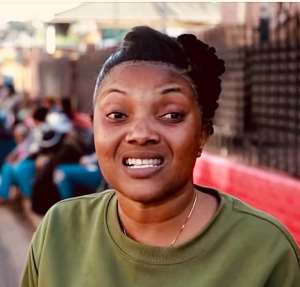
In the heart of Durban, a painful and deeply unsettling story is unfolding one that forces uncomfortable questions about identity, citizenship, governance, and the fragile promise of safety in modern Africa.
Princess Adjei, a 33-year-old Ghanaian woman raised in South Africa, fluent in Zulu and fully integrated into the social fabric of the country she calls home, now finds herself homeless alongside her 14-year-old son. Once a small business owner running a salon in central Durban, she is now reportedly sleeping on the street outside the Department of Home Affairs with nearly 200 other displaced migrants.
Her story is not just personal tragedy it has become a mirror reflecting wider tensions within South African society.
A Dream Built, Then Destroyed
According to reports, Princess Adjei invested approximately R50,000 into renovating her salon, a space that represented stability, dignity, and independence. On May 18, 2026, that dream was shattered when protesters associated with an anti-migrant movement allegedly looted and destroyed her business during demonstrations in Durban.
With her livelihood gone, she could no longer afford rent and was forced out of her apartment. Today, she and her son survive in extremely vulnerable conditions, part of a larger displaced group seeking verification of their legal residency status.
But beneath the surface of this single story lies a much larger and more difficult national conversation.
The Questions No One Wants to Ask
When societies begin to normalize repeated cycles of xenophobic violence, displacement, and destruction of livelihoods, silence becomes complicity. And so the questions arise questions that many are afraid to confront directly:
Why do these patterns of violence against foreign nationals continue to emerge in specific communities and during politically sensitive periods?
Why are ordinary workers, shop owners, and families made the primary targets of frustration over unemployment, inequality, and poor service delivery?
Where does legitimate protest end and collective punishment begin?
And perhaps most importantly: why does it appear that state institutions are repeatedly struggling to prevent escalation before it turns into destruction?
These are not comfortable questions but they are necessary ones.
A State Under Pressure, or a System Under Strain?
South Africa’s constitution is widely regarded as one of the most progressive in the world, explicitly protecting human dignity and the rights of all people within its borders, regardless of nationality. Yet the recurring outbreak of xenophobic violence raises difficult questions about enforcement, policing capacity, and political accountability.
Why do intelligence systems often fail to anticipate or neutralize organized unrest before it spreads?
Why do displaced groups frequently report contradictory experiences being escorted to safety at one point, and later allegedly being dispersed with force?
And why does it seem that long-term solutions to migration tensions remain politically unresolved, leaving space for periodic eruptions of anger?
These are not accusations they are structural questions about governance, trust, and institutional effectiveness.
The Politics of Anger and the Timing of Unrest
Analysts often point out that anti-migrant sentiment in South Africa tends to intensify during periods of economic strain and ahead of elections. In this context, migration becomes a symbolic lightning rod for deeper frustrations unemployment, inequality, and competition for limited resources.
But when political frustration is redirected toward vulnerable migrant communities, another question emerges:
Who benefits when social anger is channeled away from structural reform and toward visible, powerless targets?
And what responsibility do political actors carry when rhetoric hardens into action on the streets?
A Woman Between Two Worlds
Princess Adjei’s situation also raises a deeply human contradiction.
She is not an outsider in the conventional sense. She grew up in South Africa. She speaks Zulu fluently. She built a business in Durban. She raised her child there.
So what, then, defines belonging?
Is it birthplace? Citizenship documents? Language? Contribution to society?
Or is belonging something more fragile something that can be revoked in moments of collective anger?
Her case forces an uncomfortable reflection on how quickly integration can be erased when identity becomes politicized.
The Silence That Echoes Loudest
Perhaps the most haunting part of this story is not only what happened but what appears to be happening around it.
Displacement camps forming in public spaces. Families sleeping in the open. Children caught in cycles of instability. And ongoing uncertainty over legal status and protection.
Each of these realities raises one central question:
At what point does a society recognize that the repeated failure to protect the vulnerable is itself a crisis?
“May Africa Never Forget”
The phrase circulating around this incident “May Africa never forget” is not just emotional language. It is a warning.
A reminder that history is shaped not only by what happens, but by what is allowed to continue.
Because when destruction becomes routine, and displacement becomes predictable, and accountability becomes delayed, then society is no longer reacting to crisis it is normalizing it.
And that is where the most important question remains:
What kind of Africa is being built when dignity becomes conditional, and safety becomes uncertain?
By:
Patrick Belebang Yagsori
+233240292413
[email protected]
 2026 World Cup: Thomas Partey granted Canadian visa after court intervention
 There are efforts to help Sedina Tamakloe evade 10-year sentence — NPP alleges
 VIDEO: You are father for all, please don’t let Wontumi go to prison – NPP's Pau...
 Spiritualist reveals how some pastors go for powers to fill their churches and d...
 'I didn’t say Wontumi must be jailed' – United Party Research Director
 Fuel prices drop as OMCs cut petrol, diesel prices by GH¢1.33, GH¢0.55 in June p...
 Mahama is really interested in fighting corruption, making procurement better — ...
 June 16: Cedi sells at GHS12.30 on forex market, GHS11.11 on BoG interbank
 How does a lean government end up with a significantly higher compensation bill?...
 President Mahama heads to Abidjan for high-level cocoa economy summit


