




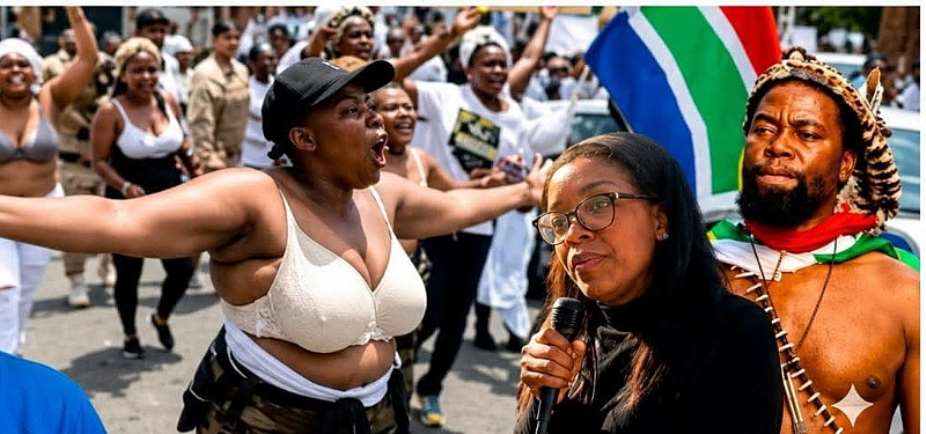
In recent days, a viral claim circulating on social media has suggested that “Zulu women in South Africa are expressing frustration over Ghanaian men marrying outside their communities,” with emotional scenes allegedly calling for husbands to “return home” and preserve cultural ties.
At first glance, the story is striking. It touches on marriage, identity, masculinity, migration, and cultural preservation issues that are deeply emotional and politically sensitive in both South Africa and Ghana. But when examined critically, several important questions arise: How true is this claim? Who is speaking? And what broader social dynamics are being misrepresented or exaggerated online?
1. Where Did This Claim Come From?
So far, the narrative appears to originate primarily from social media posts, short-form videos, and reposted commentary rather than verified journalism or official community statements.
This matters.
In the digital age, emotionally charged content especially involving gender, ethnicity, and migration can spread faster than verified facts. Often, a single clip or anecdote is amplified into a “community-wide sentiment,” even when it reflects only a small or unverified group.
There is currently no credible national survey, government report, or recognized community statement confirming that Zulu women collectively oppose marriages involving Ghanaian men or that they are demanding their return.
2. Are Ghanaian Men Commonly Marrying South African Women?
There is no documented trend showing Ghanaian men disproportionately marrying women from any single South African ethnic group, including the Zulu community.
Like many African diaspora communities, Ghanaian migrants in South Africa are part of broader urban, multicultural environments where relationships form across nationality, ethnicity, and race.
Marriage patterns in such contexts are usually influenced by:
Urban migration and proximity
Employment networks
Shared religious or educational spaces
Individual personal relationships not ethnic strategy or collective cultural decisions
Reducing this complexity to a narrative of “community frustration” risks oversimplifying human relationships into ethnic competition.
3. What Are South African Women Actually Saying?
When we examine verified public discourse in South Africa, discussions involving women Zulu or otherwise tend to focus more on:
Economic hardship affecting marriage stability
Gender-based violence and safety concerns
Unemployment and household pressures
Changing cultural expectations in modern relationships
There is no consistent, verified public movement or statement from Zulu women as a group targeting Ghanaian men or foreign husbands in general.
However, what does exist online is fragmented emotional expression some of it frustration, some satire, and some personal relationship experiences that are being generalized unfairly.
4. Why These Narratives Spread So Fast
This type of story gains traction because it sits at the intersection of several sensitive themes:
Migration anxiety (foreigners in local communities)
Cultural identity concerns
Gender and relationship tensions
Economic insecurity and competition narratives
When combined, these factors create fertile ground for viral misinformation.
Importantly, such narratives often do not ask:
Who benefits from this framing?
Are real communities actually organized around this issue?
Or is this emotional content being recycled for engagement?
5. What Are Governments Saying?
Neither the government of South Africa nor that of Ghana has issued any official statement acknowledging such a development.
At the policy level, both countries generally maintain:
Respect for individual marriage rights
Non-interference in private relationships
Focus on immigration regulation, not marital control
If anything, official discourse tends to emphasize social cohesion and anti-xenophobia efforts, particularly in South Africa, where tensions involving foreign nationals have historically surfaced in different economic contexts not marital disputes.
6. If the Narrative Were True, What Would Be the Impact?
Even if we hypothetically treat this as a real widespread sentiment (which evidence does not support), the implications would be serious:
For Families and Children
Children in cross-national families could face identity confusion or stigma
Family separation narratives could increase emotional stress
Mixed-national households could experience social pressure or discrimination
For Communities
Increased mistrust between local and migrant communities
Reinforcement of stereotypes about foreign men in relationships
Weakening of social cohesion in already economically stressed areas
For Cultural Groups (Including Zulu Identity)
The Zulu people are one of the most culturally rich and historically significant groups in Southern Africa. However, reducing their identity to a single emotional reaction online is misleading and harmful.
Cultural identity is not static it evolves through education, migration, intermarriage, and modern urban life.
7. The Bigger Issue: Misrepresentation of African Social Realities
What this viral narrative reveals is less about Ghanaian men or Zulu women and more about how African social issues are being reframed online:
Complex migration stories become ethnic conflict narratives
Personal relationships become “community disputes”
Emotional videos replace verified reporting
This is dangerous because it can slowly reshape how Africans perceive each other across borders especially between countries like Ghana and South Africa, which share deep historical and cultural ties.
Conclusion: Asking the Hard Questions
Before accepting such viral claims, we must ask:
Who recorded the original scenes, and in what context?
Are we seeing individuals or being told they represent entire communities?
Why are cross-cultural African relationships being framed as conflict rather than normal human interaction?
And most importantly: what truth is being lost in the noise of virality?
In reality, there is currently no verified evidence of a coordinated or widespread movement of Zulu women opposing Ghanaian men or their marriages.
What exists instead is a familiar digital pattern: emotionally charged content, amplified by repetition, detached from context, and transformed into perceived reality.
And in that gap between perception and truth, misunderstanding grows fastest.
By:
Patrick Belebang Yagsori
+233240292413
[email protected]
 2026 World Cup: Thomas Partey granted Canadian visa after court intervention
 There are efforts to help Sedina Tamakloe evade 10-year sentence — NPP alleges
 VIDEO: You are father for all, please don’t let Wontumi go to prison – NPP's Pau...
 Spiritualist reveals how some pastors go for powers to fill their churches and d...
 'I didn’t say Wontumi must be jailed' – United Party Research Director
 Fuel prices drop as OMCs cut petrol, diesel prices by GH¢1.33, GH¢0.55 in June p...
 Mahama is really interested in fighting corruption, making procurement better — ...
 June 16: Cedi sells at GHS12.30 on forex market, GHS11.11 on BoG interbank
 How does a lean government end up with a significantly higher compensation bill?...
 President Mahama heads to Abidjan for high-level cocoa economy summit


