




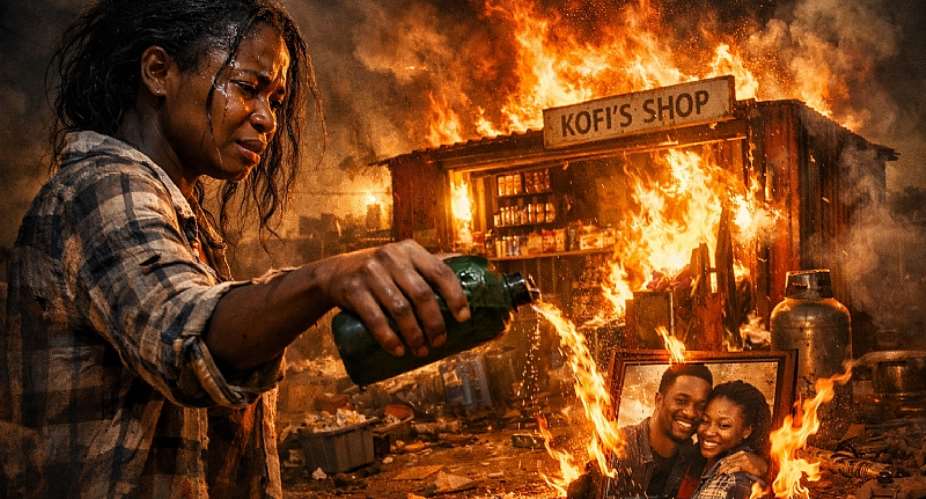
In the quiet commercial landscape of Drobo in the Bono Region, a deeply unsettling incident has once again forced Ghanaian society to confront an uncomfortable question: How far can emotional pain push a person before it becomes destruction?
A 24-year-old woman is alleged to have set fire to her boyfriend’s container shop following accusations of infidelity. The blaze reportedly spread rapidly through the metal container structure, consuming goods, equipment, and other valuables before residents could mobilize to control it. What was once a small business hub turned into ashes within minutes leaving behind not just material loss, but emotional and economic ruin for all involved.
But beyond the flames lies a deeper story that many are now beginning to ask: Why does heartbreak increasingly translate into destruction in modern relationships?
A Pattern Beyond One Incident
While this incident is shocking, it is not entirely isolated. Over the past decade, Ghana and many parts of West Africa have witnessed a troubling rise in relationship-related violence escalating into property damage, assaults, and in extreme cases, loss of life.
What used to be private disputes are now becoming public disasters often fueled by jealousy, mistrust, and unresolved emotional trauma.
Psychologists describe this pattern as emotional dysregulation in intimate relationships, where individuals, unable to process betrayal or perceived betrayal, resort to impulsive acts of retaliation.
But the critical question remains:
At what point did heartbreak become a justification for destruction?
The Psychological Undercurrent: Betrayal and Emotional Explosion
If the allegations are accurate, the trigger in Drobo was infidelity accusations. In many relationships, cheating whether proven or suspected acts as a psychological detonator.
Experts note several contributing factors:
Emotional dependency: When identity and stability are tied to a partner, betrayal feels like total collapse.
Lack of conflict resolution skills: Many young couples lack healthy communication tools.
Social media amplification: Suspicion is often fueled by screenshots, rumors, and indirect online evidence.
Economic vulnerability: When relationships are tied to financial support or shared ventures, emotional conflict becomes material conflict.
Yet none of these explain or justify destruction. They only explain escalation.
So another question emerges:
Are we failing to teach emotional control as seriously as we teach formal education?
Economic Consequences: More Than Just a Burnt Container
Container shops are a lifeline for many young entrepreneurs in Ghana. They represent:
Startup capital for small businesses
Family survival income
A stepping stone out of unemployment
The destruction of such a shop is not just a personal loss it is an economic setback that can wipe out years of effort.
In Drobo, the fire reportedly consumed all goods inside before neighbors could intervene. This raises further concerns about:
Lack of rapid emergency response systems in smaller towns
Absence of fire prevention awareness for container-based businesses
The vulnerability of informal sector entrepreneurs
One destroyed container can mean:
School fees gone
Loans defaulted
Family support cut off
So we must ask again:
Should emotional disputes be allowed to destroy entire economic futures?
Community Reactions: Shock, Sympathy, and Division
In many Ghanaian communities, such incidents often split opinion sharply.
Some residents express sympathy for emotional distress, suggesting the woman may have acted out of deep pain and betrayal. Others, however, see the act as criminal destruction that must face legal consequences regardless of emotional triggers.
Typical sentiments circulating in such communities include:
“Love is not an excuse for destruction.”
“If cheating is proven, it should be handled legally, not with fire.”
“What about her future after this act?”
“What about the man who lost everything?”
This emotional division reflects a broader societal struggle: balancing empathy with accountability.
The Legal Reality: Where Emotion Meets the Law
Under Ghanaian law, intentional destruction of property especially through fire is a serious criminal offense. Even if emotional distress is proven, it does not eliminate liability.
Legal experts generally emphasize:
Arson is treated as a felony
Intent, even in emotional states, can still lead to prosecution
Compensation for damages may be required if guilt is established
This raises another difficult question:
Should emotional trauma reduce legal responsibility or does that open a dangerous precedent?
The Bigger Questions Nobody Is Asking
Beyond the headlines, Drobo forces a national reflection:
Why are young relationships increasingly ending in destruction instead of separation?
Are emotional education and counseling accessible enough in rural and semi-urban areas?
How many more livelihoods must be destroyed before relationship conflict is taken as a public safety issue?
Are we normalizing revenge as a response to heartbreak through social media culture?
And most importantly: why is emotional pain increasingly expressing itself through fire, violence, and irreversible actions?
Conclusion: When Love Becomes a Battlefield
The Drobo container fire is more than a personal tragedy it is a mirror reflecting a growing emotional crisis in modern relationships. It shows how quickly love can transform into loss, and how unchecked emotions can destroy not only relationships but entire livelihoods.
A container shop can be rebuilt. Trust, reputation, and peace of mind are far harder to restore.
As investigations continue, one truth remains clear:
No heartbreak should ever end in ashes.
By:
Patrick Belebang Yagsori
+233240292413
[email protected]
 June 12: Cedi appreciates, sells at GHS12.50 on forex market, GHS11.06 on BoG in...
 'Unemployment requires deeper structural reforms, not slogans' – Stephen Amoah c...
 UE/R: Sandema flooded as heavy rains cut off major road
 Nigeria killed 13,000 'terrorists' in past year — President Tinubu
 Take the path to greatness through constitution review — Barker-Vormawor to Maha...
 Ghana evacuates over 500 citizens displaced by Abidjan demolition exercise
 Youth keep acquiring degrees with no end in sight due to lack of jobs — Sammi Aw...
 2026 World Cup: Black Stars arrive in Rhode Island for final phase of preparatio...
 Adu-Boahene trial: Prosecution witness denies claims of inter-branch fund transf...
 Sales boy captured on CCTV cameras stealing GH¢217,000 from employer jailed 36 m...


