




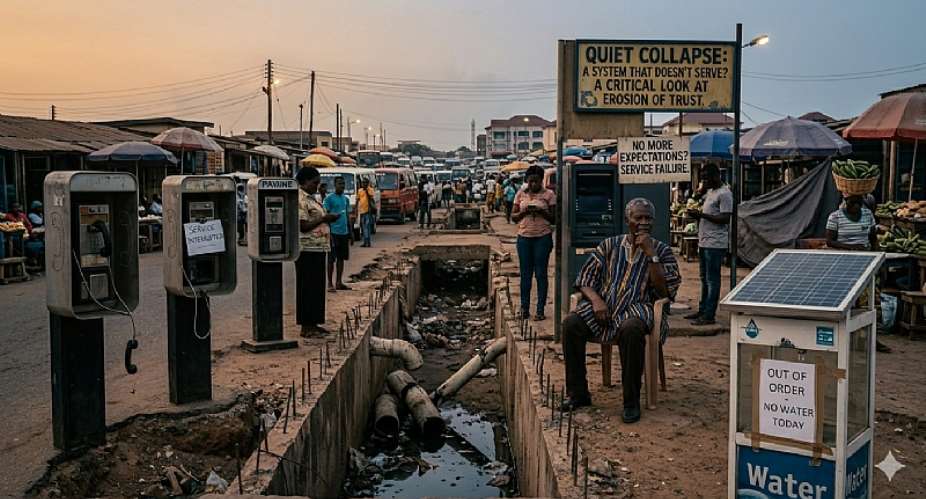
There is a slow, almost invisible crisis unfolding in many societies today. It does not announce itself with sirens or headlines. It does not collapse buildings or overthrow governments overnight. Instead, it shows up in smaller, quieter moments: when a citizen assumes a public office will be closed without explanation, when a utility outage is expected rather than surprising, when a service appointment is confirmed but never honored, or when “follow up later” becomes a national policy in practice.
This is the quiet collapse of trust in everyday services the growing belief that systems are unreliable, inconsistent, and fundamentally unworthy of expectation.
And once a society reaches that point, something deeper than infrastructure begins to break.
The Historical Backbone: When Systems Were Trusted
There was a time real or imagined, depending on who you ask when public systems carried an assumption of predictability. Post offices delivered letters. Hospitals responded. Schools opened on time. Electricity failures were exceptions, not expectations. Bureaucracies, though imperfect, were still anchored in a sense of duty and structure.
This trust was never absolute, but it was enough to hold society together.
Historically, the rise of modern states was built on one central promise: if you participate, the system will respond. Taxes would translate into services. Rules would produce order. Institutions would act as neutral engines of fairness.
But over time, pressures began to strain this promise population growth, political instability, underinvestment, corruption, weak accountability systems, and rapid urbanization. What started as occasional inefficiencies slowly hardened into patterns. And patterns, once normalized, become culture.
The Silent Shift: From Expectation to Suspicion
At some point, citizens stop asking, “Will it work?” and begin asking, “Will it fail this time or next time?”
This shift is subtle but transformative.
When a society no longer expects systems to function reliably, it develops coping mechanisms:
People bypass formal systems and rely on personal networks
“Who you know” becomes more powerful than “what exists”
Citizens prepare backup plans for basic services
Delay becomes normalized as part of the process
Frustration is replaced by resignation
The most dangerous part is not anger it is acceptance.
Because once people stop being shocked by failure, they also stop demanding improvement.
The Questions Nobody Is Asking
Here are the uncomfortable questions emerging beneath the surface:
Why do citizens plan their lives around system failure rather than system reliability?
What happens to a nation when efficiency is no longer expected but considered luck?
At what point does repeated inconvenience become psychological conditioning?
And perhaps most critically:
Is the system failing the people or have the people adapted so deeply to failure that they no longer recognize dysfunction as abnormal?
These are not just administrative questions. They are societal ones.
The Psychological Cost: Living in Permanent Uncertainty
A society that cannot trust its systems develops a different emotional rhythm. People begin to live in a state of constant adjustment. Plans are provisional. Promises are conditional. Hope becomes tactical rather than structural.
Over time, this produces fatigue not just physical, but civic fatigue.
Citizens begin to disengage. Not because they do not care, but because caring repeatedly without results becomes emotionally expensive.
This is where trust erosion becomes dangerous: it does not just weaken institutions it weakens participation.
The Economic and Social Effects
The consequences ripple outward:
Productivity declines, because time is wasted compensating for inefficiency
Informal systems grow, often unregulated and unequal
Corruption finds fertile ground, as gatekeeping replaces transparency
Innovation slows, because predictability is necessary for investment
Inequality deepens, since those with connections bypass broken systems
In such environments, survival often depends less on systems and more on personal adaptability. And when adaptability replaces structure, inequality becomes embedded rather than accidental.
What Do Citizens Expect Now?
Interestingly, citizens rarely expect perfection. What they often ask for is simpler:
Reliability over brilliance
Honesty over promises
Communication over silence
Accountability over excuses
Consistency over miracles
In other words, people do not demand extraordinary systems. They demand systems that do not constantly fail in ordinary ways.
The tragedy is that even this modest expectation increasingly feels ambitious.
The Real Danger: Normalized Dysfunction
Perhaps the most alarming outcome is normalization.
When dysfunction becomes routine, it stops being seen as a problem. It becomes “just how things are.”
And once that happens, reform becomes harder not because solutions are unavailable, but because urgency disappears.
A society can survive inefficiency. It can even survive corruption in pockets. But what is far more destabilizing is when citizens collectively lose the expectation that things should work at all.
That is not just institutional decay. It is cultural resignation.
The Way Forward: Rebuilding the Invisible Contract
Rebuilding trust does not begin with grand reforms alone. It begins with small, consistent acts of reliability. Systems that do what they say they will do. Institutions that communicate clearly when they cannot. Leaders who treat predictability as a form of respect.
Because at its core, trust is not built through perfection. It is built through consistency.
And once lost, it returns slowly not through speeches, but through repeated proof that the ordinary can be relied upon again.
Final Reflection
Perhaps the most unsettling question of all is this:
If a society stops expecting its systems to work, what exactly is it building its future on?
Because no nation can develop on hope alone. It needs structure that responds, systems that function, and institutions that earn belief not through words but through performance.
Until then, citizens will continue to live in the quiet space between expectation and disappointment adjusting, adapting, and surviving a system they no longer fully trust.
By:
Patrick Belebang Yagsori
+233240292413
[email protected]
 'Non-tariff barriers are hurting African trade' — Trade Minister calls for seaml...
 Lawyer Andy Appiah Kubi dumps Chairman Wontumi ahead of galamsey judgment
 Visa rejection dashes World Cup hopes of Ivory Coast and Senegal fans
 'Your citizens will still leave our country' — South African activist fires back...
 Anti-LGBTQ bill: 'It's not true that Parliament cannot reconsider a passed bill'...
 New NAIMOS Operations Director pledges stronger fight against galamsey
 Ghana attracting bad actors through ECOWAS free movement system — GIS laments ab...
 Court grants Abronye DC permission to travel abroad for master’s programme
 Afari Hospital Project: “They slept on a 3-year project for eight years” – Brogy...
 Chairman Wontumi seeks plea deal in GH¢30m Exim Bank fraud case


