




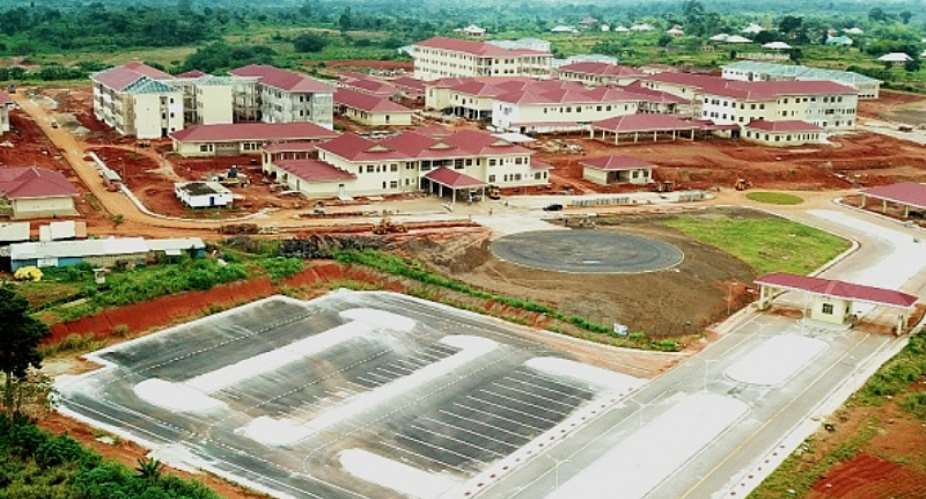
The story of the Afari Military Hospital is not just about bricks, cement, and hospital equipment. It is a story about hope. It is a story about promises made to millions of people in the middle and northern sectors of Ghana. It is a story that forces us to ask difficult questions about how major national projects are managed.
For many residents of the Ashanti Region, the unfinished hospital standing at Afari is more than a construction project. It is a symbol of expectations delayed, opportunities postponed, and lives potentially affected by the absence of a fully operational healthcare facility.
How Did the Idea Begin?
One fact often overlooked is that the Afari Military Hospital project did not begin when construction started.
Official records indicate that the contract agreement for the hospital was signed between the Government of Ghana and Egyptian construction firm Euroget De-Invest in 2008. The facility was originally planned for Tamale, later considered for Accra, before finally being relocated to Afari in the Ashanti Region. The project was designed as a modern 500-bed military hospital with residential accommodation for staff and specialized medical facilities.
The vision was ambitious.
The hospital was intended to reduce pressure on the already burdened 37 Military Hospital in Accra while serving both military personnel and civilians across large parts of Ghana.
Who Really Started the Project?
Based on publicly available records, the project was initiated under the administration that governed Ghana in 2008 when the agreement was signed. Physical construction, however, commenced in 2014 after various preparatory processes and contractual arrangements.
This distinction is important because many public discussions confuse the signing of the project agreement with the start of actual construction.
The truth is that major infrastructure projects often pass through several governments before becoming reality.
How Was the Project Funded?
The hospital was conceived as a turnkey project under an agreement with Euroget De-Invest. Public reports indicate that financial approvals, funding arrangements, and credit facility issues became major factors affecting progress over the years.
While politicians frequently debate who deserves credit, verified records show that funding and approvals for different phases occurred across multiple administrations.
The reality is that no hospital of this scale is built overnight. It requires sustained financial commitment over many years.
Why Has the Hospital Not Been Completed?
This is where the story becomes troubling.
The hospital was initially expected to be completed years ago. Yet more than a decade after construction began, completion has remained elusive. Official explanations have included:
Financial constraints.
Delayed tax exemption approvals.
Contractual disputes between contractors and subcontractors.
Site relocation challenges.
Legal and technical issues.
Delays in releasing funds.
Government officials have repeatedly announced completion timelines.
In 2021, Parliament was informed that the project was about 92% complete and could be commissioned within a year.
In 2023, contractors indicated that released funds would enable completion by March 2024.
In 2025, another target of September 2025 was announced.
Yet by 2026, discussions about completion were still ongoing.
The Questions Nobody Is Asking
Perhaps the most important questions are not political.
They are human.
How many patients who could have benefited from specialist treatment never got the chance?
How much money has been spent maintaining an unfinished facility?
What is the real economic cost of a hospital standing idle for years?
How many healthcare workers could have been trained and employed there?
Why do project completion dates keep changing?
What mechanisms exist to hold all stakeholders accountable when major public projects miss deadlines?
Should Ghana publish annual public audits of all delayed national projects?
These are not questions about parties.
They are questions about governance, transparency, and public value.
What Are Citizens Saying?
Across communities in the Ashanti Region, frustration is evident.
Many residents see the facility as a critical healthcare resource that should already be serving patients. Others wonder why a project that appears physically advanced has taken so long to become operational. Similar sentiments appear frequently in public discussions, media reports, and community conversations.
The concern is understandable.
When people pass a nearly completed hospital year after year, they naturally ask: "What is still missing?"
Why This Hospital Matters
The Afari Military Hospital is not merely another building.
It represents emergency care for accident victims.
It represents specialist treatment closer to home.
It represents jobs for healthcare professionals.
It represents reduced pressure on existing hospitals.
Most importantly, it represents hope for families who cannot afford to travel long distances in search of quality healthcare.
A Final Reflection
One day, the doors of the Afari Military Hospital will fully open.
Patients will fill its wards. Doctors and nurses will walk its corridors. Ambulances will arrive carrying people whose lives depend on timely care.
But when that day comes, Ghana must ask itself a deeper question:
Why did it take so long?
Because the true measure of a nation is not how many projects it announces.
It is how many promises it completes.
And for every year the Afari Military Hospital remains unfinished, the real cost cannot be measured only in cedis. It must also be measured in opportunities lost, healthcare delayed, and the patience of citizens who have waited far longer than they should have.
By:
Patrick Belebang Yagsori
+233240292413
[email protected]

 Baffour Awuah may spend night in EOCO custody — Lawyer
 Suspend Ghana-Colombia port and visa deals over cocaine seizures — Minority
 Ghana Law Society proposes National Service for fresh lawyers
 'We cannot continue to be a Bar of Accra, by Accra, for Accra' — Ghana Law Socie...
 Stop speculation, premature conclusions; allow investigation to determine Baffou...
 Judge halts Ex-NAFCO CEO's trial until ruling on seized phones
 Manhyia South MP who resisted arrest reports to EOCO a day after arrest warrant ...
 "Show us evidence" —Upper West teacher unions demand proof of payment before end...
 Adenta: Bolt driver jailed 25 years for cutlass attack and robbery of beautician...
 EOCO drags Manhyia South MP to former law firm, residence for search



Comments
Great submission Patrick. I hope the current government is listening. We are constantly working against our own progress with such irresponsible actions through the years.