




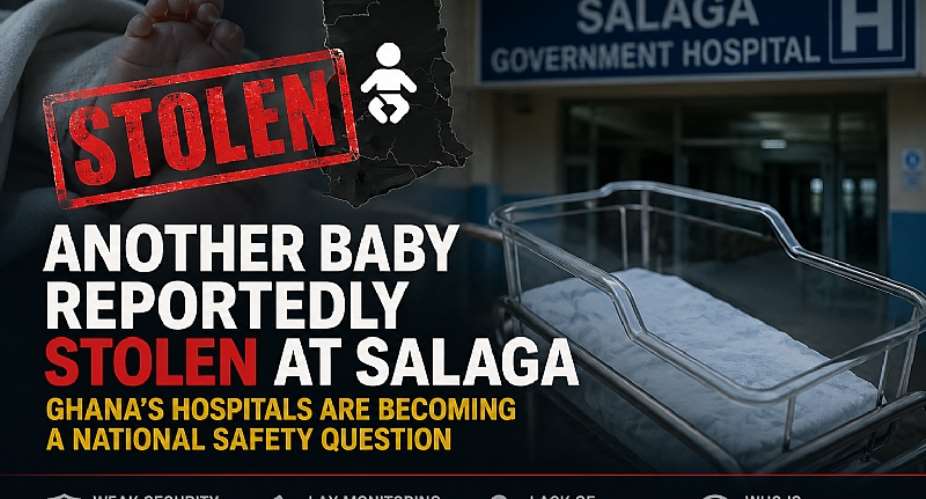
The reported disappearance of a newborn baby at the Salaga Government Hospital is not just another distressing headline it is another crack in a system that is increasingly struggling to assure citizens of the most basic expectation in healthcare: safety.
When a newborn can allegedly vanish from a maternity ward, then the issue is no longer only about one hospital, one incident, or one negligent moment. It becomes a national question about trust, oversight, and accountability within Ghana’s healthcare system.
And perhaps the most troubling part is this: we have heard this before. Too many times.
A Repeating Pattern That Demands Honesty
Over the years, Ghana has witnessed similar reports of babies allegedly disappearing from health facilities under unclear circumstances. Investigations are announced. Public outrage rises. Statements are issued. Then, silence gradually returns until the next incident.
So the unavoidable question is:
Why does this keep happening again and again in the same system that is supposed to protect life at its most vulnerable stage?
At what point do we stop treating these as isolated tragedies and begin confronting them as systemic failures?
Where Are Hospital Safeguards?
Hospitals are expected to be controlled environments with strict access management, identification protocols, and surveillance systems. Yet repeated incidents suggest serious gaps in enforcement.
The public is left wondering:
How secure are maternity wards in reality?
Who monitors entry and exit points in neonatal units?
Are CCTV systems functional and actively monitored or installed for formality?
How are newborn identification procedures enforced from delivery to discharge?
If a baby can allegedly leave a hospital unnoticed, then something fundamental in the system is not working as it should.
The Ghana Health Service Must Answer Beyond Statements
The Ghana Health Service (GHS) bears national responsibility for ensuring standards across public health facilities. Yet, the recurrence of such incidents raises uncomfortable questions about enforcement and compliance.
Policies may exist on paper, but the public is concerned about execution:
Are hospital security protocols routinely audited?
Are staff adequately trained and supervised?
What disciplinary actions follow proven breaches?
Why do systemic failures appear to persist despite repeated incidents?
At some point, policy without enforcement becomes nothing more than documentation.
Government Cannot Treat This as Routine
Government’s responsibility does not end with expressions of concern or directives for investigation. It includes ensuring that hospitals are adequately resourced, secured, and monitored.
This means:
Investing in hospital security infrastructure
Strengthening neonatal tracking systems
Ensuring proper staffing in maternity wards
Enforcing accountability when failures occur
But the deeper concern remains:
Why does reform in Ghana’s health system so often follow tragedy instead of preventing it?
A System Under Strain, Not Just an Incident
It would be irresponsible to frame this solely as an isolated criminal act. Repeated occurrences point toward broader systemic weaknesses that may include:
Poor surveillance and monitoring systems
Weak internal controls within facilities
Gaps in identity verification for newborns
Possible internal collusion in some cases
Delayed emergency response mechanisms
Each incident chips away at public confidence in the health system.
And trust, once broken in matters of life and safety, is not easily restored.
The Hard Questions Ghana Must Not Avoid
At this point, silence is no longer an option. The country must confront difficult questions, even if they are uncomfortable:
How safe is childbirth in public hospitals today?
Are current security measures sufficient for neonatal protection?
Who is ultimately accountable when a baby disappears?
How many similar cases never reach public attention?
Are investigations leading to structural reform or just procedural closure?
These are not rhetorical questions. They are governance questions.
Conclusion: A Warning Sign We Cannot Ignore
The alleged disappearance of a newborn at Salaga Government Hospital is not just a tragedy it is a warning.
A warning that Ghana’s healthcare safety systems require urgent strengthening, not reactive statements. A warning that public trust is being stretched thinner with each unresolved case. And a warning that the protection of life at its earliest stage must never be taken for granted.
If hospitals cannot guarantee the safety of newborns within their walls, then the nation must ask itself a serious question:
What exactly is failing and how long will it take before it is fixed?
Because in a functioning health system, a newborn should never have to be a missing person story.
By:
Patrick Belebang Yagsori
+233240292413
[email protected]
 Court grants Abronye DC permission to travel abroad for master’s programme
 Afari Hospital Project: “They slept on a 3-year project for eight years” – Brogy...
 Chairman Wontumi seeks plea deal in GH¢30m Exim Bank fraud case
 GH¢7 million Navrongo Youth Resource Centre stalled for nearly nine years amid l...
 BECE graduate feared dead after drowning in River Osen
 Nigerian man escapes from custody during prison van transfer in London
 Claim salaries of presidential staffers have increased under Mahama a flat lie —...
 Africa's 2026 World Cup teams carry continent's hopes — AU
 Niger criminalises same-sex relations with jail terms
 Over 260 Nigerians fleeing xenophobic attacks in S. Africa return home


