




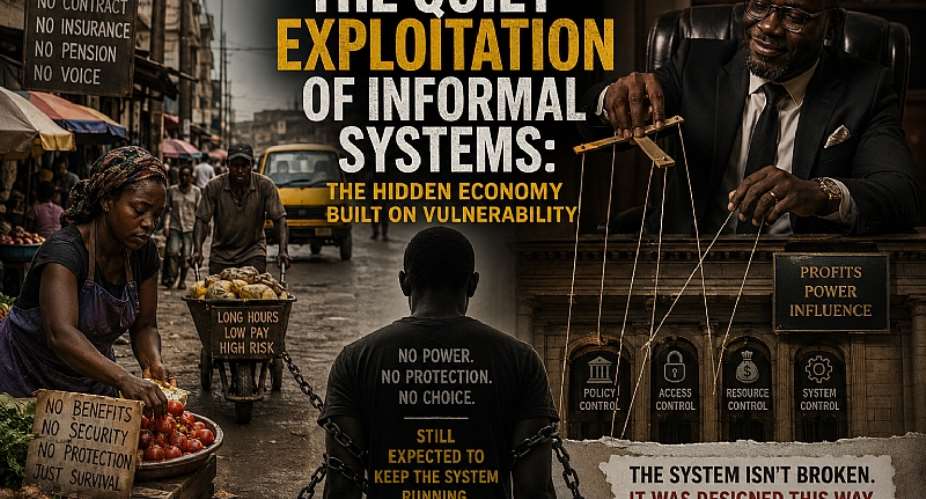
What Happens When the Rules Exist Only for Some?
Across the developing world, and particularly in many parts of Africa, millions of people survive not through formal institutions but through informal systems. They rely on informal employment, informal housing arrangements, informal transport networks, informal lending groups, and even informal healthcare solutions.
These systems often emerge because formal structures are inaccessible, expensive, inefficient, or simply absent. They fill gaps left by governments, businesses, and institutions. Yet beneath this apparent resilience lies a disturbing reality that few are willing to confront: many informal systems thrive because someone benefits from keeping them informal.
This raises a deeply uncomfortable question:
What if the very systems people depend on for survival are also the systems quietly exploiting them?
A Historical Background: How Did We Get Here?
Informal economies are not new. They have existed for centuries. However, their rapid growth accelerated during colonial administrations and continued after independence.
Many post-colonial governments inherited centralized economic systems that struggled to absorb rapidly growing populations. Urban migration increased, unemployment rose, and formal institutions failed to expand at the same pace.
As a result, people created their own solutions.
Street vending replaced unavailable jobs.
Informal transport filled transportation gaps.
Community savings groups replaced inaccessible banks.
Informal landlords provided housing where governments could not.
These innovations helped millions survive. But survival systems often evolve into power structures. Over time, some actors learned that operating outside formal regulations could become highly profitable.
The Mind-Blowing Question Nobody Is Asking
If informal systems are truly temporary solutions, why have they become permanent?
Why do millions remain trapped in systems with no contracts, no legal protections, no insurance, no pensions, and little accountability?
Could it be that some powerful interests benefit from maintaining this uncertainty?
When workers have no contracts, who benefits?
When traders pay unofficial fees, who collects them?
When citizens cannot access affordable formal services, who profits from informal alternatives?
These questions rarely dominate public discourse, yet they may reveal more about economic inequality than many official reports.
The Hidden Cost of Informality
At first glance, informal systems appear flexible and accessible.
But look deeper.
A street vendor may work twelve hours a day without health insurance.
A casual worker may earn income today but face poverty tomorrow.
An informal tenant may lose shelter overnight without legal protection.
An informal borrower may pay interest rates far exceeding those of formal banks.
The tragedy is not simply that these people face hardship.
The tragedy is that many have no realistic alternative.
Are Citizens Being Shortchanged?
Consider this carefully.
Governments celebrate economic growth.
Corporations report rising profits.
Cities continue expanding.
Yet millions remain outside formal systems that offer security and protection.
Why?
If development is truly occurring, why does informal employment continue to dominate in many countries?
If financial inclusion is improving, why do people still rely on risky informal lenders?
If housing policies are working, why do informal settlements keep growing?
The numbers may improve on paper while daily realities remain unchanged.
This is where exploitation becomes difficult to see.
It is not always dramatic.
It is often quiet.
It hides behind normality.
The Emotional Reality Behind the Statistics
Imagine spending twenty years working without a pension.
Imagine raising children without job security.
Imagine losing your only source of income because a local authority suddenly changes regulations.
Imagine paying unofficial fees every day just to earn an honest living.
For millions, this is not imagination.
It is life.
The people carrying the greatest economic risks are often the people with the fewest protections.
Yet society frequently praises their "resilience" instead of asking why they must be resilient in the first place.
Should resilience become a substitute for justice?
Should survival become a substitute for opportunity?
Is Every Informal System Bad?
Absolutely not.
Informal systems often demonstrate remarkable innovation, community solidarity, and adaptability.
Many families have escaped extreme poverty through informal entrepreneurship.
Community savings groups have financed education, businesses, and healthcare.
Informal networks frequently respond faster than formal institutions during crises.
The issue is not the existence of informal systems.
The issue is when informality becomes permanent because formal systems fail or because certain interests profit from keeping people outside them.
The Good Effects
Creates employment opportunities where formal jobs are scarce.
Encourages entrepreneurship and innovation.
Provides affordable services to underserved communities.
Strengthens community support networks.
Acts as an economic safety net during crises.
The Bad Effects
Lack of legal protections for workers.
Greater vulnerability to exploitation.
Limited access to credit and financial services.
Reduced tax revenue for public development.
Increased inequality and economic insecurity.
Absence of pensions, insurance, and workplace benefits.
The Bigger Question for Society
Perhaps the most important question is not whether informal systems should exist.
The real question is:
Why do so many people have no choice but to depend on them?
When millions operate outside formal protections, is that a sign of entrepreneurial freedom or evidence of institutional failure?
When entire sectors remain informal for decades, is it resilience or neglect?
And perhaps the most uncomfortable question of all:
If every citizen had access to fair opportunities, secure employment, affordable services, and strong institutions, would many of these informal systems still dominate our lives?
Conclusion: The Silence Must End
The quiet exploitation of informal systems rarely makes headlines. It lacks the drama of political scandals or economic crises. Yet its impact is felt every day by millions of ordinary people.
The vendor on the roadside.
The market porter.
The casual laborer.
The informal transporter.
The single mother running a small business without protection.
Their stories reveal a larger truth: economic growth means little if it leaves people permanently vulnerable.
The challenge before policymakers, business leaders, and citizens is not merely to celebrate survival. It is to create systems where survival is no longer the highest ambition.
Because a society should not be judged by how well people endure hardship, but by how effectively it reduces the need for hardship in the first place.
This article is designed to provoke reflection, challenge assumptions, and stimulate public debate about the often-overlooked consequences of informal economic systems.
By:
Patrick Belebang Yagsori
+233240292413
[email protected]
 Afari Hospital Project: “They slept on a 3-year project for eight years” – Brogy...
 Chairman Wontumi seeks plea deal in GH¢30m Exim Bank fraud case
 GH¢7 million Navrongo Youth Resource Centre stalled for nearly nine years amid l...
 BECE graduate feared dead after drowning in River Osen
 Nigerian man escapes from custody during prison van transfer in London
 Claim salaries of presidential staffers have increased under Mahama a flat lie —...
 Africa's 2026 World Cup teams carry continent's hopes — AU
 Niger criminalises same-sex relations with jail terms
 Over 260 Nigerians fleeing xenophobic attacks in S. Africa return home
 How angry mob vandalised Forestry Commission timber checkpoint housing structure...


