




Formerly in charge of sports and sustainability at France's Ministry of Sports and the World Wildlife Fund (WWF) France, Besson now advises French sports federations, insurance companies and local authorities through his agency Sport 1.5 – named for the Paris Agreement target to limit global warming to 1.5 degrees C. Sports ecological transition consultant Mael Besson, in June 2026.
RFI: What does sport have to do with the work of a conservation organisation like the WWF?
Mael Besson: Sport has a powerful influence on our lifestyles, habits, consumption and ideals.
The impact of an athlete drinking from a plastic bottle isn't limited to that one bottle. It's however many bottles are then consumed through imitation. And it's precisely because of this imitation effect that so many sponsors invest in sports: to promote and steer consumer behaviour towards their products.
RFI: The 2026 World Cup stands to be the most damaging yet in terms of climate change, but it's still world's biggest sporting celebration. What do you make of it?
MB: Societies throughout history have always needed moments to get people together. We need these moments of shared enthusiasm, be it cultural, religious, political. In this case, it's sport.
The problem lies in the format of this competition. It doesn't fit the trajectory for reducing greenhouse gas emissions to a level compatible with planetary limits.
The main issue is travel. A large proportion of the teams and fans who follow football are in Europe. This inevitably increases the number of people travelling, and travelling long distances, therefore by plane. Add to that a record number of teams, and this World Cup will be one of the most impactful. France's Kylian Mbappe scores for France in their opening game against Senegal in East Rutherford, New Jersey, 16 June 2026.
RFI: Then there's the issue of marketing and consumption…
MB: Yes, and that's not usually factored into an event's carbon footprint. This ripple effect isn't taken into account. We'll count the number of bottles consumed at the event venue, but not the additional consumption by television viewers worldwide. We don't have the figures, and major sponsors are careful not to disclose the return on their investments. It would be complicated, anyway, because it's not just consumption at a specific moment; it's long-term brand capitalisation.
France adopted the Evin Law [in 1991] banning alcohol and tobacco advertising because it influences our behaviour and ultimately our health. Given our planet's limits, we need an Evin Law for the climate.
Future of Olympics in doubt as climate change drives up temperatures
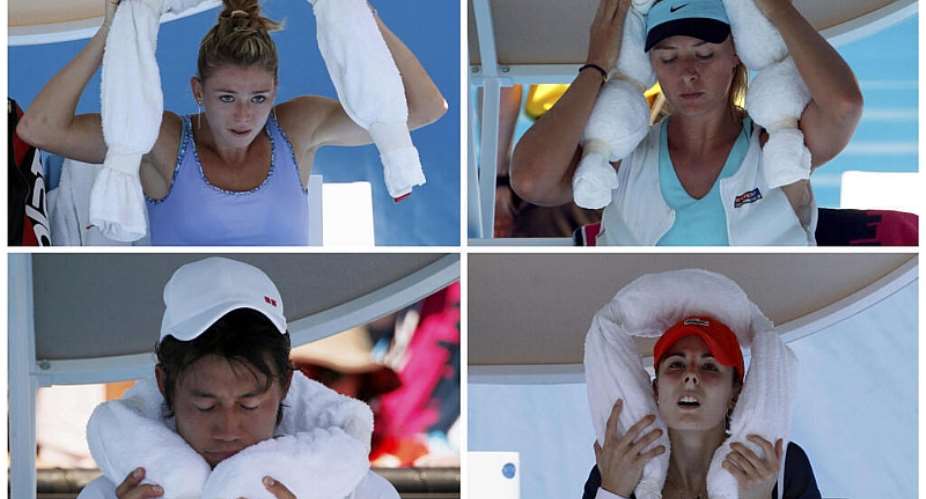
RFI: The World Cup may also put athletes at risk, with at least a quarter of matches expected to be played in potentially dangerous temperatures. Norwegian player Morten Thorsby has called on Fifa to do more to protect footballers from extreme heat and take care of the planet. Does football need more voices like his?
MB: We need more athletes to speak out, including for the very survival of the sport. Increasingly, extreme weather events will prevent events from taking place or damage sports infrastructure. Even insurance is a problem. When it comes to making the adjustments we'll need in the future, sport risks being a lower priority than other sectors such as healthcare, hospitals and schools. Football therefore has every reason to be a leading advocate for the climate.
Athletes have the most legitimacy to demand that reducing greenhouse gas emissions be taken into account when organising tournaments. But every time they speak out on these issues, athletes are to some extent criticised and accused of hypocrisy because they are obliged to follow an international circuit and be surrounded by sponsors.
In France, a collective of more than 50 athletes, the Climate Sport Camp, is working on this issue. This involves making public statements in the media and lobbying ministers, federations and event organisers.
RFI: What do you tell the athletes you work with about taking responsibility?
MB: The first thing I tell them, if they don't want to speak publicly, is to stop promoting things they should avoid doing. A story on social media filmed on a plane – we know it will have an impact. But no one will ask you why you've stopped posting stories from planes. And by doing so, you've stopped promoting this mode of transportation. So the first step is to clean up your communications.
The second option for the athlete is to contact the governing bodies of their sport privately or via the athletes' commissions. Then athletes can specify in their sponsorship contract that they will not travel to the other side of the world to shoot an advert for sunglasses, for example. This cuts down travel.
There are plenty of concrete actions like that which don't necessarily leave athletes exposed.
El Nino threat grows as Europe prepares for another hot summer
RFI: This year's Tour de France starts on 4 July and lasts three weeks. It draws hundreds of thousands of spectators during the peak summer holiday season. Should organisers change the timing or is that impossible for economic reasons?
MB: That schedule may not be compatible indefinitely with climate change. It seems inevitable to me that it will change. July will become increasingly risky in terms of temperatures and even fires. Crossing mountains covered in woods could become more difficult.
It had to be postponed during the Covid pandemic. I don't know what the financial results were like that year, but I would think the Tour de France has enough going for it to withstand being pushed back.
However, adapting could also involve adjusting the schedule or even the regulations: introducing water breaks or safety measures when it gets too hot. Or perhaps modifying the route, with less demanding stages. It will likely be a combination of all these things. The Tour de France cycling race during Stage 4 from Amiens to Rouen, 8 July 2025.
RFI: Over the weekend of 24 May, two people in France died after taking part in amateur fitness events during an unprecedented heatwave. What can we learn from this?
MB: The main lesson is that you shouldn't just look at the temperature, but also its sudden increase. In a few days, it went from around 15C to 32C and people's bodies didn't have time to adapt. Over two weeks, even amateur athletes can adapt to intense heat. We're capable of exerting ourselves in 32 or 33C – but that doesn't mean it's not risky.
You also have to be careful when resuming activities after a break. We have to get used to helping our bodies adapt, whether to changing temperatures or to different intensities of training.
RFI: In a 2021 report for the WWF, you calculated the number of sports days lost due to global warming. What was your total?
MB: Based on IPCC projections, we estimated the number of days exceeding 32C, the threshold beyond which amateurs would be discouraged from doing sport. In a world warming by 2C, this would mean up to 24 extra days above 32C. But IPCC projections are generally underestimated, and it's likely to be more than 24 days.
The 2030-2050 projections of France's national climate change adaptation plan didn't predict any days would top 32C in May, but the recent heatwave has shown the contrary. These phenomena are arriving earlier than anticipated and with greater intensity.
What does 50C feel like? Touring 'heat chamber' allows French people to find out
RFI: What's the future of street sport? In 2050, will it still be possible to play football on dried-out public fields, or skateboard on hot asphalt?
MB: There are significant inequalities in adapting to climate change, in sports and elsewhere. The most disadvantaged populations will suffer the most from the consequences of climate disruption. They will have fewer resources to adapt. Unfortunately, sports facilities in disadvantaged neighbourhoods will likely not be the first to be protected.
Sport will continue to exist, but in my opinion, the timing will change. Summer may no longer be the peak season. In the Provence-Alpes-Côte d'Azur region in the south of France, already no mountain biking competitions take place in summer due to a high risk of fire. The same goes for climbing. Girls play on an outdoor pitch in France.
RFI: Is France's infrastructure adapted to climate change?
MB: No, clearly not. Our sports facilities are ageing – half were built before 1985. We've worked on energy efficiency, but often focusing on protection against the cold and very little on summer comfort.
Furthermore, specific facilities will be under pressure. Swimming pools and other cool areas are valuable resources for helping people withstand extreme heat. France's facilities are both ageing and inadequate, because they will have to accommodate more people. During the 2022 heatwave, we saw security guards at the entrance to pools because they were full and families couldn't get in. Making these facilities places of refuge will be a major challenge.
We could have more trees surrounding stadiums to act as natural cooling channels. There's also the issue of playing surfaces: synthetic pitches heat up much faster than natural grass. And we could consider staggering training times to allow for cooler periods.
RFI: How much of a threat is climate change to France's sports economy?
MB: I don't have an overall figure, but I have lots of examples of disciplines or clubs that are affected. In the Paris region, a kayak club had to cancel many of its courses and rentals due to flooding caused by storms. The Burgundy-Franche-Comté Sailing League told me that with the high temperatures, there are more cyanobacteria [potentially toxic microalgae], so swimming and other activities are banned.
On the coast, according to the WWF's figures, one in seven sports clubs in France will be threatened by rising sea levels at a temperature increase of 2C. In the mountains, the melting permafrost is making paths to iconic peaks impassable. Mountain guides find themselves having to reconsider their activities in August. Glacier trekking is difficult to postpone to September or winter.
This interview has been adapted from the original in French by RFI's Géraud Bosman-Delzons.

 Iran says closed Strait of Hormuz as US deal hits obstacle ahead of Swiss talks
 World Cup 2026: Brobbey, Gakpo score braces as rampant Netherlands crush Sweden
 'What power do you have to collapse NPP you did not build?' – Awal Mohammed jabs...
 Chaos at Central University as vendors demand refunds after SRC Week cancellatio...
 GMet issues severe weather alert for Northern Ghana as heavy rainstorm approache...
 Ken Ofori-Atta is the first Ghanaian minister to use sickness to flee from accou...
 Family demands justice for 14-year-old girl allegedly raped, killed in Binaba
 Trump cuts HIV funding to South Africa
 88 dilapidated buildings marked for demolition in Sekondi-Takoradi
 Police crack suspected robbery network in Ashanti South, two suspects killed in ...


