




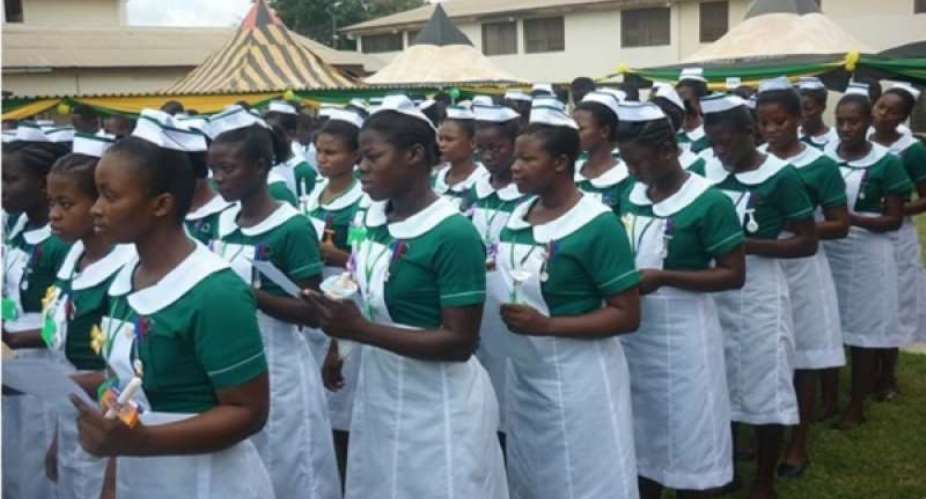
The training of nurses in Ghana over the past few years have seen some compromises on quality and ready employment as the number of trainees admitted into various nursing schools continue to escalate disproportionately to facilities available. This increase in admissions without any corresponding increase in infrastructure have had graving effects on the quality of nurses trained and their access to employment. Recent divided views have been expressed by both the ruling government and the opposition and varied Ghanaians awakened by government’s decision to reintroduce the quota system for nursing and midwifery training schools’ intake.
These views expressed got the health ministry pressed for which it sought “…to bring to the attention of the public the rationale behind this human resources planning the aim of which is to leverage admissions into the various health training institutions and resolving the equity imbalance”, (Hon. Aygemang Manu, www.citifmonline.com/2017/08/16/nursing –trainee-allowances – not – cause – of – quota –system – health – minister/). Most of the views predictably expressed by some Ghanaians and politicians are neither professional nor technical but confirms the very nature of Ghanaians to side with their political parties as long as it affords them the merit of seemingly favoring the justifiably affected ones.
On this controversial matter, professional associations such as Ghana registered Nurses and Midwives Association (GRNMA) majority of nurses across the country and a cross section of the public have endorsed the re-introduction of the quota system by the current government. Even some cross section of tutors in some health training institutions such as the cape coast nursing training college have as well endorsed this move by the government. “Quota system is a method of setting a limit on how much of something a country or company is allowed to have, produce or import etc.” (Cambridge Business English Dictionary).
This system is adopted by countries and companies or institutions for varied reasons. Some adopt this system for economic, facility and quality reasons whilst others adopt the system for human resource management reasons in terms of employment opportunities. In 2015, the standard newspaper reported that “Zimbabwe’s cash-strapped government has been forced to cut down on its recruitment of nurses and police officers following the freezing of posts five years ago”.
This cut was extended to even nursing trainees as it was again reported “that government has made a drastic reduction in the number of nurses undergoing training due to lack of funds”. Amongst other reasons was the outstanding numbers of nurses who were trained but could not be employed by government. Even some tutors in their training schools had to return to the ward to work. And this was one instance of a quota enforced by economic conditions affecting employment. Quota system however undesirable and consequential can be justified by some of these above reasons.
The critical question to ask, is the re-introduction of the quota in the training of nurses in Ghana justified or the best call to make? I unreservedly say yes. Over a period in the country now, immediate employment of nurses has suffered a huge setback. Nurses after completion of various health training institutions in Ghana were immediately employed after their rotation as it was known before 2012 which was replaced with national service in 2012/2013.
For the past few years (3 or more) nurses have had to resort to all forms of agitations and demonstrations to seek for employment. From this new development, nurses who have been trained and have not picketed or demonstrated in the country most especially in Accra cannot even afford any hope of an employment. These identified and utilized weapons had worked for this period of time though, at times require more than one demonstration or picketing at the ministry of health. Picketing of nurses at the health ministry almost became like unpaid jobs. But what was the major concern, it was the numbers that were trained to be employed year in – year out. These numbers of nurses trained had tripled over the last four years if not more by the setting of more private and government training institutions.
Those who by dint of luck or opportune political capitalization and got employed needed also to form associations of unpaid nurses and midwives to be paid their salaries outstanding from periods ranging from 1-3 years. Demonstrations became popular in Ghana than most ministers of the state. If you were paid in the first year of your employment, you either had a “working god” at home or a “conscience-wrecked” politician or a “greased palm” of a staff of controller and accountant general or a strong “tongue praying” warrior of the omnipotent, almighty God.
These nurses and midwives include degree and diploma nurses and midwives, certificate preventive and health assistant clinical nurses and numerous other health professionals also seeking for employment into the health sector. Government’s purse could not afford all these nurses to work at the required time. Though others have reservations about this view but certainly was a major reason. This particular reason is enough to re-introduce a quota system that ensures that manageable numbers are trained to be employed.
The quality of training of nursing students in the various training institutions was compromised by the numbers that outweighed the facilities available to train them. Some schools had admitted beyond their capacities just to enable them have a wider financial pool which consequentially have been reported over time to be mismanaged or misapplied or embezzled by some principals and accountants of those schools, (myjoyonline.com/news/2017/June – 12th/ principal – accountant – of – tepa – midwifery – training – college – cited – in – malfeasance.php). Some of the schools that admitted huge numbers of students had to organize their lectures in a “shift system” which reduced the period of training required per semester.
These students in some of the schools who were admitted as a year group had to be tutored in batches at different times just to enable the limited facilities accommodate them. Once a particular batch is in school, the other had to be either in the health facilities or at home. Clinical practices were also scheduled in batches to enable the facilities contained these students.
This situation laid gratuitous pressure on the facilities of the various schools and the facilities of the hospitals. At a time, a couple of schools could send their students to the field in the health facilities to lay their hands on the practical aspect of the theory taught in those congested schools. Some of these students were truant due to the numbers and those who were dedicated to their schedule did not have enough space, opportunity and time to practice the job on the field stemming from the numbers that mostly outweighed the capacity of the facilities.
This is another compelling reason for a quota to train nurses and midwives. Amongst the above reasons was a culture of some Ghanaians who did not fit into the requirements of these schools admitted not for their qualifications but for other reasons. The culture extended to chiefs, influential people or decision makers and politicians all bloating the admission lists of (these school) with their relations who are least qualified and in some instances not qualified at all even to the detriment of the most qualified.
These political infiltrations compelled these schools to admit numbers more than they normally and realistically would. Would anyone want to doubt or question the need for the quota system which would amongst other things reduce the number of the least or unqualified applicants who had their way through influential people. But government through the N&MC must put measures in place to ensure that the admission processes is transparent so that this call would not end up still favoring the relations of the influential at the expense of the most qualified “poor” applicants.
The pitch of trainee nurses had an unprecedented increase in entries by both governmental and non-governmental institutions. Most of these entries were private institutions who were not accredited to run health training schools neither were they regulated by the Nursing and Midwifery Council (N&MC), hence admitted numbers they deemed fit. They in addition didn’t have the required fundamental facilities to train nurses which most trainee and practicing nurses described as “kiosk, backyard or mushroom nursing schools”. These schools were all training into the wider pool of nurses already been trained by government and other accredited health training institutions.
How is government able to employ all these numbers, are all these numbers employable, how about a lesser number that can be well trained by training institutions for a probable easy employment. According to the WHO global health observatory data, about 48% of WHO member states reported to have less than 3 nursing and midwifery personnel per 1000 population and about 27% reported to have less than 1 nurse/midwife. Nonetheless, in many countries, nurses and midwives constitute more than 50% of the National health workforce. These revealing reports suggest that Ghana is doing remarkably well in her nurse – patient ratio which has been quoted over a period now, though not research driven to be at 1:22 as against the standards of 1:5 in places such as the USA and in some cases 1:2 depending on the demands of the cases taken care of.
But we cannot be complacent since we have not been able to attained the requisite nurse – patient ratio, however, this does not call for the opening of the flood gates for incessant training of nurses on a larger scale. Agreeably, there is still a huge gap in the nurse – patient ratio most especially at the rural communities in Ghana. “The global variation in the levels of initial education for professional nurses and midwives can no longer be ignored”. Many countries still consider initial education programs at secondary school level to be sufficient, while others require university-level education for entry into the nursing and midwifery professions. Education and training overcome issues including the shortage of nurse educators and poor quality education and training. It can contribute to the introduction of global standards and the upgrading of infrastructure, as well as increasing resources (WHO NURSING AND MIDWIFERY PROGRESS REPORT, 2008-2012).
The solution to the health care needs of this 21st century does not only lie in numbers but a well trained professional who can meet the emerging health needs of this technological driven century. The need for a competent and “standards – met” professional nurses and midwives cannot be compromised with numbers. Other countries are raising the entry levels in order to provide quality training for a resilient nursing and midwifery workforce to confront emerging disease burdens. The critical question to ask once again, is Ghana still training nurses and midwives for local utilization only or for roles in global health care especially in these rapidly changing health care boundaries. One may never know when a nation would be confronted with global health threat as we saw in the outbreak of the Ebola in some African countries.
It was a moment that left African health care workers more especially nurses and midwives at sea. In our panic to attempt an approach, so many health care workers contracted the deadly disease. Is Ghana’s need for nurses just on numbers, I say no. Ghana needs nurses and midwives who are well trained and oriented to meet global standards for roles in global health. Ghanaians deserve nurses and midwives that they can place their total need of health on and as such would not be disappointed by quantity without quality. And these, do not require just high numbers but high standards. And as it stands now, those standards are still not appreciably met. “Most nursing education does not prepare health professionals to respond effectively to public health threats in their communities or around the world” (Global health and nursing, transformations in nurses’ roles in the 21st century).
This has been a major issue in Ghana’s inability even to manage cholera outbreaks effectively. The nursing and midwifery education is centered on numbers and not on quality. “Cultivating nursing as a scholarly discipline is more than meeting supply and demand” (Global health nursing). This is a piece I love so much because, it’s simply yet deep in meaning.
The quest to supply to meet demands for nurses and midwives can and have compromised on quality health delivery in this country. Ghana must begin to take a second look at its priorities on the training of nurses and midwives. The re-introduction of the quota system is promising rather perilous and could not have been more appropriate than now. It would ensure that manageable numbers are admitted for training through the class rooms to the health facilities. Students would have enough institutional theoretical and practical training that would equip them for a resilient and competent work force.
But as the numbers are reduced, I make a strong case for government through the regulatory authority N&MC to consider of improving infrastructure in the various nursing training colleges, collaboration between schools of nursing, research projects, faculty and student exchanges, global health content in courses and Course development for International health as we begin to have exigent discussing on exporting nurses.
Written by: Bukari Bukson Adams
Senior Staff Nurse, GHS, Blogger @ Buksonadams.blogspot.com
Kumbungu District.
A member of health advocates Ghana (HAG), Tamale.
Tel: 0248557746, 0200483474, Email: [email protected], Fb: Bukson Wunpini Adams
 Iran says closed Strait of Hormuz as US deal hits obstacle ahead of Swiss talks
 World Cup 2026: Brobbey, Gakpo score braces as rampant Netherlands crush Sweden
 'What power do you have to collapse NPP you did not build?' – Awal Mohammed jabs...
 Chaos at Central University as vendors demand refunds after SRC Week cancellatio...
 GMet issues severe weather alert for Northern Ghana as heavy rainstorm approache...
 Ken Ofori-Atta is the first Ghanaian minister to use sickness to flee from accou...
 Family demands justice for 14-year-old girl allegedly raped, killed in Binaba
 Trump cuts HIV funding to South Africa
 88 dilapidated buildings marked for demolition in Sekondi-Takoradi
 Police crack suspected robbery network in Ashanti South, two suspects killed in ...


