




Our universities are centres of teaching, learning and research into society's challenges with the view to improving lifestyles.
That is why every student is obliged to undertake a project work as a condition for the award of a degree and higher certificates.
This requirement is also meant to help the graduate to understand the challenges around him or her.
Many of the breakthroughs in the world have been spearheaded by universities and their faculties.
Not too long ago, our universities led the moves by society to address the development gaps.
Unfortunately tertiary institutions now take backstage when it comes to dealing with the challenges or our time.
The resource curse that has hit our public institutions has made it impossible for the universities to perform their core values well.
Teaching, learning and research activities are going well except that these are done under more severe constraints.
Not too long ago, this country could only boast of three public universities with no private universities.
Today, we have about ten public universities and a few scores of private universities but these facilities are not enough to take care of the need of all graduates of secondary schools.
With the increasing opportunities for tertiary education in the country, our expectation is that solutions to society's problems should be resolved faster.
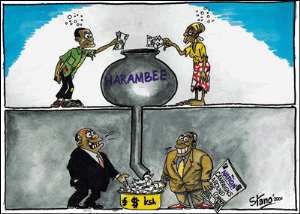
Meanwhile our collective failure reflects the growing gap between the rich and the poor as reported by the Institute of Statistical, Economic and Social Research (ISSER) of the University of Ghana.
According to the institute's 2012 Ghana Social Development Outlook Report, although the country had witnessed a 50 per cent poverty reduction since the 1990s, 25 per cent of Ghanaians were still living in poverty.
The report which was launched in Accra last Wednesday said notwithstanding consistent improvements in access to primary education in Ghana, 46 per cent of Ghanaian adults were still illiterates.
These are very disturbing statistics about our development indices that must stimulate action to reverse the trend.
As the report rightly acknowledged all is not well with us as far as efforts aimed at closing the gaps in order to attain the Millenium Development Goals (MDGs) in the next two years are concerned.
The Daily Graphic wonders how the MDGs and other development targets can be achieved if poverty gaps are widening while many of our young people are becoming adult illiterates especially at the time we are implementing compulsory primary education.
We urge the government to take another look at its policies meant to improve the quality of life of the people. Our position is that the present policy direction where the government is pursuing cost recovery for social services such as education and health is not good enough and will only accelerate the deterioration of living conditions in the country.
Safety nets to address the concerns of ordinary people of the poor appear non-existent or inadequate. We need more spending on the social sector with the view to helping the poor to lead better lives.
We are sad that every year the ISSER comes out with reports like this but the authorities pay very little attention to the issues raised to address our development challenges.
The Daily Graphic expects the government to factor the report into its development agenda to bring about social justice in the sharing of the country's resources to narrow the gap between the rich and the poor.
 There’s a space for effective OSP with special prosecution powers — Mahama
 UG, KNUST and UCC lecturers to withdraw services over unpaid promotion arrears
 "24-hour economy markets will transform the economy" — Hon Jerry Ameko
 Mahama begins Eastern Region tour with May Day address and key projects
 Free Zones boss alleges political sabotage in Akosombo sub-station fire
 Family demands justice for man lynched over witchcraft allegations in Kpandai
 Two mortuary security guards die hours apart on duty in Suhum
 We will expand the economy to create jobs and prosperity — Mahama
 Lead a final onslaught on galamsey — TUC urges Mahama
 Akosombo substation fire an opportunity to modernise power infrastructure — Maha...


