




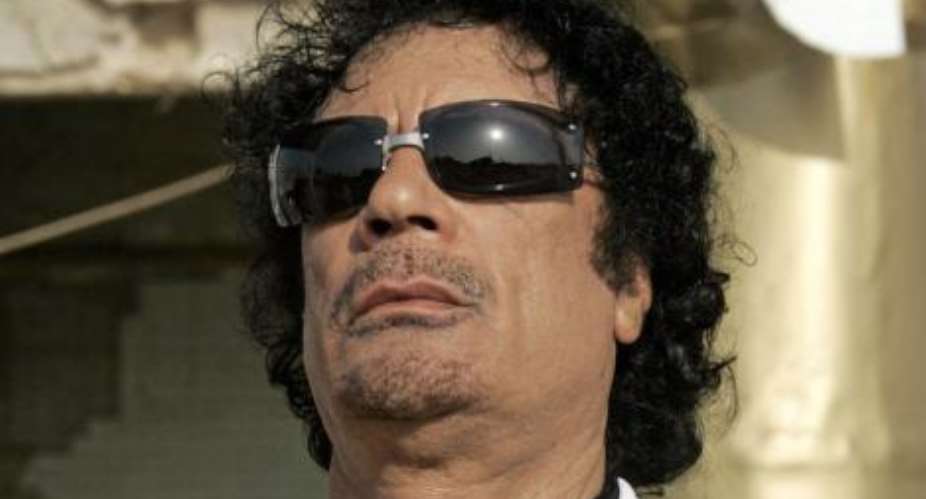
Right now, Gaddafi is a big danger to black Africans. Any black person found in Libya is likely to be given very short shrift by the white-skinned section of the Arab population, which believes that Gaddafi has imported --- or is importing – blacks from Chad, Nigeria, Ghana, Burkina Faso, Liberia and anywhere else that he has followers, to go and fight for him.
One Ghanaian who was among the first batch of about 100 that safely returned home, told reporters
that some blacks were being caught and "beheaded". There are estimated tobe a further 10,000 Ghanaians still left, whom the Ghana Government is tryingto evacuate home.
The question is: what should the rest of Africa think of Gaddafi's troubles? There is no uniform answer amongst Africa's ruling regimes.
As Mondli Makanya asked in his column in the Johannesburg Sunday Times on 27 February 201q1:
http://www.timeslive.co.za/ opinion/editorials/ article937996.ece/Weve-seen- some-crazy-leaders-but-Gaddafi-takes-the-fruitcake
“Why did the world's political community, which normally does not suffer fools, tolerate this madman?
Short answer: he paid a lot of people good money. He had many presidents, prime ministers and kings on his payroll. He also filled the coffers of some nations and financed the election campaigns of many parties."
Makhanya was rebuking the ANC for going soft on the wanton killings that Gaddafi's militias were directing at the people of Libya. That is a damning verdict on the ANC, which, as everyone knows, got a lot of political mileage from the bloodshed unleashed on the black people of South Africa at Sharpeville on 21 March 1960
http://www.sahistory.org.za/ pages/governence-projects/ sharpeville/menu.htm
and in Soweto on 16 June 1976.
http://www.southafrica.info/about/history/soweto-150606.htm
In Nigeria, a writer in the “Lagos Guardian had pointed out, as early as 13 February 2009
http://www.nairaland.com/ nigeria/topic-233513.0.html#msg3464001
that Gaddafi's enthusiasm for the creation of a 'United States of Africa' was suspect, because 'A lot of Nigerians and other Africans in search of greener pastures have been brutalised, dehumanised and tortured; some killed while the lucky ones got deported. IfGaddafi had shown some iota of mercy to these Africans who sneaked into Libya, maybe we would not have read much meaning into this idea being touted by him.'
The Ghana Daily Graphic of 17 December 2004 put some flesh and bones on thesufferings of Africans in Libya, reporting that a total of 6,027 Ghanaians had been precipitately deported from Libya, many of whom were flown down on cargo planes without any seats.
It wasn't as if Ghanaian street talk hadn't used religious imagery --sometimes very crudely -- to invent stories to counter Libya's burgeoning influence over Ghana (which encouraged so many Ghanaians to undertakethe trip to Libya) when the country's then ruler, Flight-Lieutenant Jerry Rawlings, seized power -- for the second time -- on 31 December 1981.
http://www.time.com/time/ magazine/article/0,9171, 925185,00.html
Shortly after the Rawlings coup, I was having lunch with a couple of ladies when, out of the blue, one of them asked me: “So
what are you going to do about Libya?”
“Libya? What about Libya?” I asked.
“Gaddafi is taking over Ghana!” she said.
“Nonsense,” I answered. “Ghanaians value their autonomy and no-one is going to sit down and allow a Libyan to dictate to him or her.”
She said, “You wait. You know we are to play Libya in the Confederation of African Football Cup Final in Libya, soon, don't you?”
“Yes,” I said.
“Well, that will be the sign. We will lose that match,” she said.
“Bollocks!” I exploded. “You mean the Black Stars will deliberately throw a match on theorders of a politician like Rawlings?”
“You wait and see. We shall allow the Libyans to win. And then will come the second sign -- the most unkindest cut of all.”
My heart sank. In my experience, young ladies do tend to have a lot of information!
She said: “After we have allowed them to beat us at football, Gaddafi will send a horde of wansams [untrained circumcisers] to Ghana, to circumcise all uncircumcisedGhanaian men -- in the name of Islam!”
I looked at her companion, who had remained silent. She nodded vigorously in agreement with her friend. Were they a pair of Roman Catholic propaganda agents? Or Mossad recruits spreading ill-will against Gaddafi in Ghana?
I howled so loudly with laughter (mixed with absolute horror) that everyone in therestaurant stared at me.
“Gaddafi circumcise us? Let him come and try!” I said finally.
I went on: “Libya cannot -- and will not -- beat us at football. And it can't come near our treasured male members. In the Even if Jerry Rawlings were to pilot himself to go toLibya to plead with our boys to throw the match, they would turn a deaf ear to him. You cannot fool around with Ghanaians when it comes to their football.”
I added, “Nor can you fool with their --er -- "scabbarded" 'swords' or 'sticks', either!”
Then I sat back, pleased with my own impromptu witticism.
Scabbards.
Sheaths.
Swords.
Sticks.
The talkative young lady then made a bet with me on the outcome of the CAF football match. I cannot go into details about the terms of the wager.
But Ghana did beat Libya in that CAF football cup final on 19 March 1982.
http://www.worldlingo.com/ma/ enwiki/en/1982_African_Cup_of_ Nations
However, the result was arrived at in such a tortuous manner that at one stage, I entertained a real fear that our boys were throwing the match.
The full 90 minutes of play yielded a 1-1 draw.
Extra time came and went -- but produced no goals, either.
I began to sweat profusely as the game then went into penalties.
Ghana just managed to win the penalty shoot-out by scraping 6 goals to Libya's 5. Final result: 7-6 GHANA!
Had we lost, those two ladies would have combined to run me out of town and claimed that mass circumcision of Ghana males by hordes of sword-waving wansams from Libya was coming next! And I might have believed them -- who knows?
After the Black Stars' victory, I got into my car and joined many jubilant Ghanaians who were celebrating, by driving around purposelessly in the streets, tooting the horns of their cars, late into the night.
If any of my friends had seen me, they would have thought I was quite manic.
Ha -- if only they knew what the stakes had been, that night. Next item: an appointment with a foreskin-excisor from Tripoli?
No way.

 NDC played no key role in Sedina Tamakloe's extradition, NPP did — Ahiagbah
 Seven feared dead in Saturday dawn collision at Zebila
 6th Ministers of State Awards saga: 'It is unfair to suggest all awardees bought...
 I didn't pay money for recognition at 6th Ghana Ministers of State Excellence Aw...
 2026 World Cup: Rescind decision denying Thomas Partey visa in the interest of f...
 June 13: Cedi appreciates, sells at GHS12.30 on forex market, GHS11.06 on BoG in...
 Plea bargains favour the rich and powerful in practice — Arthur Kennedy
 Exim Bank fraud case: I agree that other persons must answer some questions — Ak...
 Exim Bank fraud case: Wontumi must admit guilt before any plea deal — Akwatia MP
 Exim Bank fraud case: 'Wontumi's plea bargain is not an admission of guilt' — Na...


