




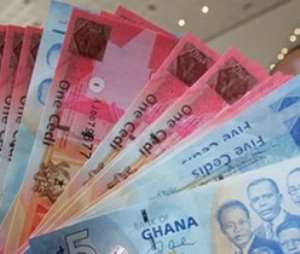
After performing creditably well against the major foreign currencies in the first five months of the year, the Ghana Cedi faces hard times in the coming months.
Analysts predict that the local currency might depreciate between 12-15 percent on year-on-year terms against the major foreign currencies.
They asserted that oil production will start in the last quarter of the year but it might not be as early as anticipated and would not be able to help much.
According to the Monetary Policy Committee (MPC) report released on July 16, the local currency continued its stability in the first half of the year.
On year-on-year terms, the report pointed out that the cedi recorded respective appreciations of 3.3, 13.3 and 18.4 percent respectively against the US dollar, the pound and the euro, which translate into 5.2 percent cumulative appreciation against the three major currencies.
This is compared with depreciations of 29.8, 14.1 and 21.4 percent against the three foreign currencies in June 2009.
But for the first time in the year, the cedi depreciated by 0.40 percent on Friday, according to Gold Coast Securities Currency Index. However, it continued its appreciation against the pound and euro, gaining 4.35 and 9.8 percent, though the margin was lower.
"International economies such as the United Kingdom and the USA appear to be recovering slowly from the financial crisis and this is putting the local currency under some pressure," Derrick Mensah, a currency analyst at Gold Coast Securities Limited, has said.
He told BUSINESS GUIDE that investors on the international market have started buying more euros and pounds, compared to the first half of the year, whilst the dollar has been regaining its strength, adding that events on the international market determine the trajectory of the cedi.
"Our local currency is run in such a way that when the foreign currencies are rising, we intend to adjust to suit events on the international market. We don't currently have a foreign exchange market so the banks dictate the pace by looking at the international market to quote their rates," Mr Mensah noted, stressing that the depreciation would not be so high like that of 2009 because of improved secondary reserves of $3.5 billion and lower inflation.
Sampson Akligoh, Senior Economic Analyst at Databank, on his part said the pressures on the cedi could continue in the third quarter of 2010, after depreciating by 0.14 percent for the first time against the dollar.
"Nevertheless, there is no room for unease, as the country's reserves position remains strong. I think we are likely to witness some recovery again in quarter four of 2010."
If the trend of appreciations by the foreign currencies continues, then the cost of imports would rise.
By the close of trading last Friday on the inter-bank market, the local currency was buying at GH¢1.426 and selling for GH¢1.448 against the dollar. It was trading between GH¢2.187 and GH¢2.221 to the pound and was going for GH¢1.845 and GH¢1.872 against the Euro.
 Police place GH¢100,000 bounty on man for killing two people in Tema
 Ultraviolet sterilisation mandatory for safe water production — FDA warns sachet...
 Cocoa smuggling: Fiapre Circuit Court grants GHC10,000 bail each to four suspect...
 Tensions rise in Bogoso as youth block mine workers over employment dispute
 Police declare military officer wanted over alleged murder of couple, announce G...
 University of Ghana distances itself from unauthorised ‘UG Partner’ app, warns p...
 Ghana's inflation rises marginally to 3.4% in April, up from 3.2% in March — GSS
 Inflation rises to 3.4% in April
 Court remands three suspects over jewelry shop robberies at Airport Residential ...
 Release ex-Buffer Stock CEO and wife immediately — Afenyo-Markin to EOCO, AG


