




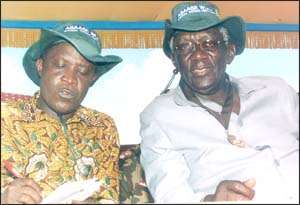
The late Baah Wiredu and president Kufour BARELY A day to 2009, the year 2008 witnessed lots of business activities on a blissful note for Ghana until the financial crisis hit the world, sending some developed countries such as USA, Britain and some EU countries into recession.
Part of Ghana's budget is funded by donor countries.
In view of this the financial crisis impacted severely on the Ghanaian economy, with oil prices escalating to $145 culminating in inflation surging to 17.41 percent in November, having direct effect on interest rate as Bank of Ghana prime rate increased to 17 percent.
The flagship Ezwich, one of the several payment systems that the Bank of Ghana intends rolling out was launched by President John Agyekum Kufuor some where during the middle of the year. The Ezwich is a very secure way of paying for goods and services throughout the country based on the biometric or finger print identification.
At the launch, President Kufuor said Ghana was ready to become a significant player in the financial market as it had completed most of the financial reforms such as the Banking Amendment Act, the Payment System Act, the Central Securities Depository Act among others.
Dr. Paul Acquah who was voted the best Central Bank Governor for 2008 also reiterated that the other payment including the code chequeline truncating and the automated clearing house system among others would be introduced by early next year. These payment systems would enhance and effectively improve transactions.
As part of the Bank of Ghana's move to deepen the financial sector in the face of the oil discovery, the Central Bank announced a new minimum requirement for all commercial banks, rural banks and savings and loans companies.
The regulator of the banking industry proposed GH¢60 million increment in the minimum capital requirement of banks from the current GH¢7.0 million.
According to the new requirement, foreign banks have up till the end of 2009 to meet the new capital requirement while indigenous banks have up till the year 2012 but will have to increase their minimum capital to GH¢20 million by the end of next year.
Two new banks, Bank of Baroda, an Indian bank and Sahel Bank, an Afro-Arabian Bank opened their operations in Ghana.
Despite the turbulent global financial environment, the economy made some impressive gains.
Economic activity for the year 2008, Dr. Acquah, Governor of Bank of Ghana opined has continued to be at reasonably fast pace with strong export growth and underpinned by expansion in domestic demand and fiscal stimulus.
On the performance of some macroeconomic indicators, the country's Gross International Reserves recorded $2.270 billion at the end of September 2008, representing 2.3 percent import cover of goods and services. This was higher than the $1.811 billion achieved last year.
Interest rates inched up to an average 24.0 percent. For instance an average benchmark 91-day Treasury bill rate increased to 24.58 percent in the third quarter from 16.32 percent in the second quarter.
Total revenue and grants for the period January to September 2008 amounted to GH¢3.451 billion compared with GH¢3.127 billion for the corresponding period in 2007.
Total merchandise exports also at the end of September 2008 stood at $4.017 billion, an annual growth of 30.8 percent.
While cocoa exports for the first nine months were $1.160 billion, gold exports was $1.247 billion.
The Central Bank is expected to review the health of the economy for the last quarter of 2008 next month.
The economy also witnessed an increase in growth.
Exclusive data sighted by CITY & BUSINESS GUIDE indicated that Ghana's economy grew by 6.7 percent for this year, missing the projected target of 7.0 percent documented in the 2008 budget.
According to projected figures from the Ghana Statistical Service, Ghana's economy reached GH¢17.104 billion, from GH¢14.178 billion recorded in 2007.
Similarly, the country's per capita income which stands at $661.0 according to the 2007 figure had shot up to about $720 though the figure was not included in the document.
According to the figures, industry which was hit severely by the energy crisis or power fluctuation in 2007 recorded the highest growth of 9.99 percent as compared with 7.4 percent achieved in 2007.
Remarkably, the mining, quarrying, and construction sub-sectors recorded significant growth whiles manufacturing as well as electricity and water witnessed slight marginal growth.
On the other hand, the services sector also grew by 6.47 percent as against 8.2 percent obtained in 2007.
Similarly, inflation shot up marginally to 17.44 percent for November 2008.
The marginal surge which broke a four-month downward trend was a result of food prices increasing lightly in November.
The banking sector which is vital to every economy also witnessed impressive growth irrespective of the global financial crisis.
This was so because Ghana's financial sector is not directly linked with the global one. Importantly, total assets of the industry stood at GH¢9.676 billion in September 2008, a growth of 36.0 percent, compared with GH¢7.114 billion for the same period in 2007.
The stock market also posted some gains despite the bearish trend that the market witnessed lately culminating in some share price depreciation.
According to a Bloomberg report, the Ghana Stock Exchange (GSE) achieved a 37 percent return in dollar term, putting it at the top of the world's stock-return league table for the first six months in 2008.
Companies also witnessed some impressive gains in the year.
Whilst total assets of Ecobank Ghana reached GH¢853.791 million as against GH¢587.458 during the same period in 2007, current assets of GOIL increased from GH¢59.870 million in 2007 to GH¢88.738 million in 2008. Importantly, both firms increased their shareholders fund substantially.
Ghana Commercial Bank, the largest bank in terms of assets in Ghana also posted a net operating income of GH¢120.065 million as at September 2008 compared with GH¢119.100 million recorded in 2007.
Similarly, insurance and most investment companies also posted some good results.
With regard to the manufacturing sector, it recorded some growth, mainly due to the stable energy situation. The nation witnessed severe energy crisis in the year 2007 but government installed some thermal plants to help curb the situation.
According to the GSS, industry grew by 9.99 percent as compared with 7.4 percent achieved in 2007.
Agriculture also grew slightly by 4.93 percent as compared with 4.3 percent achieved in 2007.
Government's move to mechanize the agriculture sector can help accelerate the agriculture sector and bring it back to life.
Despite all these impressive gains, Ghana lost its Finance and Economic Planning Minister, Kwadwo Baah Wiredu through a short illness in September.
The man touted as “Mr. Figures” who even in his absence won the best Finance Minister in Africa was laid to rest in his beautiful hometown of Agogo in the Ashanti region.
He left many legacies such as helping the nation, south of the Sahara after South Africa to raise $750 million sovereign bonds on the international market. These monies were meant to support several development projects such as the dualization of the country's' roads and improvement in infrastructure.
Others include tax reforms such as the introduction of three percent flat rate scheme for the informal sector and the Venture Capital Trust Fund, meant to grow the small and medium scale enterprise (SME) sector which is considered as the bedrock of every economy.
On some government policies to help improve employment and the lives of the people, the government introduced the National Youth Employment Programme (NYEP) and the Livelihood and Empowerment Programme (LEAP).
By Charles Nixon Yeboah
 Mahama's anti-flood committee has failed to present any plan — Miracles Aboagye
 June 8: Cedi sells at GHS12.50 on forex market, GHS11.86 on BoG interbank
 'The rain didn't fail us; we failed ourselves' — Kennedy Agyapong on Ghana's flo...
 Awards from ‘Awardpreneurs?’: NDC activist slams ministers
 Nonsense – Prof Prempeh rips into ministers over awards
 'May we not become what we criticized'—Agbana warns NDC appointees against doubl...
 Silent killer: Prostate cancer shows no signs until it’s late – Dr. Antwi
 NADMO blames unauthorised construction, poor sanitation for Tema West floods
 We are not xenophobic — South African President
 KATH strike: Regional Minister says Agreement reached between management and hea...


