




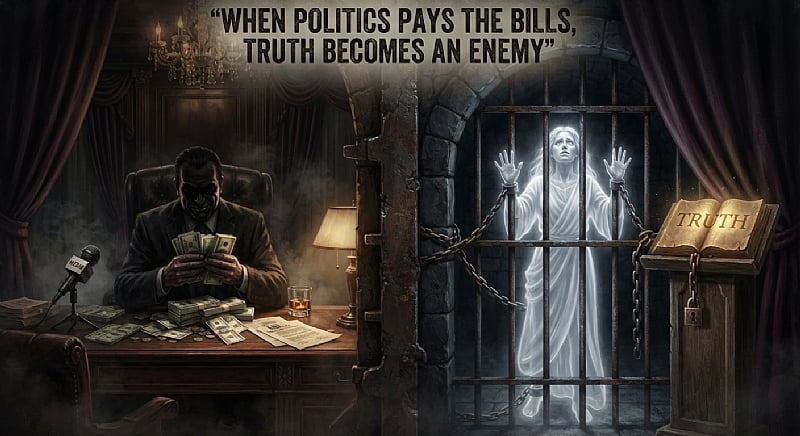
There is something dangerous about any country whose politicians no longer regard politics primarily as the opportunity to serve the people who voted them into public office. When these politicians see public office as a dependable means of earning a living, acquiring wealth, securing privileges and guaranteeing a comfortable future, all is not well. When political office becomes the principal source of personal survival, ambition begins to compete with conscience, loyalty to party or proximity becomes more valuable than plain honesty, and truth becomes an inconvenience that must be silenced, manipulated or even destroyed.
This is one of the greatest challenges that is confronting democracy in many parts of Africa and, indeed, across the world. Politics ought to be an instrument for advancing the collective interests of society. But in many countries today it is increasingly being treated by some public office holders as a lucrative occupation, a permanent career and, in some circumstances, an investment that must yield enormous returns.
The consequences are visible in societies where political competition is less about governance strategies, development programmes and the welfare of citizens and more about who controls government appointments, public contracts, financial allocations and access to state resources. In such an environment, winning an election becomes more important than having a workable vision, and remaining in power becomes more important than developing the country.
The fundamental question is this: if a politician depends entirely on political office to pay personal bills, maintain an expensive lifestyle and sustain an extensive network of beneficiaries, how can that politician speak against the corruption, incompetence and wrongdoing that threaten the political establishment?
A person whose livelihood depends on pleasing political patrons will definitely find it difficult to challenge them. Someone whose political survival depends on the goodwill of a powerful party leader will obviously choose silence over principle. And an individual who has invested enormous personal resources in securing political office will, no doubt, regard losing that office not as the end of a public assignment but as a financial catastrophe. And that is precisely where the danger begins.
Politicians should understand that politics is a responsibility entrusted to them by the electorate, not an employment entitlement bestowed upon them by a political party. It is a temporary mandate to exercise power in public interest. The politician is a trustee, not the owner of the state. He is a representative of the people, not their Monarch. He is the servant of his constituents, not their beneficiary who is entitled to perpetual rewards in public office.
The Organisation for Economic Co-operation and Development has repeatedly warned about the dangers of political patronage, nepotism and politically motivated appointments. Its work on public integrity highlights how public institutions can be weakened when political connections become more important than competence and merit. Once public appointments are treated as rewards for political loyalty, government ceases to function exclusively as an institution for serving citizens. It becomes a mechanism for maintaining political alliances.
Nigeria offers a painful historical illustration of what happens when political power becomes more important than transparency and accountability. The experience of the Ogoni people under the military government of General Sani Abacha remains one of the most disturbing examples. Ken Saro-Wiwa, the environmental activist and writer, had consistently drawn international attention to the environmental degradation of Ogoniland and the grievances of its people against oil exploration activities. But rather than allow those grievances to receive the transparent and impartial attention they deserved, the military government treated the growing Ogoni agitation as a threat to its authority. Saro-Wiwa and eight other Ogoni activists were tried by a special tribunal over their alleged involvement in the killings of four Ogoni leaders. The proceedings attracted widespread international criticism over serious questions of fairness, independence and due process.
On 10 November 1995, all nine men were executed despite international appeals for clemency and intervention. The African Commission on Human and Peoples' Rights subsequently found Nigeria responsible for violations of several provisions of the African Charter in the case. The episode remains a chilling reminder of how a government determined to protect its power can turn legitimate dissent into political enmity and treat inconvenient voices as threats to be eliminated.
The lesson is particularly relevant to contemporary African politics. A government that cannot distinguish between criticism and rebellion is already displaying the symptoms of political insecurity. Citizens who demand environmental justice, accountability, transparency or responsible governance should not necessarily be seen as enemies of the state. Often, they are performing the very democratic function that politicians should welcome.
South Africa provides another example of the consequences of allowing political relationships to override public responsibility. Investigations into the administration of former President, Jacob Zuma, exposed disturbing allegations concerning the influence of politically connected business interests over state institutions and public enterprises. The Zondo Commission examined how public institutions and state-owned companies, including Eskom and Transnet, were allegedly manipulated for private and political benefit. What made the scandal particularly instructive was the institutional dimension. It was not simply a question of individual corruption. It raised fundamental questions about the independence of public officials, the integrity of government appointments and the willingness of people within the system to speak out against wrongdoing. Wherever officials believe that their careers and financial future depend on political loyalty, silence can become an attractive survival strategy.
The United States also offers a powerful example through the Watergate scandal of the 1970s. Following the break-in at the Democratic National Committee headquarters in the Watergate complex in Washington, attempts were made by individuals connected to President Richard Nixon's administration to conceal the involvement of the President's political circle. Nixon repeatedly denied knowledge of the burglary and resisted congressional demands for access to presidential information. However, testimony from former White House counsel, John Dean and the eventual release of presidential recordings exposed the extent of the cover-up. The recordings demonstrated Nixon's involvement in efforts to conceal the administration's connections to the scandal. Faced with impeachment and the prospect of removal from office, he resigned in August 1974. Watergate demonstrated that the desire to protect political power can become more dangerous than the original wrongdoing. Rather than confront the truth, those involved expended enormous political energy suppressing evidence, intimidating witnesses and discrediting investigators. Yet it also demonstrated the importance of independent institutions, investigative journalism and the rule of law in ensuring that political authority does not become immunity from accountability.
Another disturbing example emerged from the former Soviet Union, following the Chernobyl nuclear disaster in April 1986. When reactor number four exploded, Soviet authorities initially withheld information about the seriousness of the accident. Residents of affected areas were not immediately given adequate warnings about the dangers of radiation exposure. The mass evacuation of nearby residents did not begin until approximately 36 hours after the explosion, while the Soviet leadership's public acknowledgement of the disaster was delayed. The International Atomic Energy Agency's retrospective account describes how the prevailing culture of secrecy prevented the public from receiving necessary information. Mikhail Gorbachev did not address the Soviet public on state television about the disaster until 14 May 1986, 19 days after the explosion.
The tragedy illustrates the terrible consequences of placing national prestige and the protection of political reputation above the public's right to know. People needed accurate information to protect themselves and their families. Instead, political embarrassment and institutional secrecy contributed to a dangerous information vacuum.
The Iraq War provides another important international lesson. In the period leading to the 2003 invasion of Iraq, governments in the United States and Britain presented intelligence assessments about Saddam Hussein's alleged weapons of mass destruction programmes as part of the justification for military action.
Subsequent investigations exposed serious weaknesses in the intelligence used to support those claims. The United States Commission on the Intelligence Capabilities of the United States Regarding Weapons of Mass Destruction described the pre-war intelligence assessment as a major intelligence failure. It identified groupthink, inadequate analysis and the failure to communicate uncertainty properly to policymakers. Britain's Iraq Inquiry also examined how intelligence limitations and uncertainties were presented in the government's public case for war.
It is important to distinguish between a demonstrably false claim, an intelligence failure and deliberate political deception. Not every inaccurate government statement proves that leaders knowingly lied. Nevertheless, the Iraq experience demonstrates the danger of allowing the political momentum towards a preferred decision to overwhelm critical scrutiny. When leaders become committed to a political course, inconvenient evidence and uncertainty can be marginalised, while supportive information receives disproportionate attention.
The common thread running through these examples is the willingness of political institutions to protect authority, reputation or established interests at the expense of transparency. Whether in a military dictatorship, a developing democracy or an established Western democracy, the temptation to manipulate information remains a persistent threat.
Perhaps the most worrying consequence of treating politics as a career is the gradual destruction of political honesty. A politician who sees public office as a means of livelihood may become more concerned about protecting the political structure that sustains that livelihood than defending the truth. Such a politician may defend an indefensible government decision, justify an obviously failed policy, attack legitimate critics and dismiss uncomfortable revelations as the work of political enemies.
Truth becomes dangerous because it threatens access to power, financial security and political relevance.
This explains why some political supporters defend individuals rather than principles. They are not necessarily defending the quality of governance; sometimes they are defending the opportunities, appointments, contracts and financial advantages associated with the political arrangement. Their political allegiance becomes transactional. If the government succeeds, they celebrate. If it fails, they manufacture excuses. If wrongdoing is exposed, they attack the messenger.
In this atmosphere, constructive criticism is interpreted as betrayal, dissent is regarded as hostility, and intellectual independence is treated with suspicion. Those who speak honestly are isolated, while those who tell political leaders what they want to hear are rewarded.
Democracy cannot flourish under such circumstances. Its survival depends on the ability of citizens, journalists, opposition parties, civil society organisations and even members of the governing party to question authority without fear of losing their livelihoods or personal security.
History also offers examples of leaders who understood that political authority must have limits. George Washington, the first president of the United States, voluntarily declined to seek a third presidential term in 1796, despite having no constitutional obligation to retire after two terms. His decision helped establish an important democratic tradition: no individual should become indispensable to the republic.
Nelson Mandela also offered an important example of restraint when he chose not to seek a second presidential term in South Africa after serving his first. At a time when his extraordinary international reputation could have supported a prolonged political career, he demonstrated the importance of leadership succession and institutional continuity. The lesson was not that experienced leaders should abandon public life, but that personal popularity must never become more important than building institutions capable of surviving beyond an individual.
These examples should challenge political leaders everywhere, particularly in countries where electoral contests are treated almost as battles for economic survival.
The solution requires a fundamental change in how political leadership is understood, recruited and rewarded. Political parties must become institutions of ideas, democratic participation and national development, rather than platforms for distributing economic benefits among loyalists. Candidates should be selected on the basis of competence, integrity, character and a demonstrable commitment to public service.
Equally important, public institutions must be strengthened to ensure that civil servants serve the constitution and the people rather than individual politicians. Political financing must be transparent, public procurement must be accountable, and those entrusted with public funds must be prepared to explain how those funds are spent. Citizens must also stop celebrating politicians simply because they distribute money, provide personal favours or reward supporters with appointments. Such gestures are not substitutes for good governance.
There is nothing wrong with earning an honest living before entering politics, or returning to one's profession after completing public service. In fact, the ability to leave political office without facing financial ruin should be regarded as a strength of democratic leadership. A healthy political system should not make individuals economically dependent on retaining power.
Ultimately, politics should be an avenue through which capable individuals contribute to society, not an escape route from unemployment, a shortcut to wealth or a permanent source of personal entitlement.
A politician should be able to lose an election without losing the ability to feed a family. A minister should be able to leave government without fearing financial irrelevance. A legislator should be able to criticise the president without worrying about losing the political appointments that sustain personal comfort.
These are important tests of political independence.
When politics becomes the only occupation through which an individual can maintain a desired standard of living, the temptation to manipulate the system becomes overwhelming. When political loyalty determines access to economic opportunities, honesty becomes expensive. When personal survival depends on the continuation of a political arrangement, truth becomes an enemy.
And that is the tragedy: the very people elected to protect the public interest may become the greatest defenders of arrangements that undermine it.
A society must therefore ask itself whether it wants politicians who need the people or politicians who need political power to survive. The distinction is fundamental.
Democracy was never designed to provide permanent employment for politicians. It was designed to give citizens the power to choose representatives, hold them accountable and replace them when they fail.
Political office is a privilege, public trust is an obligation, and service to humanity is the ultimate measure of leadership.
The day politicians begin to understand that they do not own their offices, that public resources are not personal rewards and that their relevance does not depend on remaining in power indefinitely, democracy will begin to recover its true meaning.
Until then, where politics pays the bills, truth will remain an unwelcome visitor.
There is an important distinction between politics as a vocation and politics as a means of personal enrichment. A person may devote an entire professional life to political organisation, public policy, legislation and democratic participation. There is nothing inherently wrong with that. Indeed, societies need experienced politicians. But political experience must never become a justification for treating elected office as an entitlement or a permanent source of wealth.
The danger of confusing public service with personal employment is that the individual begins to measure political success by what office delivers to him rather than what he delivers to society. Public resources become opportunities for reward, government appointments become instruments of patronage, and political supporters become people who must be compensated rather than citizens who must be served.


 ANC Suffers Worst-Ever Municipal Election Result, Coalition Talks Loom Across So...
 Bawumia Proposes Binding National Masterplans to Ensure Development Continuity
 Drug store operator arrested after allegedly spending 3 days in coffin at Foase ...
 Pastor and wife whose petition sparked service passport scandal revealed
 'NDC has now become more attractive' — Dr. Otokunor
 'You are stepping on too many toes' – Adutwum cautions Sam George
 ECG to disconnect customers with unpaid bills in 18-day nationwide revenue mobil...
 Foreign Ministry interdicts two officers, terminates 10 illegally issued Service...
 Mahama announces $9bn investment plan to drive job creation from 2027 to 2030
 GHS makes health declaration forms mandatory for all travellers entering Ghana f...


