




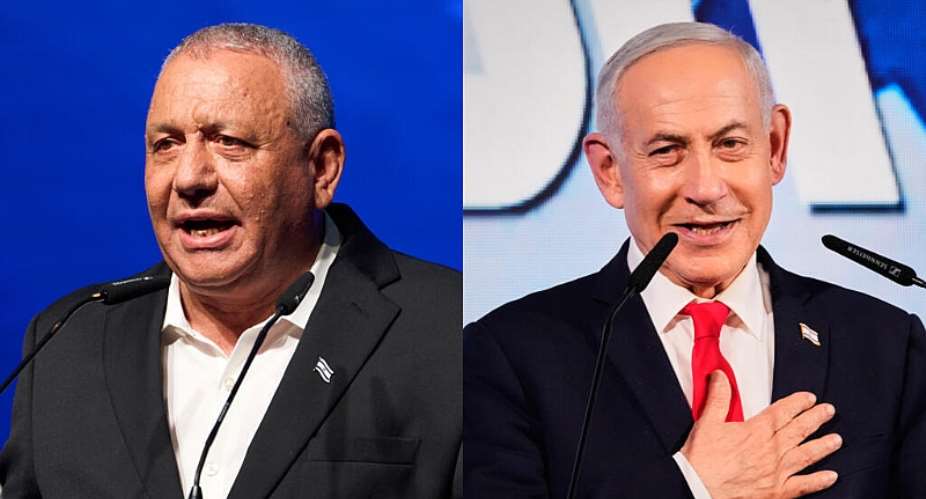
The former army chief will go to the residence of President Isaac Herzog in Jerusalem to discuss his plans to create a coalition to rule in the 120-seat parliament.
On Saturday, after days of consultations with the parties contesting the elections, Herzog chose Eisenkot to have the first chance to govern ahead of outgoing Prime Minister Benjamin Netanyahu.
After an official ceremony, Eisenkot will launch negotiations with potential coalition partners. He will have up to six weeks to form a government.
Eisenkot, 66, has declined to join forces with Arab parties, whose support would give him a majority of seats in parliament.
But Arab leaders, incensed by what they view as the racist policies of Netanyahu and his far-right allies, still nominated Eisenkot to try to form a government first — giving him the most endorsements.
Polls open in Israel as Netanyahu faces close contest after three years of war
"Now is the time to form a national emergency government," said Eisenkot on social media. "I will do everything I can to ensure we are worthy."
Ways to power in Israel
Eisenkot's potential pathways to power include trying to form a minority government with Arab party votes on key issues; forming a coalition with ultra-Orthodox parties that he and his allies have shunned in the past; or forging a unity government withNetanyahu.
If Eisenkot were to fail, another candidate can try to form a government and if that candidate fails, parliament can nominate another.
There is a deadline for the process of around 100 days. If no one succeeds, another election is held.
Netanyahu's Likud party won the most seats of any single party with 27 in parliament.
But the 77-year-old's wider religious-nationalist coalition garnered only 53 in total, short of a 61-seat majority.
Israel's Arab parties emerge as kingmakers after decades of discrimination
Eisenkot's Yashar party emerged as the second-largest party with 21 seats, while his coalition, spanning four centre-left to right-wing Jewish-led parties, won 48 seats. Two parties representing Israel's Arab minority won an unprecedented 19 seats.
Recent arrival on political scene
A son of Moroccan immigrants, Eisenkot would be the country's first prime minister from Israel's Mizrahi community – Jews who trace their roots to the Middle East and North Africa.
Reserved and media-shy, Eisenkot only entered politics in 2022. He briefly served in Netanyahu's wartime cabinet following Hamas' attack on Israel on 7 October 2023, before returning to the opposition.
From opposition, he publicly rebuked Netanyahu over his leadership, including his management of the military campaign in Gaza, and has sworn that he would not serve in government with him.
Eisenkot has criticised settler violence against Palestinians, which has surged since 2023, raising tensions in Israel's ties with Western states.
He opposes Netanyahu's far-right coalition partners Itamar Ben-Gvir and Bezalel Smotrich, who have both faced sanctions by some Western countries for inciting violence against Palestinians.
(with newswires)

 ANC Suffers Worst-Ever Municipal Election Result, Coalition Talks Loom Across So...
 Bawumia Proposes Binding National Masterplans to Ensure Development Continuity
 Drug store operator arrested after allegedly spending 3 days in coffin at Foase ...
 Pastor and wife whose petition sparked service passport scandal revealed
 'NDC has now become more attractive' — Dr. Otokunor
 'You are stepping on too many toes' – Adutwum cautions Sam George
 ECG to disconnect customers with unpaid bills in 18-day nationwide revenue mobil...
 Foreign Ministry interdicts two officers, terminates 10 illegally issued Service...
 Mahama announces $9bn investment plan to drive job creation from 2027 to 2030
 GHS makes health declaration forms mandatory for all travellers entering Ghana f...


